





Mirror Placement in Living Rooms: Vastu Rules That Actually Affect Your Interior Design

Of all the vastu questions our clients bring to us during the interior design phase of a project, mirror placement is the one that tends to arrive last, usually after the floor plan is finalised and we are working through the actual decor and furniture layout, and it is also the one where a client's vastu consultant and their personal taste in decor most often pull in different directions, because mirrors are one of the few interior elements vastu shastra treats with real specificity about compass direction and, in the bedroom particularly, about literal sightlines from the bed. We have designed around this rule enough times across living rooms, bedrooms, and dressing areas in New Town, Salt Lake, and Rajarhat apartments to know that it is entirely possible to satisfy the vastu guidance without giving up a well-placed mirror, but it does require thinking about mirror position as part of the furniture layout from early on rather than as a decor afterthought hung wherever there happens to be blank wall space.
The Core Direction Rule for Mirrors in a Living Room
Vastu shastra associates mirrors with the water element, since a mirror reflects light and energy much the way water reflects and moves, and the guidance that follows from this is that mirrors are considered most favourable when placed on the north or east walls of a room, because these directions are associated with positive energy flow, prosperity, and the entry of natural light through the day in most Kolkata apartment orientations. A mirror on the north wall of a living room, reflecting the room's activity and its natural light back into the space, is considered to amplify the positive energy already present, which is part of why we default to the north or east wall whenever a client's living room layout gives us a genuine choice between two or more viable placements for a large decorative or functional mirror. The south and west walls, by contrast, are traditionally considered less favourable for mirror placement, not because a mirror there causes active harm in the way some other vastu violations are described, but because these directions are associated with the fire and earth elements respectively, and a water-associated object like a mirror is thought to sit in some tension with them, which in practical terms means we treat a south or west wall mirror as a compromise position rather than an outright violation, something to avoid where a better option exists but not something that forces a redesign if the room's proportions genuinely leave no other wall available.
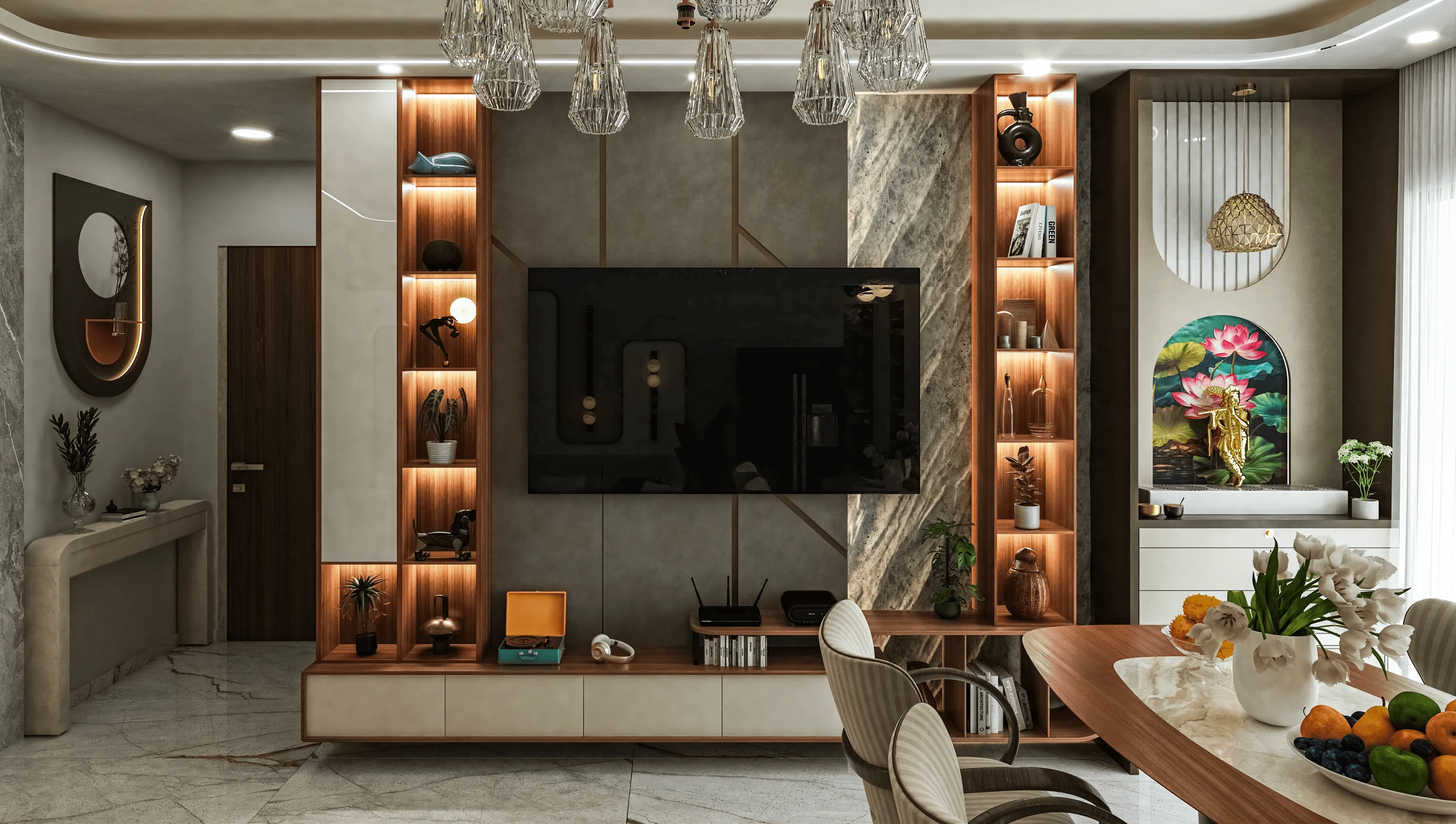
Where this direction rule becomes a real design constraint rather than a minor preference is in narrow or oddly proportioned living rooms, which are common enough in New Town apartments in the 900 to 1400 square foot range, where the only wall with enough continuous length to take a full height decorative mirror or a mirrored accent panel might happen to be the south wall simply because that is where the room's longest unbroken run of wall sits, with windows, doorways, or the television console occupying the north and east. In those cases we usually offer clients a genuine alternative rather than forcing the mirror onto a compromised wall, most often replacing a single large mirror with two or three smaller framed mirrors distributed across a north-facing gallery wall instead, which preserves the reflective and decorative effect the client wanted while keeping the placement within the preferred directions, and this kind of substitution tends to work better aesthetically too, since a cluster of smaller mirrors on a gallery wall photographs and lives better in a compact living room than one oversized mirror competing for the same wall as a media unit.
The Bedroom Rule That Actually Changes Furniture Layouts
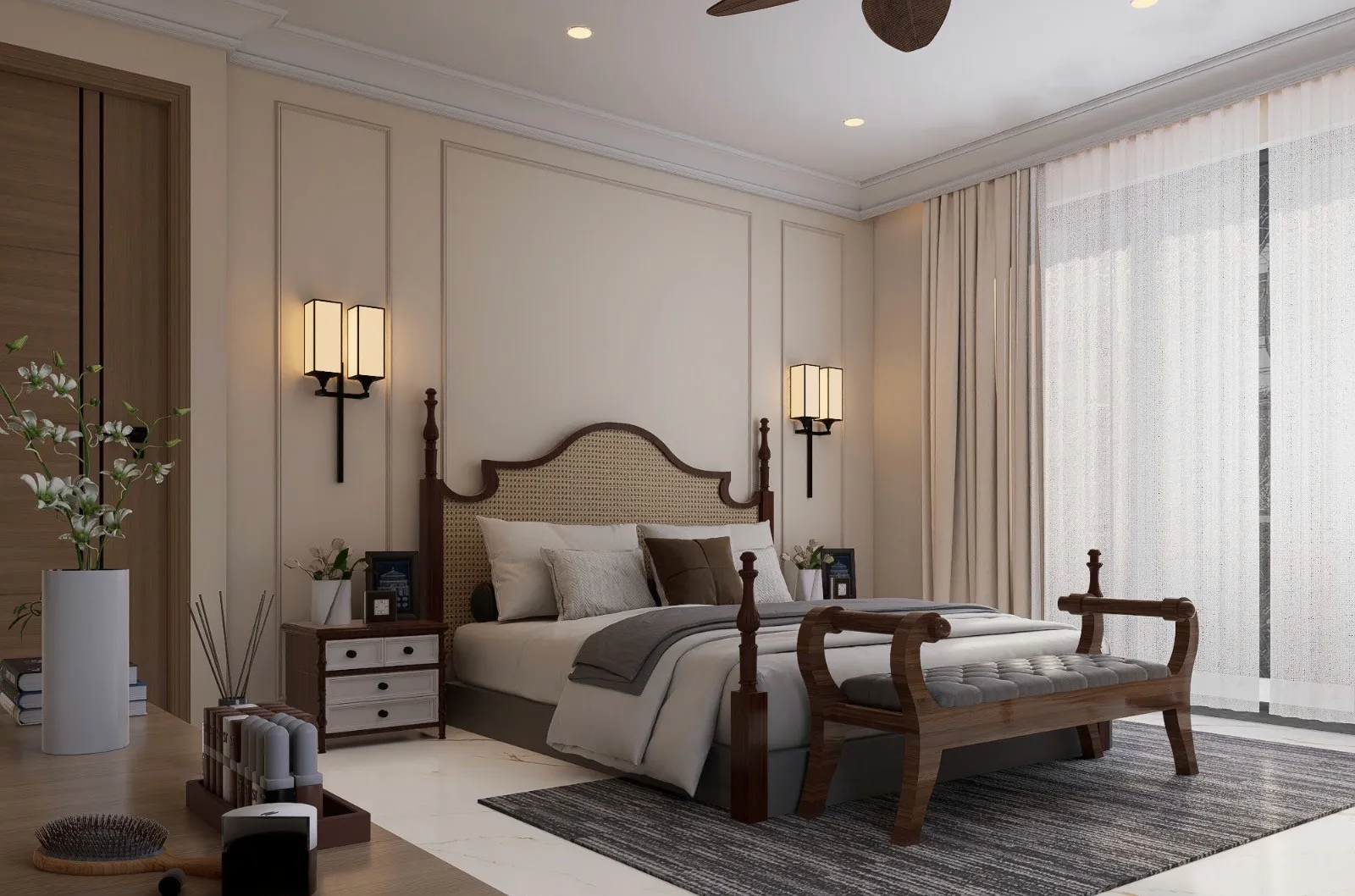
The single most consequential mirror rule we design around, and the one that has the most direct bearing on furniture placement rather than just wall selection, is the taboo against a mirror facing the bed, whether that mirror is a wardrobe shutter mirror, a full length standing mirror, or a wall-mounted dressing mirror. The vastu reasoning here is that a mirror reflecting a sleeping person is believed to double or amplify negative energy during a vulnerable, unconscious state, and separately from the purely directional logic, there is also a long-standing cultural belief, one that shows up across several regional traditions beyond formal vastu shastra too, that a reflection glimpsed upon waking in the dark can be genuinely unsettling, so this is a rule we find clients hold onto with real conviction even in households that are otherwise fairly relaxed about vastu generally. In practical terms, this rule means that any mirror positioned on a wall directly opposite the foot of the bed, or on a wardrobe shutter that faces the bed when open, is treated as a placement to actively avoid, and because most Kolkata bedroom layouts put the wardrobe on the wall opposite or adjacent to the bed simply for reasons of circulation and door swing, this single rule ends up shaping the wardrobe design itself far more often than clients expect when they first raise the concern.
The most reliable design solution we use, and the one we now suggest by default in any bedroom brief that mentions vastu, is separating the mirror from the wardrobe entirely and giving it its own dedicated dressing table or dressing unit positioned on a side wall, meaning a wall perpendicular to the bed rather than directly facing it, so the mirror is fully usable for daily dressing without ever reflecting the bed itself even when the person using it is standing directly in front of it. A dressing table alcove of roughly four feet by two and a half feet, built into a corner of the bedroom or carved out of a walk-in wardrobe layout where the room size allows it, gives us enough space for a proper seated dressing unit with its own mirror, task lighting, and storage, and because the mirror in this configuration faces a side wall or a blank return rather than the bed, it satisfies the vastu requirement automatically without the client having to remember to keep a wardrobe door closed or hang a cloth over a mirror at night, which is the workaround some families resort to when the layout was not planned around this rule from the start. Where a bedroom is genuinely too compact to carve out a separate dressing alcove, commonly in secondary bedrooms under roughly 120 square feet, we instead use wardrobe shutters without mirrored panels at all and place a single slim mirror on the inside of a walk-in closet door or on a wall segment that sits outside the direct sightline from the bed even when every door in the room is open, which takes more careful measuring during the design phase but avoids the mirror entirely disappearing from the room's function.
Living Room and Bedroom Mirrors Are Not Governed by the Same Logic
It is worth being clear that the bed-facing taboo is specifically a bedroom rule tied to the vulnerability of sleep, and it does not extend to living rooms in the same way, so a mirror facing a sofa or facing the main seating area of a living room carries none of the same concern, which is why we can be more flexible with reflective surfaces, mirrored console backs, and decorative mirror clusters in living and dining spaces than we ever would be in a bedroom. Where the two rooms do share a common thread is the underlying idea that a mirror should never reflect a source of negative or draining energy back into the room, which in a living room context is sometimes interpreted to mean a mirror should not directly face the main entrance door either, since a mirror positioned there is thought to reflect incoming positive energy straight back out before it settles into the home, so alongside the north and east direction preference we also check entrance sightlines specifically when finalising a living room mirror's placement.
We covered a closely related set of directional concerns in Is It Bad Vastu to Live in a Flat Directly Below the Building's Overhead Water Tank?, where the same water element association that makes north and east the favoured directions for a mirror also plays into how families think about a tank's position relative to specific rooms, and if your family is planning a larger structural change to accommodate vastu preferences rather than just a decor level fix, our piece on Vastu Rules for Adding a Second Floor to Your Existing Kolkata Home walks through how those bigger directional principles extend to actual construction and load-bearing decisions.
What Happens When Vastu Corrections Get Delayed
One thing worth flagging honestly is that mirror and furniture placement corrections are genuinely one of the cheaper and faster vastu adjustments available to a homeowner, since unlike structural changes they involve moving furniture, resequencing a wardrobe order, or repositioning a dressing table rather than any civil work, and clients who catch this during the design phase, before cabinetry is fabricated and fixed in place, save themselves both money and the disruption of living around an unfinished correction later. We have seen the opposite scenario often enough too, where a family moves into a flat with a wardrobe mirror already facing the bed and then delays the fix for months while living with a covered mirror or an awkward workaround, and the broader financial reality of letting any interior fix drag on, whether it is vastu related or not, is something we quantified in detail in The Real Financial Cost of Interior Project Delays in Kolkata (Rent, Storage, EMI), since even a small, seemingly cosmetic correction like this one carries a real cost when it sits unresolved.
Getting Your Mirror Placement Right From the Start
If you are working through a bedroom or living room layout right now and want the mirror placement resolved properly rather than patched later with a covered wardrobe door or an awkwardly angled dressing table, we would rather sit down with your actual floor plan and compass orientation early, while the wardrobe and furniture layout are still on paper, so reach out to our team with your room dimensions and your family's specific vastu concerns and we will work through a placement that gives you both the functional mirror you need and the compliance your family wants.