






Duco Paint vs Laminate Finish for Your Wardrobe Shutters
When a client sits across the table from us trying to decide between a duco paint finish and a laminate finish for their bedroom wardrobe shutters, the conversation almost always starts with a photograph on their phone of a perfectly smooth, matte, single-colour wardrobe from an interior page they follow, and it almost always ends with us explaining that the finish which photographs beautifully on day one and the finish that survives a family of four opening those shutters twice a day for the next ten years are not automatically the same thing. Having specified both finishes across a good number of the well over a hundred residential projects we have completed since 2014, our honest position is that duco paint wins decisively on look and colour flexibility, laminate wins decisively on day-to-day toughness and repair cost, and the right answer for your bedroom depends far more on who uses that wardrobe and how than it does on which finish simply looks nicer in a showroom sample.
What Duco Paint Actually Is and Why It Looks the Way It Does
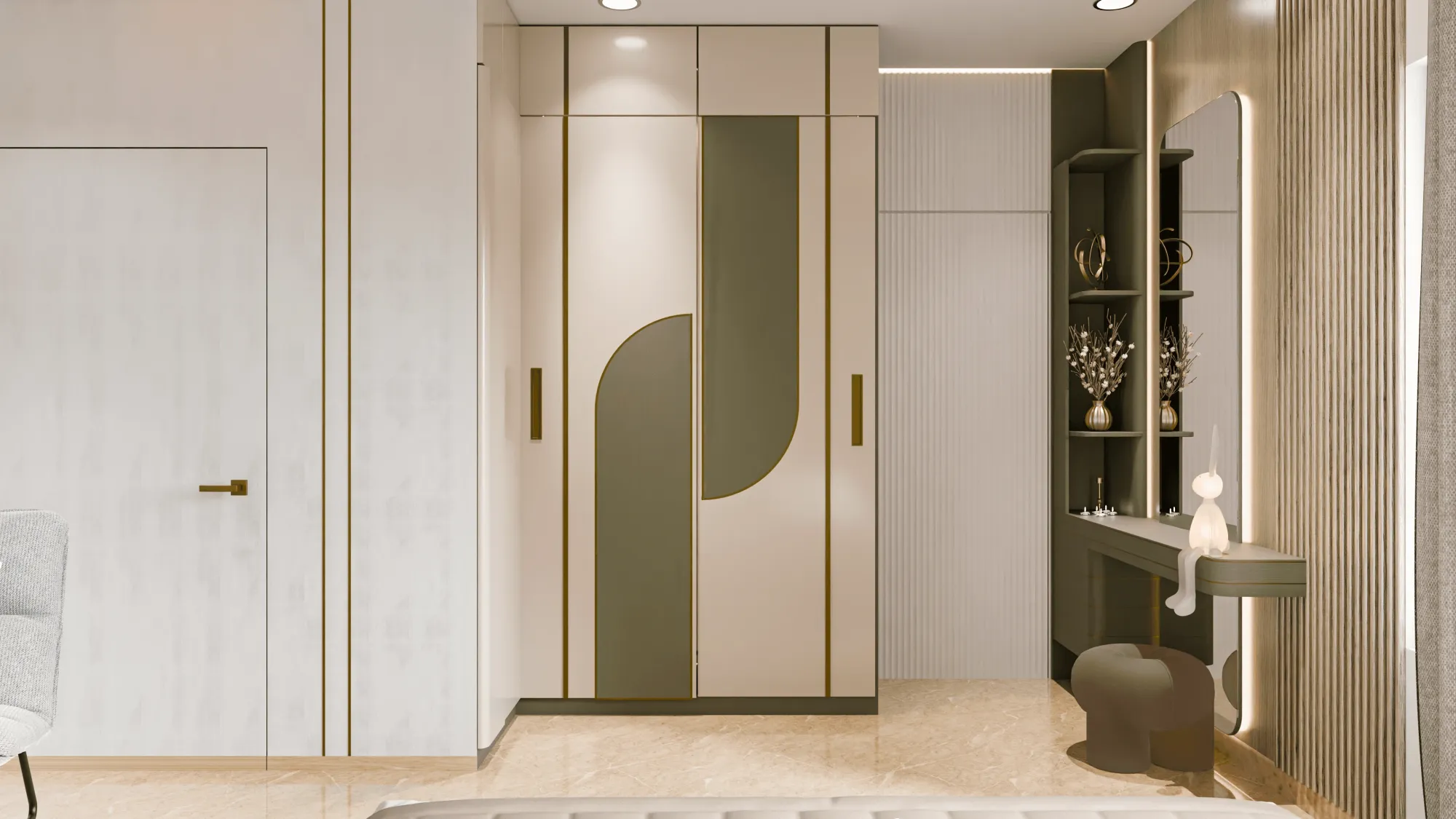
Duco is a spray-applied polyurethane or melamine based paint finish, applied in multiple coats over a primed and sanded MDF shutter, and it is the finish responsible for that flawless, seamless, single-tone look that laminate can approximate but rarely matches exactly, because paint has no visible joint lines, no sheet edges, and no grain pattern unless you specifically ask for one to be replicated. The process itself is labour intensive, which is part of why it costs what it does, since a proper duco job involves priming the MDF shutter, sanding between coats, spraying the base colour, and finishing with either a matte or gloss lacquer topcoat, with the better workshops applying anywhere from four to six coats total to get a surface that reads as genuinely smooth rather than slightly textured under raking light. We generally recommend duco to clients who want a specific colour that is difficult or impossible to source in laminate, muted sage greens and dusty blues being common requests in New Town bedrooms lately, or who want the shutter to disappear visually into a flush, handle-less wardrobe wall rather than announce itself as a piece of furniture.
What Laminate Brings to a Wardrobe Shutter
Laminate is a factory manufactured decorative sheet, typically 0.8mm to 1mm thick, bonded onto a plywood or MDF substrate under heat and pressure rather than sprayed on site, and that manufacturing process is precisely why it behaves so differently from duco once the wardrobe is actually in use. Because the decorative layer is fused to the board rather than layered on top of it as wet paint, laminate resists surface scratching, everyday knocks from keys or bag zippers, and the kind of light abrasion that comes from sliding items in and out of a shelf, in a way that a painted surface simply cannot, since paint sits as a film on the surface and a sharp enough scratch will always cut through to the substrate underneath. Laminate also comes pre-finished from the factory in a genuinely enormous range of woodgrain, stone, and solid colour options, so while it cannot replicate duco's completely seamless look across a run of shutters because sheet joints are visible if you look closely, it gets close enough for the vast majority of bedrooms while asking far less of the wardrobe's daily users in return.
How Each Finish Actually Ages With Daily Use
This is the part of the comparison most vendors gloss over, because it is easier to sell a finish on its opening-day appearance than to talk honestly about what it looks like in year three, and it is exactly the conversation we insist on having with every client choosing between the two. Duco paint's weak point is chipping, specifically at shutter edges, around handle cutouts, and at any corner that regularly makes contact with a doorframe, bed frame, or a child's school bag, because those are the points where the paint film takes repeated mechanical impact rather than the light surface wear it is designed to tolerate. Once a chip exposes the MDF underneath, it stands out sharply against a flawless painted surface, and unlike laminate you cannot simply wipe it clean, because the touch-up requires re-spraying the affected panel or living with a visible mark until you do. Laminate's weak point is different and shows up mostly at edges and seams rather than across the face of the shutter, where poor edge banding can start to lift after a few years of humidity exposure, though a well-executed 2mm PVC edge band holds up considerably longer than the thinner tape some vendors substitute to save cost, and the face of the laminate itself typically stays visually intact for well over a decade of normal use.
| Feature | Duco Paint Finish | Laminate Finish |
|---|---|---|
| Surface look | Seamless, no visible joints | Slight seam lines, wide colour range |
| Scratch resistance | Low, chips at edges and corners | High, resists daily knocks well |
| Repair method | Re-spray affected panel | Spot repair or full sheet replacement |
| Colour flexibility | Any custom shade, matched to paint code | Fixed catalogue of manufactured shades |
| Typical lifespan before touch-up needed | 3 to 5 years in high-contact zones | 10 to 15 years with proper edge banding |
What This Costs on an Actual Kolkata Wardrobe
For a standard 3-door wardrobe shutter face running roughly 42 square feet, which is a common size for the secondary bedrooms we build across New Town and Rajarhat, duco paint typically costs between ₹85 and ₹140 per square foot depending on whether you choose matte or high gloss lacquer and how many coats the workshop applies, while laminate runs a comparatively modest ₹45 to ₹75 per square foot for a standard textured or woodgrain sheet, climbing to ₹90 to ₹130 per square foot if you choose a premium high-gloss acrylic laminate that tries to mimic duco's seamless sheen.
| Wardrobe Type | Shutter Area | Duco Cost | Standard Laminate Cost |
|---|---|---|---|
| 3-door wardrobe (secondary bedroom),42 sq ft | ₹3,570 to ₹5,880 | ₹1,890 to ₹3,150 | |
| 4-door wardrobe (master bedroom),58 sq ft | ₹4,930 to ₹8,120 | ₹2,610 to ₹4,350 | |
| Walk-in closet run,75 sq ft | ₹6,375 to ₹10,500 | ₹3,375 to ₹5,625 |
On a full wardrobe, duco typically adds somewhere between ₹1,700 and ₹4,300 over standard laminate depending on size, and while that gap looks small in isolation, it compounds across a full flat once you count wardrobes in two or three bedrooms alongside any duco accents elsewhere, which is worth factoring into the broader renovation budget we discuss in our related piece on WPC doors versus flush doors for a Kolkata bathroom that never fully dries, since bathroom and bedroom finish decisions in the same flat often draw from a single combined budget.
Maintenance Realities Nobody Mentions at the Showroom
Duco's ongoing maintenance cost is the part clients underestimate most, because a single chipped corner does not usually justify calling the workshop back, so most households live with a small visible mark for months before finally scheduling a touch-up, and when they do, a partial re-spray of one or two panels typically runs ₹1,500 to ₹3,000 depending on how much masking and colour matching the job requires, a cost that repeats every few years in households with young children or where the wardrobe sits close to a doorway. Laminate's maintenance is comparatively boring, which in this context is a compliment, since a damp cloth wipe handles almost all daily cleaning and the only real repair scenario is edge band lifting, which a carpenter can usually re-glue on site for a few hundred rupees rather than requiring a full panel replacement.
Before you commit to either finish, it is worth confirming a handful of specifics directly with your carpenter or vendor rather than assuming they are covered. For duco, ask whether the quote includes an MDF substrate or is being sprayed over existing plywood, since MDF generally holds a painted finish better, and confirm exactly how many spray coats are included along with whether a protective lacquer topcoat is standard rather than an optional add-on. For laminate, request the exact brand and thickness in writing rather than accepting a vague "branded laminate" line item, and check specifically whether edge banding is a proper 2mm PVC strip or a thinner substitute tape that tends to lift within a couple of years. Either way, it is worth asking upfront what a partial touch-up or repair will cost, so you know the number before you actually need it rather than being quoted a surprise figure the first time something chips or lifts.
Where We Would Actually Recommend Each Finish
For a minimalist, handle-less wardrobe wall in a primary bedroom where the household is careful with furniture and the visual seamlessness genuinely matters to the overall room design, we lean toward duco, particularly in matte finishes that hide light surface marks better than gloss does. For a children's room, a secondary bedroom that sees heavy daily traffic, or any household budgeting carefully across a full flat renovation, laminate is almost always our practical recommendation, since the durability difference matters more over a ten-year horizon than the marginal difference in visual seamlessness that most guests never notice unless they are standing directly in front of the wardrobe. If you are furnishing a smaller flat where every finish decision needs to work harder because there is less room to hide wear, our guide to furniture arrangement for a 700 sq ft 2BHK flat in Kolkata covers some of the same durability-first thinking that applies here, and if noise rather than finish is your bigger concern in the same bedroom, our comparison of double glazed versus single glazed windows for a Salt Lake home facing traffic is worth reading alongside this one since both decisions typically get finalised in the same planning conversation.
Choosing the Right Finish for How You Actually Live
There is no universally correct answer between duco and laminate, only the right answer for how your household actually treats a wardrobe day to day, and we would rather walk you through both finishes on physical samples under your bedroom's real lighting, with an honest cost and maintenance breakdown for your specific shutter dimensions, than let you choose based on a photograph alone, so get in touch through our contact page and we will bring both finish options to your next site visit.