








Local Clay Brick vs Fly Ash Block: Which Is Actually the Greener Choice for Bengal Construction
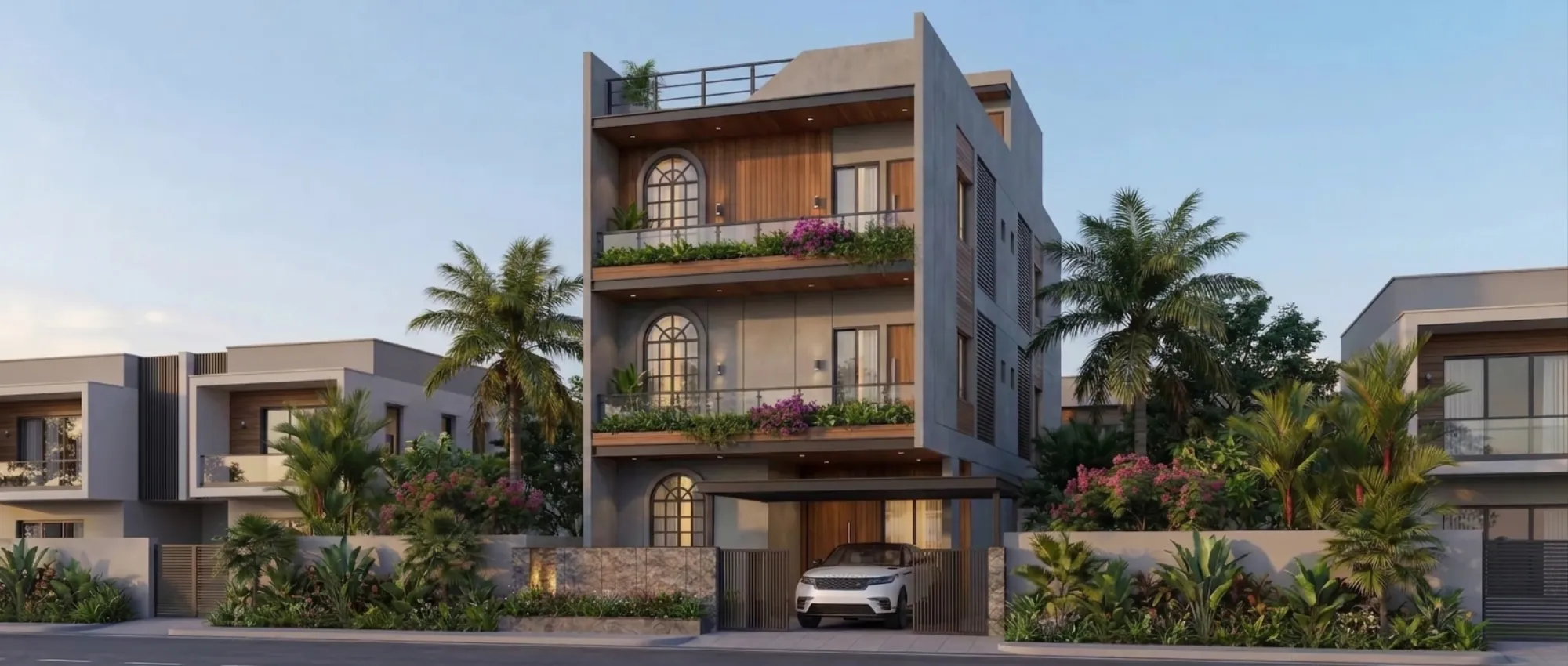
Almost every client who comes to us partway through planning a house in New Town or Rajarhat has already been told by at least one contractor that fly ash blocks are the "eco-friendly" choice and that traditional clay brick is an outdated, polluting material best left behind, and we understand why that narrative has taken hold so completely, because fly ash blocks are marketed heavily as a green alternative and the pitch is simple enough to repeat at a site meeting. What we've found after specifying both materials across dozens of residential projects around Kolkata over the past decade is that the real comparison is considerably more textured than the marketing suggests, and that the greener choice depends on where your site sits, what thermal performance you actually need through a Bengal summer, and how far the material has to travel before it reaches your plot, not simply which one carries the word "eco" in its brochure.
What Embodied Carbon Actually Means Here
Embodied carbon is the total greenhouse gas emitted in extracting, manufacturing and transporting a building material to your site, and it's a genuinely useful lens because it forces you to look past the factory gate and consider the whole journey a brick or block takes before it ends up in your wall. Traditional Bengal clay brick is fired in kilns, typically the bull's trench or the increasingly common zigzag kiln design that has replaced older, dirtier fixed chimney kilns across West Bengal over the last several years, and that firing process is genuinely carbon-intensive because it requires sustained high temperatures, usually reaching 900 to 1,000 degrees Celsius, held for days at a stretch, burning coal or a coal-biomass mix as fuel. A single fired clay brick typically carries an embodied carbon figure in the range of 0.20 to 0.24 kilograms of CO2 equivalent, largely from that firing energy.
Fly ash blocks, by contrast, are not fired at all. They're formed by mixing fly ash, a waste byproduct captured from coal power plant chimneys that would otherwise go to a landfill or an ash pond, with lime, gypsum and sometimes cement, then cured under pressure and steam rather than kiln heat. Because there's no firing stage, the embodied energy per block is meaningfully lower on paper, and this is the number that gets quoted in the pitch to homeowners. But the honest comparison has to include two things that number leaves out. First, fly ash blocks are considerably larger and heavier per unit than a standard clay brick, so you need fewer of them per square metre of wall, and comparisons that quote embodied carbon per brick without adjusting for wall coverage are misleading in both directions depending on which material happens to look better that way. Second, and this is the part we think gets glossed over most often, fly ash itself has to travel to reach a block manufacturing unit, and in the eastern region that fly ash is sourced predominantly from thermal power stations, several of which sit at meaningful distance from Kolkata, so the "waste material, therefore free of embodied cost" framing undercounts the transport emissions baked into getting that ash from the power plant ash pond to a block factory and then to your site.
Sourcing Distance Is Where the Comparison Actually Tips
This is the part of the conversation we spend the most time on with clients, because sourcing distance is doing more work in the real-world sustainability calculation than either material's raw manufacturing footprint. Traditional clay brick kilns are scattered widely across the districts immediately surrounding Kolkata, including brick fields in North and South 24 Parganas and along the Hooghly belt, many of them within 30 to 50 kilometres of a New Town or Rajarhat site, because brick-making has historically located itself near the alluvial clay deposits that the Ganga delta provides in abundance. That proximity matters enormously for a heavy, bulky material where transport emissions scale directly with distance and truck-load count, and for a mid-sized residential project needing, say, 40,000 to 60,000 bricks, a supply chain measured in tens of kilometres rather than hundreds keeps the transport component of embodied carbon genuinely small relative to the material's total footprint.
Fly ash block units serving the Kolkata market draw their raw ash from thermal power stations that are not always local to the immediate metropolitan area, and depending on which manufacturer and which plant is supplying a given batch, that ash can be moving a considerably longer distance before it even reaches the block-forming unit, before the finished block then makes its own trip to your site. We're not suggesting fly ash sourcing is uniformly worse, because plenty of block manufacturers serving greater Kolkata do source from reasonably proximate thermal stations and run efficient logistics, but it is not automatically the shorter supply chain simply because the raw material started life as industrial waste, and we always ask a fly ash block supplier directly which plant their ash comes from and how far their finished units travel before we treat "sustainable" as a settled fact on a project.
Thermal Mass and What It Means for a Bengal Summer
Where clay brick genuinely earns its keep, independent of the carbon accounting, is in thermal performance through Kolkata's long, humid, high-heat months. Fired clay brick has a relatively high thermal mass and a cellular pore structure that gives it decent insulating behaviour, meaning a well-built clay brick wall absorbs and releases heat more slowly than a denser material, which in practice translates into interior walls that lag a few degrees behind the peak outdoor temperature during the worst of an April or May afternoon, and that lag is not a marginal comfort detail in a city where daytime highs regularly sit above 38 degrees Celsius for weeks at a stretch. Fly ash blocks are denser and more thermally conductive than clay brick of comparable thickness, which means a fly ash block wall of the same nominal thickness tends to transmit exterior heat into interior spaces somewhat faster, and on several of our projects we've had to compensate for that by specifying a thicker block, adding external insulation, or leaning more heavily on shading devices and cross-ventilation strategy to hold indoor comfort where a clay brick wall would have done more of that work passively.
This isn't a reason to rule fly ash out on thermal grounds alone, because the density that costs it some passive insulating performance also gives fly ash block walls better compressive strength and dimensional consistency, which is genuinely useful on taller structures or where a client wants fewer, larger units to speed up masonry work and reduce mortar joints, and mortar joints themselves are a meaningful source of thermal bridging regardless of which unit you're laying. What we typically recommend, and what we've built into several New Town and Salt Lake homes, is a hybrid approach, specifying fly ash block for internal partition walls and load-bearing sections where speed, strength and dimensional precision matter most, while keeping fired clay brick on west and south-facing external walls that take the brunt of direct summer sun, letting each material do the job it's genuinely better suited to rather than forcing a single material across an entire structure for the sake of specification simplicity.
Cost Per Unit Is Not Cost Per Wall
The other place this comparison gets distorted is price, because fly ash blocks are almost always quoted as cheaper per unit than clay brick in the Kolkata market, and contractors eager to win a bid will lean on that number without walking a client through what it actually means for total wall cost. A fly ash block replaces roughly six to eight standard clay bricks in wall coverage given its larger dimensions, so a raw per-unit price comparison is close to meaningless unless you convert it to cost per square metre of finished wall, and once you do that conversion the gap between the two materials narrows considerably, sometimes disappearing altogether depending on current local brick-field pricing and which fly ash supplier is quoting. Labour cost also shifts the comparison, because fewer, larger units laid per square metre generally means faster masonry work and lower labour hours, which is a real saving on a fly ash specification, but it's a saving that shows up in the masonry contractor's bill, not in the raw material's environmental credentials, and we think those two things get conflated far too often in how this choice gets pitched to homeowners.
Building on What We Already Have Around Us
We'd rather our clients think about local material sourcing as a spectrum than a binary label, because the most genuinely sustainable choice for a given plot in New Town or Rajarhat is usually the one that travelled the shortest distance to get there while still performing the job the wall needs to do, and that calculus can land on clay brick, fly ash block, or a considered mix of both depending on orientation, budget and the specific supply chains available that season. This is part of a broader pattern we keep coming back to in our own material choices, which is that Bengal already has genuinely good regionally available options if you're willing to look past the default catalogue, something we've written about at more length in our piece on laterite and other local stone as a facade and flooring alternative to imported marble, where the same sourcing-distance logic applies just as directly. If you're weighing a full renovation where wall material choices interact with a lot of other retrofit decisions at once, our renovation and remodeling service page walks through how we sequence those calls project by project.
The embodied carbon conversation doesn't stop at the wall, either, and once a home is built the next lever most of our clients reach for is generating their own power, which is why we'd point anyone thinking seriously about a lower-footprint New Town home toward our piece on sizing rooftop solar, finding shadow-free roof zones and understanding net metering basics, since the two decisions, what you build with and how you power what you've built, tend to get planned by the same clients in the same conversation with us.
Let's Work Out the Right Mix for Your Site
If you're at the stage of choosing structural material for a New Town, Salt Lake or Rajarhat plot and you want an honest, site-specific read on clay brick versus fly ash block rather than a generic recommendation, bring us your plot orientation, your budget range and your building footprint and we'll walk you through exactly which walls should carry which material and why, the same way we do for every residential project that comes through our studio. You can get in touch with our team here and we'll start with a straightforward conversation about your site before any material gets specified.