






Main Door Materials That Don't Swell on a Monsoon-Facing Entrance in Kolkata

If the main door of your flat or independent house has started sticking hard enough by late June that you need a shoulder into it to get inside, and easing off again only once October's dry air rolls in, and if that door happens to sit on the south or south east face of the building, the side that catches Kolkata's monsoon wind and driving rain head on rather than a more sheltered north or west aspect, what you are dealing with is not a one time carpentry fault that a plane and a bit of sanding will fix for good, it is an orientation and material mismatch that will keep recurring every single monsoon until the door itself is replaced with something built to sit directly in wind driven rain for four months at a stretch, and across a decade of specifying entrance doors for homes in New Town, Salt Lake and Rajarhat we have fixed this exact complaint often enough to know precisely which door materials hold their dimensions on a monsoon facing frame and which ones simply cannot.
Why a Monsoon-Facing Entrance Swells a Door That an Inner Doorway Never Would
A main door that opens onto an internal corridor or a covered stairwell rarely sees direct rain at all, so the wood or laminate on its face stays at a fairly stable moisture content through the year, but an entrance that opens straight onto an open compound, a driveway, or an unprotected porch on the south or south east side of a New Town or Rajarhat plot takes the brunt of wind driven rain directly on its outer face for hours at a stretch during a heavy monsoon spell, and that outer face absorbs moisture at a different rate than the drier interior face of the same door, which is exactly the uneven moisture gradient that makes a door swell unevenly rather than uniformly, bowing slightly outward and binding against the frame at the top or bottom corner rather than sitting flush the way it did in April. We see this most often in independent houses and duplex units in Rajarhat and the newer blocks of Action Area II and III, where the main entrance frequently sits at ground level facing an open approach road with little overhang to break the rain before it hits the door, compared to a mid rise apartment entrance that at least has a covered lobby or an overhanging balcony above it cutting the direct exposure by a considerable margin.
Solid Teak: Still the Strongest Option, With One Maintenance Catch
Solid teak has been the default material for a serious main door in Bengal for generations, and there is good reason for that, since teak carries a naturally high oil content in its grain that gives it a real head start on moisture resistance compared to most other timbers, meaning a well seasoned teak slab genuinely absorbs and releases moisture more slowly than cheaper hardwoods, and that slower moisture exchange is exactly what keeps a door dimensionally stable through a wet season rather than swelling sharply the moment humidity climbs. Where teak still needs help on a south or south east facing entrance in Kolkata is in the finish, because the factory grade seal on a teak door is not built to survive four months of direct wind driven rain plus the pre monsoon sun that bakes the same door face for weeks beforehand, so we tell every client specifying solid teak for an exposed entrance that the door needs a proper exterior grade polyurethane or marine spar varnish reapplied roughly every twelve to eighteen months on the exposed face, and skipping that maintenance is the single most common reason we see an otherwise excellent teak door start checking and swelling at the edges within three or four monsoons rather than lasting the fifteen or twenty years solid teak is genuinely capable of.
Flush Doors: The Budget Option That Fails Fastest at This Exact Exposure
A standard flush door is built from a timber or plywood frame with a hollow or block board core, faced on both sides with a thin veneer or laminate skin, and the entire structural logic of that door depends on the core material and the edge sealing holding moisture out, because once water gets past the face laminate at a corner or an edge, which is almost always where the factory sealing is thinnest and the first place it wears through, the core itself starts absorbing water unevenly across its layers. Plywood itself is manufactured to different water resistance grades, and as Wikipedia's overview of plywood explains, the adhesive used between veneer layers is what actually determines a panel's moisture performance, so a door built around commercial grade plywood rather than BWP, or boiling water proof, grade plywood has a core that was never rated to survive standing exposure to driven rain in the first place, and on a monsoon facing entrance that is precisely the exposure it gets, which is why we see flush doors on exactly these entrances delaminating at the edges, bowing, and swelling within two to three years, well before a comparable flush door on a sheltered inner doorway shows any wear at all. We still specify flush doors regularly for internal doors and for sheltered entrances where the exposure risk is genuinely low, but for a main door catching direct monsoon rain we no longer recommend a standard flush door regardless of the laminate finish, because the vulnerability sits in the core, not the surface.
WPC Doors: What We Now Specify by Default for a Rain-Facing Entrance
Wood plastic composite doors, built from a core that blends wood fibre with a polymer binder rather than solid timber or layered plywood veneers, behave fundamentally differently in water because the polymer content in the core means the door does not absorb moisture into its structure the way natural wood or plywood does, so a WPC door sitting in direct monsoon rain for hours does not swell, does not delaminate at the edges, and does not need the annual resealing regimen a teak door depends on to perform the same way. The trade off clients should know going in is aesthetic rather than structural, since a WPC door reads as slightly more uniform and less grain rich than solid teak even with a wood look laminate finish, and it sits a notch above a standard flush door in cost while remaining meaningfully cheaper than solid teak, which is exactly the middle position that has made it our default recommendation for any main door on a south or south east facing entrance across the New Town and Rajarhat projects we have specified doors for over the last three or four years, reserving solid teak for clients who specifically want the grain and heft of real wood and are committed to the maintenance schedule that comes with it.
| Solid Teak Door | WPC Door |
|---|---|
| Genuine wood grain, premium feel at the entrance | Uniform wood-look laminate finish, less grain variation |
| Needs re-varnishing roughly every 12-18 months on exposed face | No resealing required for moisture performance |
| Naturally moisture resistant but not immune to swelling if unsealed | Core does not absorb water, dimensionally stable through monsoon |
| Higher material and labour cost | Meaningfully lower cost than solid teak |
| Best where upkeep is genuinely manageable | Best as the default for a rain-facing entrance with low-maintenance intent |
The Frame, Threshold and Overhang Matter as Much as the Door Slab Itself
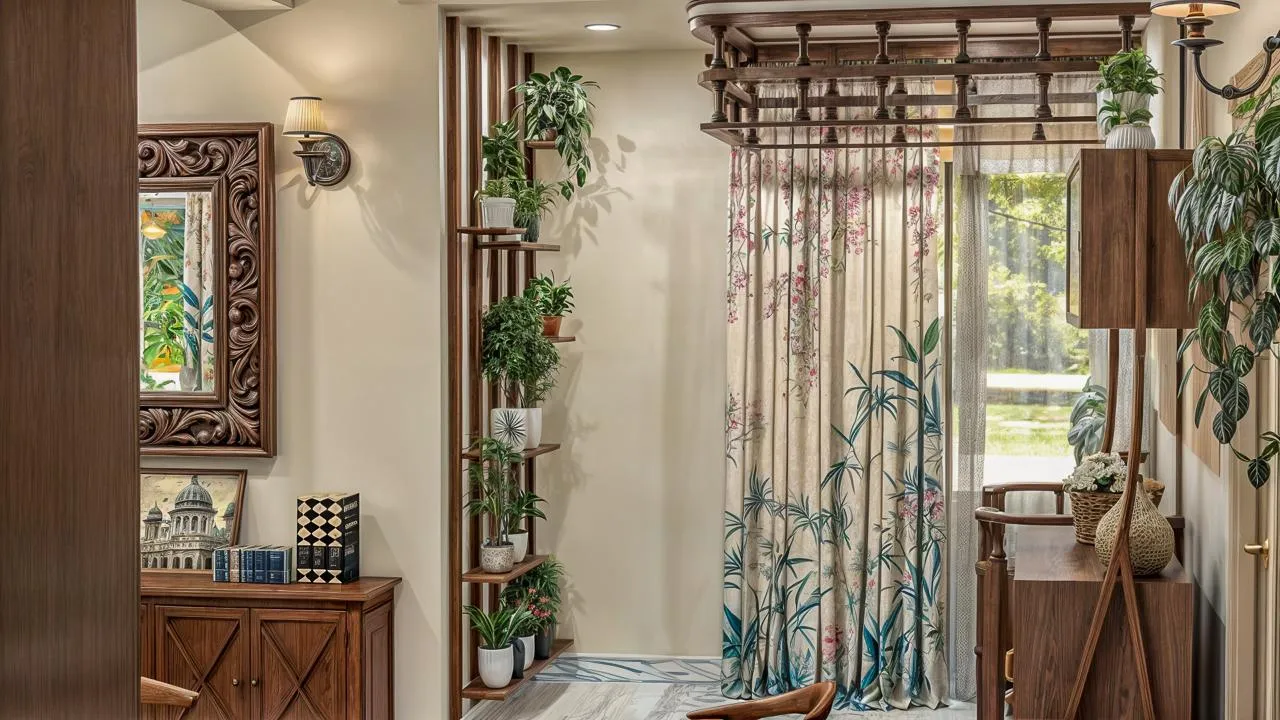
None of these material choices perform to their potential if the frame around the door is still ordinary timber that swells and shifts independently of the door slab, so on every monsoon facing entrance we now specify a frame in either treated hardwood or a matching WPC profile, because a door that resists swelling but sits in a frame that has itself warped out of square will still bind and stick regardless of what the door itself is made from. A raised threshold detail of even 15 to 20 millimetres above the outer floor level keeps pooling rainwater off the door's bottom edge, which is consistently the first place we see swelling begin on entrances without one, and a chajja or overhang projecting at least 450 to 600 millimetres beyond the door face cuts a meaningful share of the direct wind driven rain before it ever reaches the door, which is a small structural addition at the design stage that saves years of maintenance headache later. Stainless steel hardware rather than standard mild steel hinges and closers rounds out the specification, since ordinary hardware corrodes and seizes under the same sustained humidity that swells the door, often jamming a perfectly good door shut through a stuck hinge long before the timber itself is the actual problem.
- Confirm which compass direction your main entrance actually faces before choosing a door material
- Specify a chajja or overhang of at least 450mm projecting beyond the door face if one does not already exist
- Choose WPC as the default for a south or south-east facing entrance unless you are committed to teak's maintenance schedule
- Insist on BWP-grade plywood if a flush door is used anywhere near direct rain exposure
- Raise the threshold detail by 15-20mm to keep pooling water off the door's bottom edge
- Use stainless steel hinges and closers rather than standard mild steel hardware on any exposed entrance
How a Swelling Main Door Fits Into a Fuller Monsoon-Proofing Plan for the Flat
A jammed front door is rarely the only monsoon complaint we hear about in the same visit, and it is worth thinking about the entrance alongside the rest of the flat's humidity exposure rather than in isolation, since a living room just past that same entrance often has its own fabric and finish problems through the same four wet months, which is why our piece on curtain fabrics that actually hold up to Kolkata's humidity and dust in a living room is worth reading alongside this one if your entrance opens directly into a living space. Independent houses and duplexes in Rajarhat that have a monsoon facing main door frequently also have a semi basement or stilt parking area taking on standing water in the same weather, a separate but related problem we cover in flooring for semi basement parking that can take Kolkata's monsoon waterlogging, and narrow plot row houses in the same belt often pair a swelling entrance with a stale, poorly ventilated interior, which our guide on fixing no cross ventilation in a narrow plot row house in Rajarhat addresses directly. For clients who want to understand how we think about sourcing the right material for Kolkata's specific climate more broadly rather than door by door, our piece on sourcing materials locally for Kolkata's climate and construction realities lays out the thinking behind choices like this one.
Let Us Specify the Right Door Before Your Next Monsoon Arrives
If your main door is already sticking or you are finalising a new entrance on a plot that faces the rain bearing side of the compound, send us the compass direction, a photo of the current frame, and roughly what overhang exists above it, and we will tell you plainly whether teak, WPC, or a properly detailed flush door is the right call for that specific entrance. Reach out through our contact page and we will work it through with you before the humidity climbs again.