







Quartz vs Solid Surface Counters: The Seam Problem Nobody Explains Before You Buy
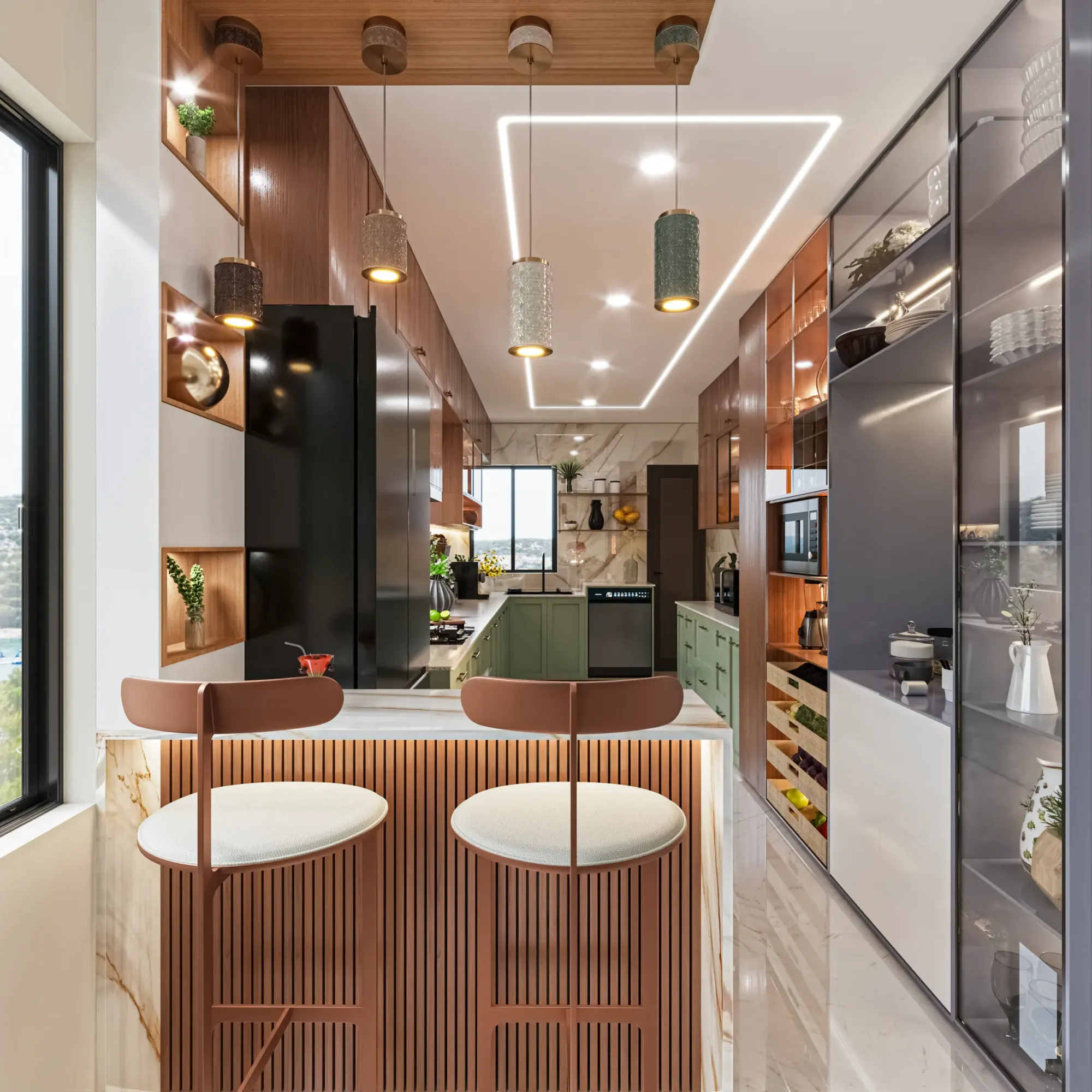
Every kitchen counter conversation we have with a client in New Town starts with color and finish, and almost none of them start with the question that actually determines how the counter looks eighteen months in, which is where the seams will fall and how visible they will be once the fabricator has actually cut and installed the material. We understand why this happens, because a showroom sample is a flat 2x2 foot piece with no joints anywhere on it, and it is genuinely hard to picture how that same material behaves once it has to turn a 90 degree corner in an L-shaped kitchen or wrap around a 9 foot island, which is exactly the layout we see in a large share of the 2 and 3BHK apartments we work on across New Town, Rajarhat, and Salt Lake. So before you pick a material based on how the sample chip feels under your thumb, we want to walk through what actually happens at the joint, because that is where quartz and acrylic solid surface behave in genuinely different ways, and it is the difference that decides whether your counter still looks like one continuous piece of stone five years from now or whether you can trace every seam with your fingernail from across the room.
Why the Seam Exists at All
Quartz slabs, the engineered stone made from roughly 90 to 93% crushed quartz aggregate bound with polyester resin, come from the factory in standard slab sizes, typically around 120 by 60 inches for the slabs we source for Kolkata projects, and no single slab is large enough to cover an L-shaped counter run plus an island without at least one join somewhere in the layout. Acrylic solid surface, the fully synthetic material sold under names like Corian and several Indian-manufactured equivalents we specify for budget-conscious projects, ships in longer continuous sheets, commonly up to 12 feet and sometimes beyond depending on the brand, which already changes how many seams a given kitchen layout needs before you even get to how those seams are finished. The core difference that matters here is chemical rather than cosmetic: solid surface is a homogeneous acrylic polymer all the way through its thickness, which means a properly executed seam can be thermoformed and sanded until it becomes genuinely invisible to touch and very difficult to spot with the eye even at close range, while quartz is a resin-bound aggregate that cannot be melted and reflowed the same way, so its seam will always remain a glued joint between two hard slab edges no matter how skilled the fabricator is.
What a Quartz Seam Actually Looks Like a Year Later
We have fabricated and installed quartz counters across probably sixty or seventy kitchens over the past decade, and the honest answer on seam visibility is that a well-executed quartz seam, done by a fabricator using a color-matched epoxy adhesive and diamond polishing on-site, is a thin, tight line that most clients stop noticing within the first few weeks of using the kitchen. Where it becomes a genuine problem is in two specific situations we see repeatedly. The first is when the seam falls across a heavily used zone, most often right where the L-turn happens next to the main sink or where an island run meets the main counter, because that is exactly where knives get set down, hot vessels get slid across the surface, and daily wiping happens hardest, and repeated micro-abrasion at that one line accelerates any hairline gap that was already there. The second is thermal stress from placing very hot cookware directly at or near the joint, which can cause the epoxy bond to expand and contract at a different rate than the quartz itself, and over two or three years of that cycling we do sometimes see a seam that was originally tight open up into a line you can catch a fingernail on. For a typical L-shaped kitchen counter with an island, layouts we design constantly in New Town flats between 900 and 1400 square feet, we can usually plan the cut so the unavoidable seam falls in a lower-traffic stretch, like along a run that only holds a wall oven or under a stretch of overhead cabinetry, rather than dead center under the sink, and that single decision at the design stage does more for long-term seam appearance than any material choice does on its own.
What a Solid Surface Seam Actually Looks Like a Year Later
This is where solid surface earns its premium in kitchens where the client has told us seamlessness matters more than anything else in the brief. Because the material is thermoformed, a good fabricator heats and fuses two sheets together with a matching adhesive, then sands and buffs the entire surface including the joint until the seam is, in the most literal sense, molecularly continuous rather than glued, and the result on a well-run kitchen is a counter where you genuinely cannot find the seam by running your hand across it, even directly at an L-turn or around a curved island edge, which quartz cannot replicate because it cannot be reshaped that way. The tradeoff, and it is a real one we walk every client through, is that solid surface is significantly softer than quartz, roughly comparable to a hard plastic in scratch resistance rather than an engineered stone, so while the seam itself stays invisible, the surface around it picks up fine scratches from knives, abrasive scrubbing pads, and sliding ceramic cookware far more readily, and it is also more vulnerable to heat marking from a pan set down without a trivet. We have re-sanded more than a few solid surface counters in Salt Lake apartments around the four or five year mark to buff out accumulated scratching, which is a maintenance step quartz essentially never needs, so the invisible seam comes at the cost of a surface you have to treat more carefully day to day.
Cost and Layout: How We Actually Decide With Clients
For a mid-size New Town kitchen with an L-shaped run around 16 to 20 running feet plus a small island, we typically see installed quartz land between ₹1,600 and ₹2,800 per square foot depending on the tier of quartz brand, while comparable acrylic solid surface runs ₹1,800 to ₹3,200 per square foot for the branded options and can go higher for imported ranges, so solid surface is rarely the cheaper choice even though it is often assumed to be the "plastic" alternative to stone. Where we steer clients toward solid surface despite the higher per-square-foot cost is when the layout genuinely cannot avoid a seam falling in a high-visibility zone, such as a waterfall edge island where the seam would otherwise run down the vertical face in full view of the dining area, or when the client wants integrated sinks and backsplashes thermoformed as one continuous piece with zero visible joints anywhere, which is a detail we build into some of our higher-end kitchen briefs. Where we steer clients toward quartz is everywhere else, which is most kitchens, because the scratch and heat resistance means less babying day to day, and because a well-planned seam location genuinely does fade into the background of daily use. The one layout we actively discourage regardless of material is an island seam that falls directly under a drop-in hob or sink cutout, because the cutout itself already weakens that section of slab, and stacking a seam on top of that weak point is asking for a crack line within a few years, something we specifically design around during the shop drawing stage before any material gets ordered.
A Note on Grout-Free Doesn't Mean Joint-Free
Clients occasionally tell us they chose quartz or solid surface specifically to avoid the grout lines that come with a tiled or natural stone counter, and while that is true in the sense that neither material needs grout, it is worth being clear that "seamless-looking" and "seam-free" are not the same promise, and even the best fabricators cannot make a large L-shaped or island kitchen with zero joins unless the budget allows slabs to be ordered and cut specifically to minimize seam count, which does happen on some of our premium briefs but adds meaningfully to material wastage cost. What we can control, and what we walk through with every client at the layout stage regardless of which material they choose, is where that seam falls, how it is oriented relative to the grain or pattern of the material, and whether the fabricator doing the on-site join has done enough quartz or solid surface seams specifically to get the color match and polish right, because a rushed seam by an inexperienced fabricator will show regardless of which material you picked.
If you want to see how countertop material choices connect to other renovation decisions, our post on wall putty quality and why the wrong prep coat fails within a single monsoon covers a similar theme of a detail that looks fine on handover day and only reveals itself months later, and our breakdown of structural repair costs versus renovation costs in Kolkata is useful if you are weighing a full kitchen counter replacement against other budget priorities in the same renovation. If your kitchen is built around reclaimed timber elements alongside the counter, our guide to sourcing reclaimed wood from Kolkata's old houses is worth a read before you finalize the material palette.
Let's Plan Your Counter Layout Before You Order the Slab
If you are mid-renovation and staring at two or three quartz or solid surface samples trying to guess how the seams will fall in your specific kitchen, that is exactly the kind of decision we like to work through on paper before any material gets cut, because moving a seam six inches during the design stage costs nothing and moving it after installation costs an entire counter. Reach out to our team through our contact page and share your kitchen layout or floor plan, and we will walk you through where the joints will actually land in your L-shaped run or island and which material makes sense for how you actually cook and live in that kitchen.