






Bookshelf Material That Won't Foster Mold in a Kolkata Study Room
Clients building a study or a home library in Kolkata rarely ask us about bookshelf material until they have already lived through one bad monsoon with a shelf full of books, and the question that actually gets asked at that point is some version of which bookshelf material will not grow mold in Kolkata's humidity the way their current one already has, usually accompanied by a description of grey-green spotting on the back panel or a faint musty smell coming from a closed cabinet section that never used to be there. The pattern behind almost every one of these complaints is the same, which is that a closed, flush-backed shelving unit sitting against an exterior wall or a wall that backs onto a bathroom traps a pocket of still, humid air with nowhere to go, and once ambient humidity in that trapped pocket sits above roughly 65 to 70 percent relative humidity for long enough, which happens routinely across a Kolkata monsoon, both the board the shelf is made from and the paper the books are printed on become genuinely hospitable to mold growth, and the fix has less to do with which specific timber species you choose and more to do with board grade, sealing, and whether the design lets that trapped air move at all.
Why a Closed Bookshelf Is Worse Than an Open One in This Climate
A bookshelf with a solid, flush back panel pressed directly against a wall behaves almost like a small sealed box once its doors are closed, and if that wall is an exterior facade or a wall shared with a bathroom, the temperature difference between the room-side air and the wall surface causes the humid air trapped in that gap to condense as fine moisture on the inside of the back panel, which is precisely the moisture mold spores need to establish themselves on organic material, and cellulose-based board along with the paper of the books themselves is exactly that kind of organic material. Open shelving, by contrast, or shelving with even a modest air gap and some form of ventilation at the back, lets ambient room air circulate across that same wall surface continuously, which keeps localized humidity from building up to the point where condensation actually forms, and this single design decision, closed versus ventilated, matters more to long-term mold resistance than most of the finish choices clients spend their design budget agonizing over.
Board Choice: Why Plywood Consistently Outperforms MDF and Particle Board Here
Once the ventilation question is settled, the board itself is the next decision, and for a Kolkata study room we default to BWP grade plywood, meaning boiling water proof grade, or marine plywood for the carcass and back panel over medium density fibreboard or particle board, because plywood is built from thin layers of wood veneer glued together with the grain of each layer running perpendicular to the one beneath it, a cross-laminated structure that resists swelling and warping under fluctuating moisture far better than MDF or particle board, both of which are made from wood fibres or particles compressed with resin and tend to absorb ambient moisture across their whole surface, swell along their edges first, and hold that moisture long after the surrounding air has dried out again. That swelling is not just a dimensional problem where doors stop closing properly, it is also what keeps the board damp long enough for mold to take hold, whereas a properly sealed BWP plywood carcass sheds ambient humidity fast enough that spores rarely get the sustained wet window they need.
| BWP or Marine Grade Plywood | Standard MDF or Particle Board |
|---|---|
| Cross-laminated veneer resists swelling from ambient humidity | Compressed fibre absorbs moisture and swells at exposed edges |
| Retains structural strength even after repeated damp exposure | Loses screw-holding strength once edges have swollen and softened |
| Higher material cost per sheet | Lower material cost per sheet |
| Needs proper edge banding to look finished | Needs proper edge banding to prevent moisture wicking, not just appearance |
| Recommended for exterior-facing or bathroom-adjoining shelving walls | Acceptable only for interior partition walls away from humidity sources |
Finish and Edge Detailing Matter as Much as the Board Underneath
A good board choice undone by unsealed edges is still going to develop problems, since the raw cut edge of any board, plywood included, is where moisture actually enters fastest, so every exposed edge on a study bookshelf, not just the visible front edges but the ones tucked against the wall and hidden inside cabinet returns, needs proper PVC or laminate edge banding rather than being left raw or only painted over. We also specify a two-pack PU or a good quality laminate finish on the back panel itself in humid-prone installations, since a sealed back panel resists moisture penetration from a damp wall far better than a raw or single-coat painted one, and we keep the base of any floor-standing bookshelf lifted on a plinth of at least three to four inches rather than sitting the carcass directly on the floor, which matters on ground floor units and anywhere near a balcony door where floor-level splash and rising damp are a real factor across the monsoon months.
What We Do Differently for a Dedicated Home Library
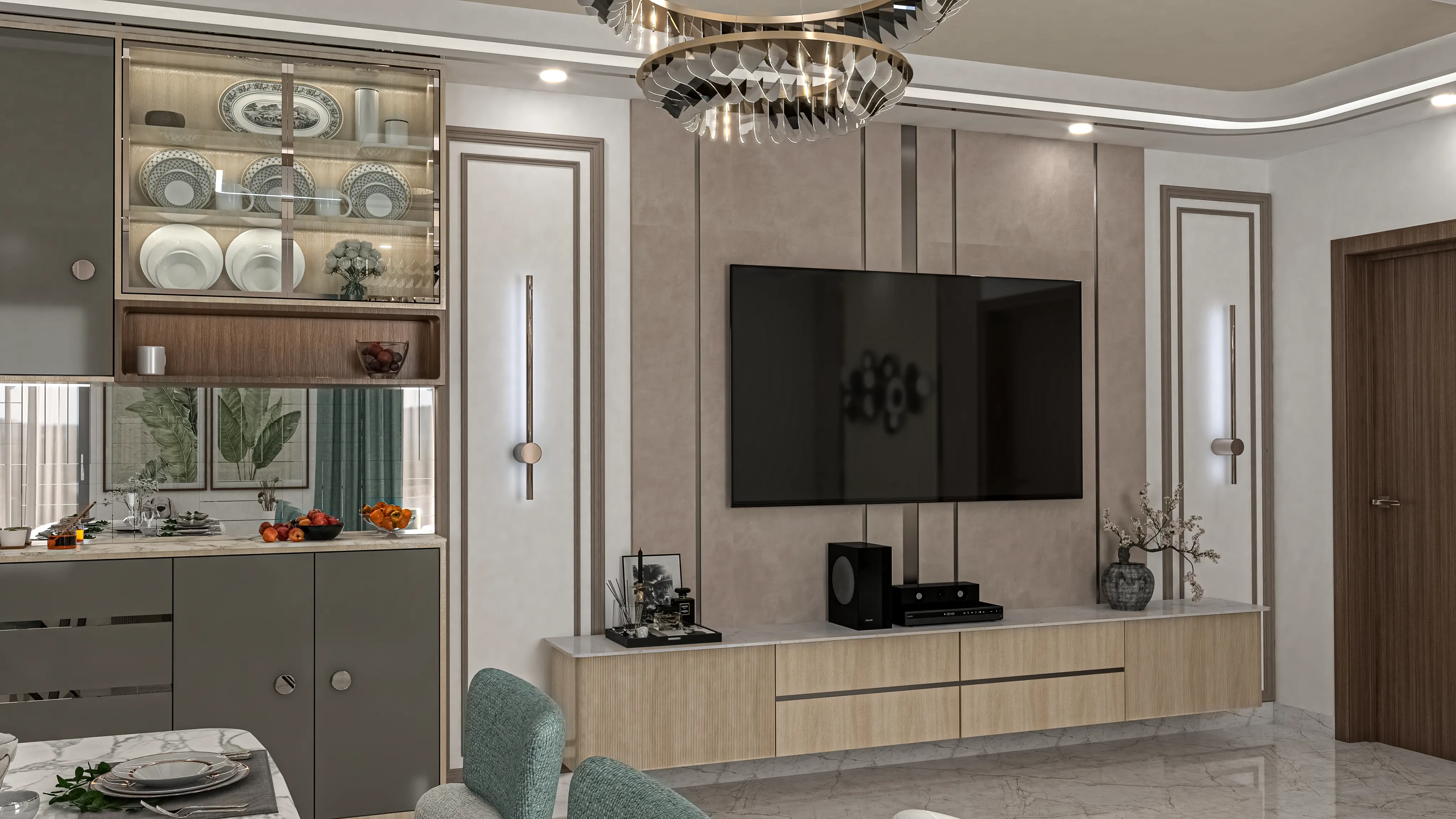
For clients building out a larger home library rather than a single study wall, we usually walk them through a 3D visualization of the ventilated back panel and air gap detail before fabrication even begins, since it is a hard thing to picture from a section drawing alone and clients want to see exactly how much of the wall stays visible behind the shelving, and our 3D visualization and rendering service is where that conversation usually happens before the carpentry order goes out. For rooms carrying a genuinely large book collection, we also recommend a small dehumidifier or, at minimum, silica gel sachets tucked into any fully enclosed cabinet sections below the open shelving, since even the best board and ventilation combination benefits from actively managing the air rather than relying on passive design alone during the peak humidity months.
A Pre-Fabrication Checklist Worth Running Through
Before finalizing a bookshelf or home library design for a Kolkata flat, we ask clients to work through the same short list every time, since it catches the majority of the humidity problems before they become a fabrication decision that is expensive to reverse later.
- Confirm the shelf is not flush-mounted against an exterior or bathroom-adjoining wall without an air gap
- Specify BWP or marine grade plywood for the carcass and back panel rather than MDF or particle board
- Confirm every cut edge, including hidden ones, has proper edge banding or sealant
- Lift the base off the floor by at least 3 to 4 inches on a plinth
- Plan for silica gel or a small dehumidifier in any fully enclosed cabinet sections
The Same Humidity Logic Applies Elsewhere in the House
The moisture pathway behind a bookshelf is really the same pathway that shows up in several other parts of a Kolkata home, and our broader piece on choosing materials for Kolkata's humidity covers that logic across flooring, wardrobes, and wall finishes rather than just shelving. On the exterior side of the same wall a study room sits against, the compound or boundary wall is fighting a related battle with repeated monsoon soaking, which we cover in choosing a boundary wall finish that survives Kolkata's monsoon, and if that same exterior wall happens to sit near an air conditioning unit, the ledge it rests on has its own frequently overlooked waterproofing detail, addressed separately in waterproofing and tile detail for an AC ledge niche. Storage areas lower down in the same building carry the identical risk in a different form too, which is why we also point clients toward fixing damp smell in stilt parking and basement storage when a bookshelf conversation expands into a wider storage and humidity walkthrough of the whole flat.
Planning a Study or Home Library That Will Actually Hold Up
If you are building a study wall or a dedicated home library anywhere in Kolkata and want the shelving specified so your books outlast the next several monsoons rather than developing that first faint musty smell within a year, walk us through the room's orientation and wall adjacencies through our contact page and we will work out the board grade, ventilation gap, and finish that actually fits your specific wall.