







Lime Plaster Finishes Enter Kolkata Homes in 2025 as the Anti-Paint Movement Grows
Somewhere around the middle of 2025 we noticed a pattern in our client consultations that we had not seen in the previous decade of practice, which was homeowners arriving at the first meeting already asking about lime plaster or clay plaster instead of the usual conversation about paint shades and accent walls, and by the time the year closed we had specified breathable mineral finishes on walls in six different projects across New Town and Salt Lake, a number that would have been zero in any year before it. We want to use this piece to walk through what actually changed, why lime and clay plaster behave so differently from emulsion paint in a city where the air itself carries moisture for half the calendar year, and where this finish genuinely earns its place versus where it is simply a trend people are chasing because they saw it in a European interiors feed.
Why Paint Has Always Been a Compromise in This Climate
Emulsion paint forms a plastic film over the wall surface, and that film is precisely the problem in Kolkata, because our humidity sits above 80 percent for roughly six months of the year and monsoon walls take on moisture from both the exterior render and, in ground floor and older constructions, from rising damp through the foundation. Paint traps that moisture behind its film rather than letting it pass through, so what happens next is familiar to anyone who has lived here for more than one monsoon cycle, which is bubbling, peeling, and the grey-green bloom of mold that reappears within a season or two no matter how many times you repaint over it. We have opened up water-damaged walls in older Salt Lake homes and found four or five layers of paint stacked on top of each other, each one applied because the previous coat had failed, and each one making the underlying moisture problem slightly worse because it sealed in dampness that had nowhere left to go.
Lime plaster and clay plaster work on the opposite principle, which is that they are vapour-permeable, meaning moisture that enters the wall from outside or from ambient humidity can migrate back out through the plaster surface rather than being trapped against a painted film. Lime has been used as a building material in Bengal for well over a century, visible in the older colonial-era structures around central Kolkata that have survived monsoons for decades with lime render intact, and what is happening now is really a rediscovery of a material our climate always suited, dressed in a more contemporary, hand-troweled aesthetic that fits current design sensibilities.
Lime Plaster Versus Clay Plaster, and Why We Do Not Treat Them as Interchangeable
Clients often use "lime plaster" and "clay plaster" as if they are the same product with different names, and we spend real time in the first site visit explaining that they behave differently and suit different rooms. Lime plaster, whether applied as a base coat lime render or a finer finishing coat, cures through carbonation, absorbing carbon dioxide from the air over several weeks as it hardens, and the result is a genuinely hard, mildly alkaline surface with natural antimicrobial properties, which is part of why it resists the mold growth that plagues painted walls here. We have specified lime plaster finishes in bathrooms and kitchen backsplash zones for exactly that reason, since the alkalinity of cured lime does not offer mold the same foothold that a painted gypsum surface does.
Clay plaster, by contrast, never fully hardens in the same chemical sense, staying a soft, earthen, breathable finish that regulates humidity by physically absorbing and releasing moisture vapour from the air in the room, which makes it exceptional in bedrooms and living spaces where you want the wall to soften Kolkata's humidity swings rather than resist water contact directly. It is not the right choice for a shower enclosure or a kitchen splash zone, where lime or a proper waterproof tile remains the sounder decision, and part of our job as designers is steering enthusiastic clients away from applying a trending finish somewhere it will not perform.
What This Looks Like on a Real Kolkata Wall
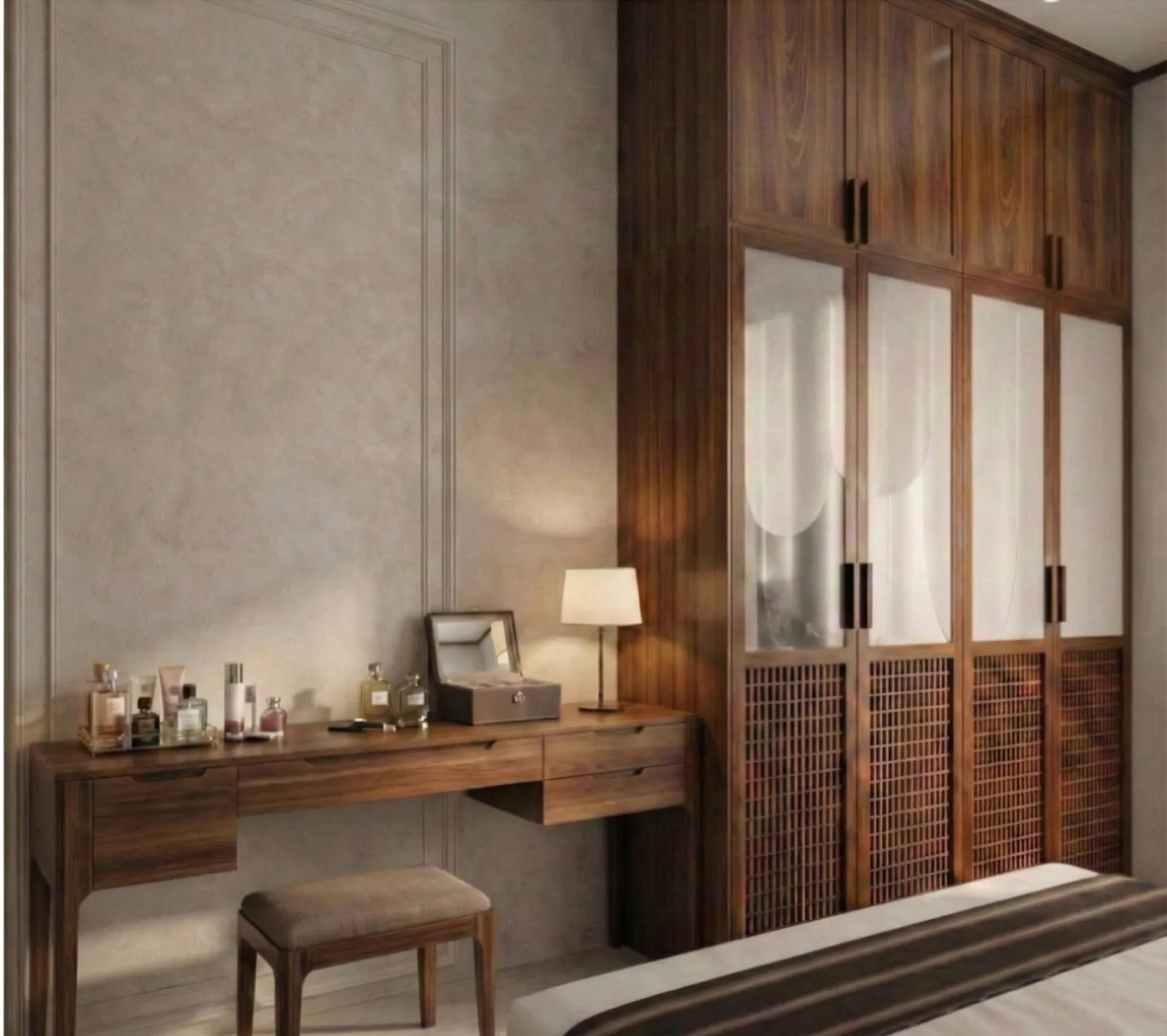
The finish itself is not the flat, uniform plane a roller produces. Applied lime plaster is hand-troweled in thin coats, typically two to three passes building up to somewhere between three and six millimetres of total thickness, and the trowel work leaves subtle variation across the surface, so light raking across the wall in the late afternoon, which is a quality of light we get generously in New Town apartments with west-facing balconies, catches on the slight undulations and gives the wall a depth that flat paint simply cannot produce. Clients who have chosen it for a living room accent wall in our recent projects have consistently commented on this, that the wall seems to change character across the day as the light angle shifts, something a painted wall never does.
Colour comes from the material itself rather than from a pigment layer sitting on top, which means lime plaster in its natural state reads as a warm, chalky off-white with faint variation, and where clients want colour we blend natural earth pigments into the mix rather than painting over the cured surface, preserving the breathability that is the entire point of choosing the finish in the first place. Clay plaster runs an even wider natural palette, from pale sand tones through to deeper ochres and warm greys depending on the clay source and any pigment blended in, and because it stays workable it can be refinished or patched far more easily than a fully cured lime wall if a client wants to adjust a section years later.
How This Differs From the Micro-Cement Trend
We get asked often enough whether lime and clay plaster are just another name for micro-cement, and the honest answer is that they sit at nearly opposite ends of the performance spectrum despite both being trowel-applied mineral finishes. Micro-cement is a cement-polymer composite, applied in very thin coats over a primed substrate, and it cures to a dense, largely non-porous surface that is prized precisely because it resists water and stains, which is why we specify it for bathroom floors, shower walls, and kitchen counters where genuine waterproofing matters more than breathability. Lime and clay plaster are doing the structurally opposite job, letting moisture pass through the wall rather than sealing it out, and that difference in vapour permeability is the whole reason the anti-paint conversation in 2025 centred on lime and clay specifically rather than on micro-cement, which had already been popular in Kolkata bathrooms for a couple of years before this newer trend emerged. If a client wants both aesthetics in one home, which is a request we have had more than once, the resolution is usually micro-cement in the wet zones and lime or clay plaster everywhere else, letting each material do the job it is actually suited for.
Cost, Maintenance, and Setting Expectations Early
We are direct with clients about cost, because lime and clay plaster are not budget finishes and we would rather someone walk into the decision with clear numbers than feel surprised at the estimate stage. Skilled hand application, the material cost of quality lime or clay plaster product, and the longer install timeline (curing between coats, unlike a same-day paint job) typically put these finishes at two to three times the cost per square foot of a good quality emulsion paint job, and that is before accounting for the fact that few contractors in Kolkata have genuine experience troweling these materials correctly, which narrows the pool of people we trust to execute it well. On the maintenance side the trade-off runs the other way, since a properly cured lime wall in a dry or semi-dry zone can go a decade or more without needing rework, versus repainting cycles of every three to four years that most Kolkata homes settle into with standard emulsion, so the lifetime cost gap narrows considerably once you look past the first year.
We have also found that clay plaster pairs unusually well with the softer, layered lighting approach many of our clients are already moving toward, and if you have read our piece on how Kolkata homeowners are replacing heavy false ceilings with cove lighting strips, the connection is direct: cove lighting grazes light along the ceiling line and upper wall in a way that flatters a textured plaster surface far more than it flatters flat paint, so the two trends have been showing up together in the same rooms more often than not this past year.
Where We Are Steering Clients in 2026
Heading into this year, our recommendation has settled into a fairly consistent pattern, which is lime plaster for bathroom accent walls and kitchen zones where some water resistance is useful alongside the breathability, clay plaster for bedroom feature walls and living rooms where humidity regulation and tactile warmth matter more than water contact, and a frank conversation about budget and contractor availability before either goes on the drawing. We are also finding that the request often surfaces alongside other changes to how a home is being reworked, the same clients rethinking wall finishes tend to be rethinking underused spaces too, which is part of why we still reference our study of utility balconies converted into sit-outs when a client is planning a fuller renovation rather than a single-room refresh, since the material and spatial questions tend to arrive together in a full home project. And for anyone starting from the very beginning of a home, deciding on wall finishes properly means having settled on entrance orientation and layout first, which is where our note on main door direction and what your building's entrance actually allows under Vastu becomes relevant before the plastering conversation even starts.
Considering a Breathable Wall Finish for Your Home
If your home has been through the familiar Kolkata cycle of repainting over damp patches every few monsoons and you are ready to try a wall that actually works with this climate instead of against it, we would be glad to walk your specific rooms with you and tell you honestly where lime plaster earns its cost and where a simpler finish will serve you just as well. Reach out through our contact page and we can start with a site visit to assess your walls' current moisture condition before recommending anything.