






Corian vs Quartz for a Kitchen Island Countertop
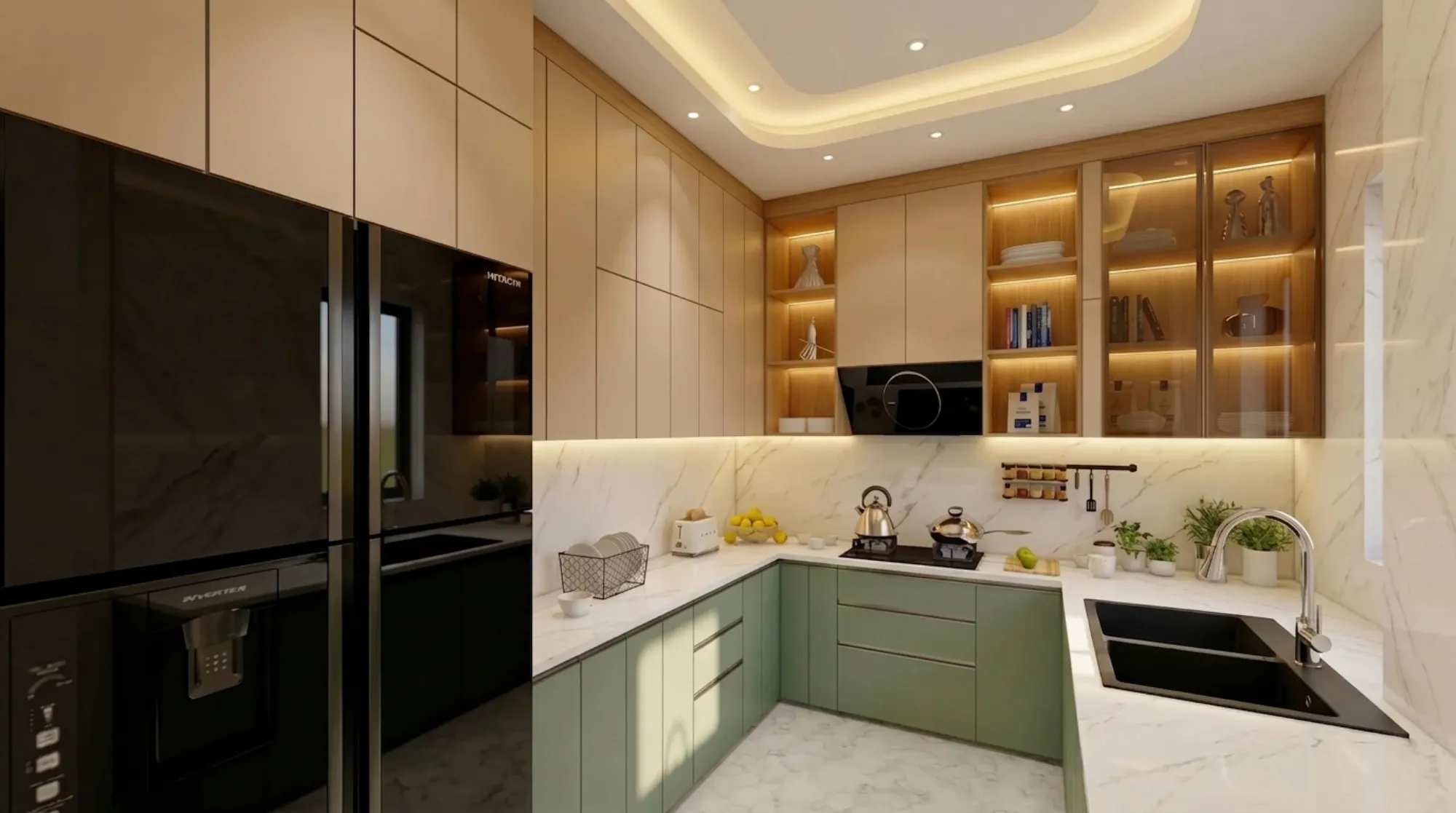
A kitchen island counter is not the same design problem as a regular counter run against a wall, because an island is viewed and touched from all four sides, it usually has a visible edge profile running its full perimeter, and in most of the Kolkata homes we design it doubles as a breakfast seating spot where hot vessels, hot cookware and hot cups of tea land on the surface daily, so when a client asks us whether Corian or quartz makes more sense for their island specifically, we treat it as a genuinely different question from the one we'd answer for a standard L-shaped kitchen counter. The two materials solve the seamless-joint and heat-exposure problems in very different ways, and getting this choice right on an island matters more than it does almost anywhere else in the kitchen.
Why the Island Changes the Material Question
On a wall-facing counter run, joints between slabs are common and mostly hidden against the backsplash or tucked at a corner where the eye does not linger. An island has no wall to hide a joint against, every seam is visible from at least one angle, and if the island includes a waterfall edge, where the countertop material wraps down the side panel to the floor in one continuous plane, any visible joint at that fold line reads as a flaw rather than a design feature. This is the single biggest reason the Corian versus quartz decision looks different for an island than it does for the rest of the kitchen.
How Corian Actually Achieves a Seamless Look
Corian, and other acrylic-based solid surface brands like it, is essentially a blend of acrylic resin and natural mineral fillers, poured and cured into sheets rather than quarried or engineered from stone aggregate. Its defining advantage is that seams between two Corian sheets can be thermally fused and then sanded down until the joint is genuinely invisible, not just hidden, because the material is homogeneous all the way through rather than a hard mineral surface with a resin binder holding it together. On an island with a waterfall edge or a curved profile, this means our fabricators can wrap the material around a corner or down a side panel with a join that simply does not show, even under close inspection or raking light, which is very difficult to achieve with quartz.
Corian is also warm to the touch, quieter when you set down a glass or a ceramic plate, and it can be routed, carved and inlaid into custom edge profiles, integrated drainboards or even a sink moulded from the same sheet, which is a genuinely useful option for an island that includes a secondary prep sink. The trade-off is that Corian is softer than engineered stone, meaning it scratches more easily under a knife dragged directly across it, and it is far less heat tolerant, a hot pan set directly onto Corian can scorch or discolour the surface within seconds, which is a real concern on an island where a pot often comes straight off the induction hob and gets set down nearby.
How Quartz Handles the Same Problems Differently
Engineered quartz is roughly 90 to 93 percent crushed natural quartz bound with polyester resin under high pressure, which makes it significantly harder than Corian and considerably more heat tolerant, generally rated to handle brief contact with cookware up to around 150 degrees Celsius without scorching, and resistant to scratching from everyday knife use in a way acrylic solid surface simply is not. For an island that gets heavy daily use as a landing spot for hot pots, kettles and serving dishes, quartz is the more forgiving material to live with day to day.
The seamless-joint problem, though, is where quartz genuinely struggles compared to Corian. Quartz slabs cannot be thermally fused the way Corian can, since the resin-bound mineral structure does not melt and reflow cleanly, so joints between quartz slabs are made with a colour-matched epoxy adhesive that, even in the hands of a skilled fabricator, remains faintly visible as a thin line under close inspection or angled light. For a straightforward island without a waterfall edge, a single well-matched slab can often cover the entire top with only one or two joins at the underside supports, which keeps the visible seam count low, but if your island design calls for a full waterfall edge wrapping down both ends, quartz will show a seam at that fold that Corian would not.

| Feature | Corian Solid Surface | Engineered Quartz |
|---|---|---|
| Seamless joins | Thermally fused, genuinely invisible | Epoxy-bonded, faintly visible under close light |
| Heat resistance | Scorches from direct hot cookware | Tolerates brief contact up to roughly 150°C |
| Scratch resistance | Softer, shows knife marks over time | Hard surface, resists everyday scratching |
| Waterfall edge result | Fully seamless wrap | Visible seam at the fold unless carefully mitred |
| Repairability | Sandable, scratches and burns can often be buffed out | Not repairable, damage usually means a slab replacement |
| Cost per sq ft (installed) | ₹250 to ₹450 | ₹350 to ₹650 |
What This Actually Costs on a Real Island
A typical kitchen island in the New Town and Salt Lake homes we work on runs somewhere between 18 and 28 square feet of top surface, larger if it includes a waterfall edge on one or both ends, which roughly doubles the material area since the side panels count too. On an 8 foot by 3 foot island with a single waterfall end, that works out to around 30 square feet of total surface, and at typical installed rates that lands between ₹7,500 and ₹13,500 for Corian and ₹10,500 and ₹19,500 for quartz, with the gap widening further if the design calls for a moulded Corian sink integrated into the same sheet or a particularly premium quartz pattern.
Which One We Actually Recommend, and When
If your island design includes a waterfall edge, a curved profile, or an integrated sink or drainboard moulded into the counter, we lean toward Corian almost every time, because the seamless result is simply not achievable with quartz in the same way, and the heat sensitivity can be managed with a designated trivet zone or a small inset heat-resistant panel near the hob side. If your island is primarily a flat rectangular prep and dining surface without a waterfall detail, and the household cooks heavily with pots going straight from stove to counter, we generally steer clients toward quartz, since the hardness and heat tolerance matter more day to day than a seam that most guests will never notice unless they are looking for it. For households genuinely torn between the two, a useful middle path we have used is quartz for the main working section near the hob and Corian for a waterfall end used mainly for seating, which lets each material do the job it handles best.
- Decide early whether the island will have a waterfall edge, since that alone tips the decision toward Corian
- Confirm where the induction hob or gas stove sits relative to the island and whether hot cookware will regularly land on it
- Ask your fabricator to show a sample joint in person rather than relying on a brochure claim of invisibility
- Check the warranty terms, most quartz brands offer 10 to 15 years against most Corian solid surface warranties of similar length
- Discuss a mixed-material approach if your household's cooking and seating needs genuinely pull in different directions
- 01Confirm island dimensions and waterfall requirement
- 02Select material and slab or sheet pattern
- 03Template the exact island shape on site
- 04Fabricate and polish edges and joints
- 05Install and seal the finished countertop
Getting the Island Right for How You Actually Cook and Live
An island countertop gets more daily contact, more visual attention and more conflicting demands than almost any other surface in the kitchen, so it is worth working through your specific layout, your waterfall plans and your household's cooking habits before locking in a material. For related decisions elsewhere in a Kolkata bathroom or ceiling, our piece on PVC Ceiling Panels vs Gypsum False Ceiling for a Kolkata Bathroom covers a similar material trade-off logic, and if your TV unit or feature wall is next on your list, Fluted MDF vs Fluted PVC Panels for a Living Room TV Unit walks through that comparison in the same detail. If you are still finalising where the island itself sits within the kitchen footprint, our broader space planning piece for a 1300 Sq Ft 3BHK Flat in Baguiati shows how island placement interacts with the rest of an open kitchen layout, and our dedicated guide to kitchen island layouts for Kolkata flats goes deeper into shape and clearance planning specifically. If you would like us to look at your kitchen's exact dimensions and tell you plainly which material fits your island and how you cook, get in touch with Studio Contour and we will take it from there.