






Cove Lighting vs Profile Lighting for Your False Ceiling Step
Almost every client who comes to us with a false ceiling brief eventually asks the same practical question once the drawings reach the lighting stage, whether the step or drop in the ceiling should carry a recessed cove channel that hides the LED strip entirely from view, or an aluminium profile light fixed along the step's edge where the fixture itself remains partly visible as a clean linear element. Both approaches light the same false ceiling step, both use a continuous LED strip as the light source, and both can look genuinely good in the right room, but they differ enough in how they are built, how they spread light, and what they cost to install that we think the choice deserves more attention than most homeowners give it before signing off on their electrical drawing.
What a Cove Channel Actually Is and How It Is Built
Cove lighting, in the way we detail it, is a recessed channel built directly into the gypsum board framing of the false ceiling step, typically two to three inches deep and four to six inches wide, positioned so that the LED strip sits fully hidden inside the pocket and the light it throws bounces off the ceiling and wall surfaces around it rather than shining directly at the eye. Because the channel is framed in as part of the ceiling's structure rather than added afterward, it has to be planned before the gypsum board goes up, which means the ceiling contractor and the electrician need to coordinate on the exact channel dimensions, the strip's power draw, and where the driver box will sit, usually tucked above the ceiling on a nearby accessible tier. Done well, a cove channel disappears completely from view during the day, and at night it reads as pure light rather than a visible fixture, which is the specific effect most clients are chasing when they ask for this look.
What Profile Lighting Is and Why It Installs Differently
Profile lighting uses a pre-manufactured aluminium extrusion, usually with a frosted or opal diffuser snapped into its face, that is surface-mounted or recessed into a shallow groove along the edge of the ceiling step rather than built into a deep hidden pocket. The LED strip sits inside the aluminium channel, which serves two purposes at once, it diffuses the strip's individual LED points into an even line of light rather than a series of visible dots, and it also acts as a heat sink that helps the strip run cooler and last longer than a bare strip stuck directly onto gypsum board. Because the profile is a finished, factory-made component rather than a framed recess, installation is generally faster and more forgiving of small errors in the ceiling step's dimensions, since the profile can be trimmed to length and fixed with screws or adhesive without needing the same precision the gypsum framing for a cove channel demands.
| Feature | Cove Lighting | Profile Lighting |
|---|---|---|
| Visibility of fixture | Fully hidden, indirect wash only | Visible linear fixture, defined edge of light |
| Installation sequence | Must be framed before board goes up | Fixed after ceiling step is finished |
| Typical install time | 1 to 2 extra days for framing coordination | Half a day to a day once ceiling is ready |
| Light spread | Soft, diffused, fills room ambient light | Crisper defined line, better for accent and task use |
| Cost per running ft | ₹110 to ₹180 | ₹90 to ₹150 |
| Heat management | Relies on ceiling void airflow | Aluminium body acts as heat sink |
Light Spread: Where the Real Difference Shows Up After Dark
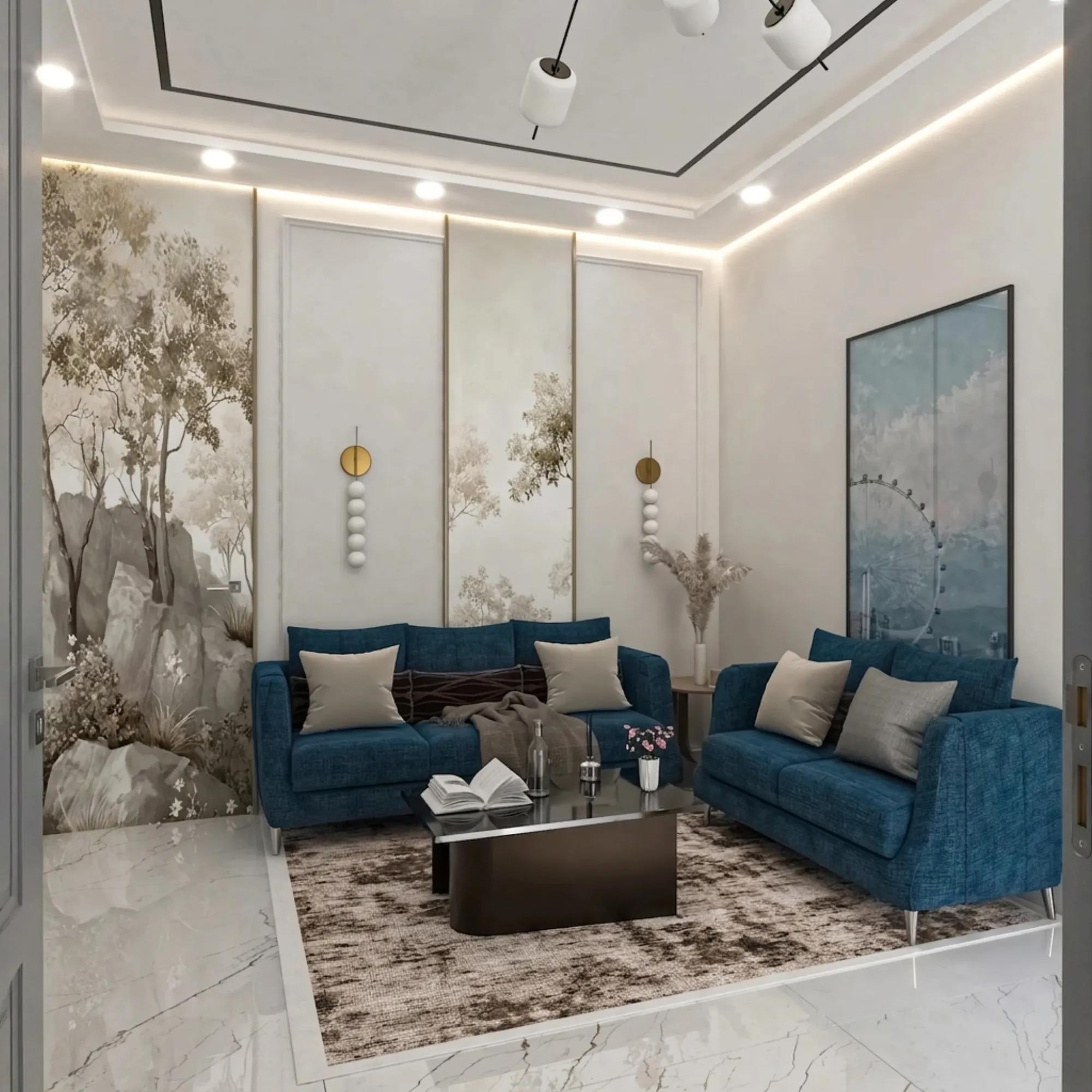
The most meaningful difference between the two, once you get past construction detail, is how the light actually behaves in a finished room after the sun goes down. A cove channel throws light indirectly, meaning you never see the LED strip itself, only the soft glow it casts onto the ceiling plane and the upper wall, and in a living room this reads as a gentle ambient wash that raises the overall light level in the room without creating any single bright line to draw the eye. We have found this effect particularly good in Kolkata living rooms that already have generous natural light through the day, since a cove-lit ceiling extends that same soft, even quality into the evening rather than replacing it with a harsher, more directional source. Profile lighting, by contrast, produces a visible line of light with a defined edge, which reads as more architectural and more deliberate as a design statement, and works especially well when the ceiling step itself is meant to be seen as a feature rather than disappear into the room.
Installation Complexity and What It Means for Your Timeline
Because a cove channel has to be built into the gypsum framing before the board goes up, any change of heart after that stage, say deciding the channel needs to be deeper or wider once the client sees a mockup, means reopening finished ceiling work, which is expensive and disruptive compared to correcting a profile light fixture that has not yet been installed. We generally ask clients to confirm their cove channel dimensions and LED strip specification at the drawing stage, before framing begins, precisely because retrofitting a cove after the ceiling is closed up is one of the more painful and avoidable corrections we see on site. Profile lighting is considerably more forgiving here, since the profile itself is a finished component that gets fixed once the ceiling step is complete, so a change in fixture choice or even a swap to a different profile width rarely requires touching the gypsum work at all.
- Confirm cove channel depth and width before gypsum framing begins
- Specify LED strip CRI (color rendering index) of 80 or higher for accurate colour rendering
- Ask whether the driver box location is accessible for future maintenance
- Decide on warm white, cool white, or tunable colour temperature before wiring is finalised
- Check that profile light aluminium body is rated for the strip's wattage without overheating
Cost Comparison for a Standard Living Room Ceiling Step
For a typical New Town or Salt Lake living room with a perimeter ceiling step running roughly 45 to 60 running feet, the two approaches land close enough in raw material cost that the deciding factor is usually less about money and more about the look and the installation timeline a client is willing to accept.
| Perimeter Length | Cove Lighting Cost | Profile Lighting Cost |
|---|---|---|
| 40 running ft | ₹4,400 to ₹7,200 | ₹3,600 to ₹6,000 |
| 50 running ft | ₹5,500 to ₹9,000 | ₹4,500 to ₹7,500 |
| 60 running ft | ₹6,600 to ₹10,800 | ₹5,400 to ₹9,000 |
These figures cover the LED strip, driver, and the channel or profile itself, but they do not include the additional gypsum board framing labour that a cove channel requires, which typically adds a separate ₹15 to ₹25 per running foot to the ceiling contractor's bill regardless of which lighting approach you choose.
Where We Recommend Each One
For a primary living room where the ceiling is meant to feel calm and the light should raise the whole room's ambience without drawing attention to itself, we lean toward a cove channel, particularly in homes where the client has already committed to a largely flat, minimal ceiling design rather than a heavier multi-tier one. For a dining area, a study nook, or any ceiling step where the client wants the lighting itself to read as a visible architectural line, especially in more contemporary interiors with exposed materials and clean edges, profile lighting tends to suit the brief better and installs with fewer coordination headaches along the way. We covered a closely related shift in ceiling philosophy in our piece on how Kolkata moved from heavy multi-tier ceilings to flat cove-lit ones in 2025, which is worth reading if you are still deciding how ambitious your ceiling step design should be in the first place.
Pairing Your Ceiling Choice With the Rest of the Room
A ceiling lighting decision rarely stands alone, and once you have settled on cove or profile lighting for the step, the wall finishes and flooring below tend to shape how that light actually reads in the finished room. If your living room also has a television feature wall in the plan, our comparison of fluted MDF against fluted PVC panels for that wall is worth reading alongside this one, since both a cove wash and a profile line interact differently with a fluted, grooved surface below them. And if you are planning ceiling and lighting decisions for a full independent house rather than a single flat, our room-by-room layout guide for a 2400 sq ft independent house in New Town covers how these choices should vary from a formal living room to a more casual family room within the same home. Independent house clients working through an interior ceiling brief with us are also, quite often, deciding on their rooftop terrace in the same renovation cycle, and our comparison of wooden deck tiles against stone tiles for a terrace facing Kolkata's monsoon is worth reading if that decision is still open on your plate as well.
Let Us Walk Your Ceiling Step With You
Whether a cove channel or a profile light suits your ceiling step better depends on your room's proportions, your slab height, and how much the lighting itself is meant to stand out versus disappear, and that is a much easier conversation to have standing under your actual ceiling than over a phone call. Get in touch through our contact page and we can look at your ceiling drawing together and tell you plainly which approach fits your room.