






HDHMR vs BWP Plywood for a Wet-Area Kitchen Cabinet in Kolkata
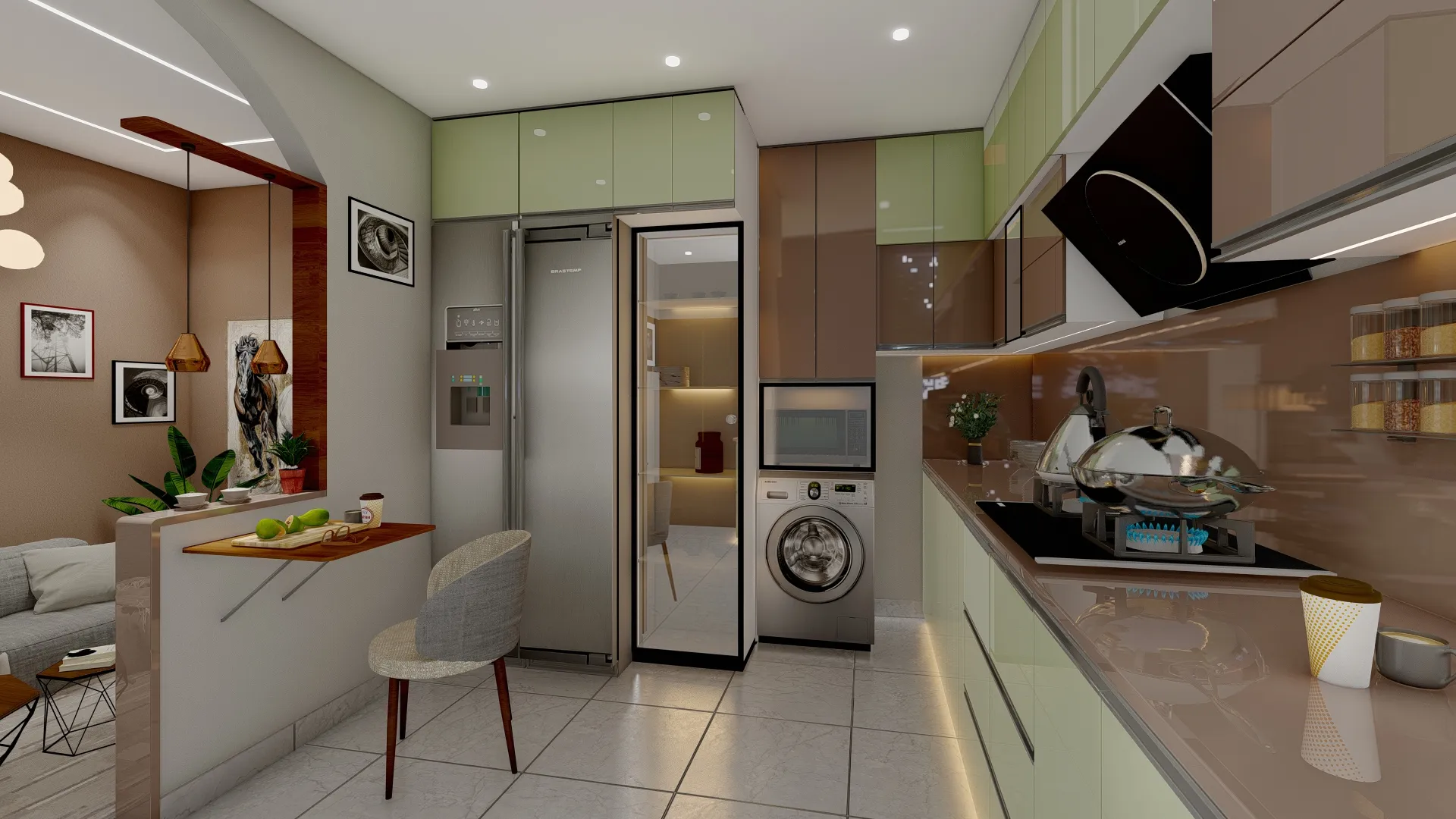
The question we hear most specifically, almost word for word, from clients finalizing a modular kitchen with us is what board to use for the cabinet directly under the sink and the two or three units flanking it, because that narrow strip of cabinetry takes a different beating than the rest of the kitchen entirely, standing water from a leaking trap, condensation dripping off cold pipes, splash from washing vegetables, and general dampness that never fully dries between uses, and the honest answer requires comparing HDHMR board against BWP-grade plywood specifically for that wet zone rather than treating the whole kitchen carcass as one uniform material decision, which is the mistake we see most often in DIY-specified kitchens across New Town and Salt Lake.
Why the Under-Sink Cabinet Is a Different Problem From the Rest of the Kitchen
Most of a modular kitchen carcass, the tall units, the wall cabinets, the drawer banks away from the sink, deals with ambient kitchen humidity and occasional splash, which any reasonably moisture-resistant board handles adequately over its life. The under-sink unit and its immediate neighbors are a different category of exposure entirely, because they sit directly beneath a plumbing connection that will eventually develop a slow drip even in a well-maintained kitchen, and unlike a splash that gets wiped up within minutes, a slow leak under a sink can go unnoticed for days or weeks, sitting as standing water against the cabinet base and lower side panels. We have opened up under-sink cabinets in Kolkata kitchens barely three years old where the base panel had swollen to nearly double its original thickness and delaminated into visible layers, purely from this kind of low-grade, unnoticed leak sitting against a board that was never rated to handle sustained water contact.
BWP Plywood: What the Grade Actually Certifies
BWP stands for Boiling Water Proof, and it is a specific designation under the IS 710 Indian Standard, which means a board carrying a genuine BWP certification has been tested by boiling samples in water for a defined period and checking that the phenol-formaldehyde adhesive bond between plies does not fail or delaminate. This is meaningfully different from the more commonly seen MR, or Moisture Resistant, grade, which uses a different adhesive formulation that resists occasional dampness but is not designed for sustained or standing water contact, the exact condition an under-sink cabinet eventually experiences. Genuine BWP plywood, made from cross-laminated wood veneers bonded with phenolic resin, can sit in direct water exposure for extended periods without the plies separating, which is why we specify it as the non-negotiable minimum for the under-sink carcass on every kitchen we design, regardless of what board grade the rest of the kitchen uses. The one caution we give every client is that BWP labeling in the local Kolkata plywood market is inconsistently enforced, and boards sold as BWP without a genuine IS 710 mark sometimes fail to perform as advertised, so we buy only from suppliers who can show the certification mark on the board itself, not just on the invoice.
HDHMR Board: A Newer Option With a Different Trade-Off Profile
HDHMR, High Density High Moisture Resistance board, is a more recently popular engineered wood product, manufactured by compressing wood fibers under high density with a moisture-resistant resin binder rather than laminating wood veneer plies the way plywood does. The result is a board with a smoother, more uniform surface than plywood, which takes paint and certain laminate finishes more cleanly, and genuine moisture resistance that is a significant step above standard MDF, along with better termite resistance since there are no natural wood grain channels for termites to exploit the way there sometimes are in lower grade plywood. Where HDHMR earns real consideration for the under-sink zone specifically is edge and cut-face performance, since a well-manufactured HDHMR board resists moisture ingress at a cut edge more consistently than mid-grade plywood does, because the fiber structure is uniform throughout rather than layered, so there is no ply seam for water to work its way into. The trade-off is that HDHMR, while moisture resistant, is not rated for the same sustained standing-water exposure that certified BWP plywood is, and structurally it does not hold screws quite as securely as plywood over the very long term in a carcass that sees repeated opening and closing, which matters for the hinges and drawer channel mounting points on a heavily used sink cabinet.
| BWP Plywood (IS 710) | HDHMR Board |
|---|---|
| Genuinely rated for standing water and sustained moisture | Strong moisture resistance but not rated for standing water |
| Layered veneer structure with visible ply lines at cut edges | Smooth, uniform surface ideal for paint and certain laminates |
| Superior screw and hinge holding strength long term | Good but marginally lower long term screw holding |
| Higher weight, harder for termites to penetrate | Lighter, genuinely termite resistant |
| Our default recommendation for the under-sink carcass | Strong second choice or complement for adjoining shutter panels |
What We Actually Specify for a Kolkata Wet-Zone Cabinet
In practice, we do not treat this as an either-or decision for most kitchens, we specify BWP 710-grade plywood for the carcass, the base, back, and side panels of the under-sink unit and its immediate neighbors, because that is the component in direct and sustained contact risk, and we often use HDHMR for the shutter panels and visible drawer fronts across the wider kitchen where its smoother, paintable surface gives a cleaner finish and the moisture exposure is lower splash rather than standing water. This combination gives clients the structural water resistance where it genuinely matters most while taking advantage of HDHMR's better finish quality and lower cost where the moisture risk is lower. For the base of the sink cabinet specifically, we also insist on a raised plinth of at least 15 to 20mm so the carcass itself never sits in direct contact with the cabinet floor even if a leak does pool briefly, which is a detail that costs almost nothing to specify but meaningfully extends the life of whichever board grade is used above it.
| Location in Kitchen | Recommended Board | Why | |
|---|---|---|---|
| Under-sink carcass and base | BWP 710-grade plywood | Genuinely rated for standing water exposure | |
| Sink cabinet shutters | HDHMR or BWP with laminate | Smooth finish | good moisture resistance |
| Tall unit and dry storage carcass | MR-grade plywood or HDHMR | Adequate for ambient humidity only | |
| Wall cabinets away from sink | MR-grade plywood | Lower moisture exposure | cost efficient |
Cost Difference Between the Two Grades
BWP 710 plywood typically costs 15 to 25% more than MR-grade plywood of the same thickness, and roughly comparable to or slightly above a good quality HDHMR board depending on the brand and thickness specified, so the cost gap between using BWP versus HDHMR specifically for the sink cabinet carcass is usually modest in absolute rupee terms, often just a few thousand rupees across the one or two units that actually need it. This is exactly why we push back when a client wants to save money by using MR-grade plywood or standard HDHMR under the sink to match the rest of a budget kitchen, because the saving is small and the downside, a swollen and delaminating carcass within two to three years, is expensive and disruptive to fix once cabinetry, countertop, and often tiling have to be partially dismantled to replace it.
- Confirm BWP 710 certification mark is visible on the board, not just quoted on paper
- Specify a raised plinth of 15 to 20mm under the sink cabinet base
- Use BWP for carcass, base, and back panels of the sink unit specifically
- HDHMR is acceptable for shutters and drawer fronts across the wider kitchen
- Seal all cut edges of any board used near the sink with edge banding or PU sealant
- Ask your fabricator to identify the plumbing inlet point before finalizing the cabinet layout
Getting This Right at the Drawing Stage
We flag the board specification for wet zones at the very first kitchen design meeting, before layout or finish selection even begins, because retrofitting the right board grade after a kitchen is installed means tearing out cabinetry that may otherwise be perfectly fine, and this is the same underlying humidity logic that governs a lot of other Kolkata-specific material decisions, which is why our comparison of engineered wood against solid wood flooring for Kolkata's humidity covers very similar swelling and delamination risk one room over from the kitchen. If your kitchen sits on an exterior wall that also carries a balcony door facing the monsoon directly, our piece on UPVC versus aluminium windows for Kolkata's monsoon-facing balconies covers the water intrusion risk at that adjoining opening. And for clients still working out how a kitchen fits into a compact footprint, our guide to planning an 800 sq ft duplex in Kolkata without wasting the staircase touches on kitchen placement decisions at the layout stage, before board specification even comes into play. If your plot happens to sit within New Town's development jurisdiction, it is also worth knowing which Action Area governs it, which our post on Action Area I versus II versus III building rules breaks down separately.
Ask Us to Specify Your Kitchen's Wet Zone Correctly
If you are finalizing a modular kitchen anywhere in New Town, Salt Lake, Rajarhat, or greater Kolkata and want the under-sink cabinet specified so it actually survives daily use rather than needing repair in three years, send us your kitchen layout through our contact page and we will mark out exactly which units need BWP, which can use HDHMR, and what that specification will cost before your fabricator quotes a single rupee.