






Terrazzo Moves to the Countertop: Kolkata Kitchens' 2026 Material Shift
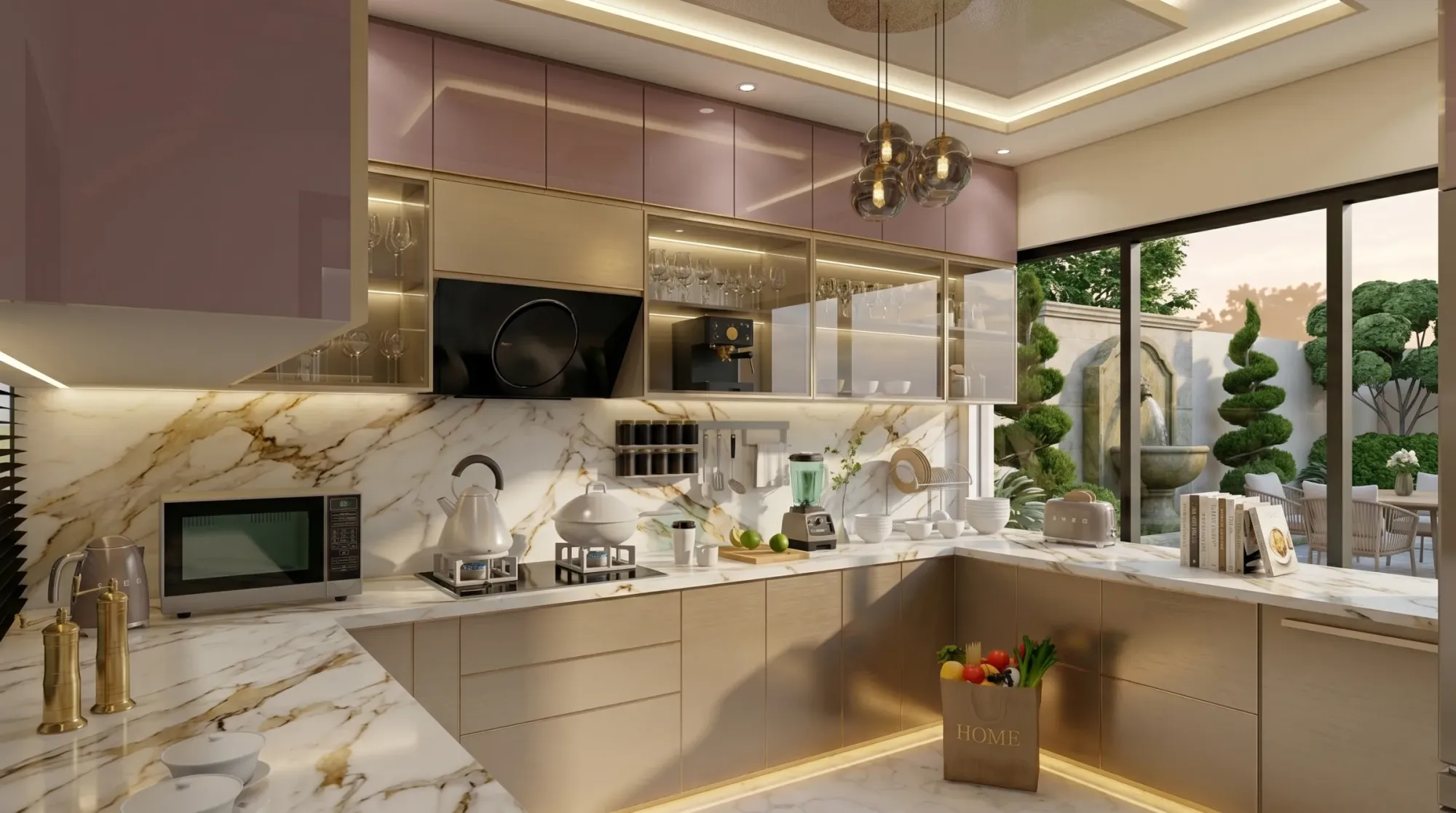
We spent a good part of 2023 and 2024 specifying terrazzo flooring for clients across New Town and Salt Lake who wanted something with more personality than plain vitrified tile and less cost volatility than imported natural stone, and that flooring trend has been well covered elsewhere, including in plenty of design press. What we have not seen written about yet, and what has genuinely surprised us inside our own studio over the past several months, is that terrazzo has now climbed off the floor and onto the kitchen counter, and by early 2026 it has become one of the two or three most requested countertop materials in our new kitchen briefs, sitting alongside and in a growing number of cases ahead of the granite and engineered quartz that dominated almost every kitchen quote we wrote between 2016 and 2024.
This is worth taking seriously as a distinct shift rather than folding it into the general terrazzo-is-trendy conversation, because a floor and a countertop are entirely different performance problems. A floor does not touch hot pans, does not get cut on, and does not need to resist turmeric and oil staining at close range every single day. A countertop does all three, and the fact that terrazzo is now holding up to that scrutiny in real Kolkata kitchens, and that clients are choosing it with open eyes about the trade-offs, tells us this is a genuine material shift rather than a look borrowed from Pinterest without thinking through the daily use case.
Why Granite and Quartz Demand Has Softened
To understand why terrazzo found an opening, it helps to look at what was happening with the two materials it is displacing. Indian granite, in shades like Black Galaxy, Tan Brown, and Steel Grey, has been the default recommendation for most budget and mid-range Kolkata kitchens for well over a decade, typically running 80 to 180 rupees per square foot installed, reliable, heat resistant, and easy to source a matching replacement slab for if something cracks. Engineered quartz sits above it, usually 180 to 400 rupees per square foot installed, prized for its non-porous surface and consistent Calacatta or Statuario patterning in premium kitchens. Both are still perfectly good materials and we still specify both regularly. What has changed is that a growing number of our clients, particularly those who have already lived through one kitchen renovation cycle and are now doing a second flat or a resale renovation, have started telling us they find granite's heavy speckled patterning visually dated next to the pared-back, warmer material palettes now common in living and dining spaces, and that quartz, while practical, reads as a little cold and showroom-uniform when every surface in the kitchen is the same flat, unvarying pattern. Terrazzo answered both complaints at once: it has visible texture and personality without granite's busy speckle, and because each slab or poured section is genuinely unique, it does not carry quartz's slightly manufactured uniformity.
There is also a cost angle that matters more in 2026 than it might have three years ago. Natural stone prices, particularly for imported quartz slabs, have seen enough volatility in the Kolkata supply chain over the past two years that several of our vendors have quoted price ranges rather than fixed numbers during the sourcing stage, which makes budgeting harder for clients. Terrazzo, especially the cement-based and increasingly the precast composite terrazzo now available through Kolkata and Howrah fabricators, has held a more stable price position, generally landing in the 150 to 350 rupees per square foot installed range depending on chip size, binder type, and finish, which puts it in direct competition with quartz on cost while offering the differentiated look clients are now actively seeking out.
What Terrazzo Countertops Actually Look Like in Our 2026 Projects
The terrazzo we are specifying for countertops is meaningfully different from the terrazzo flooring we were doing in 2023 and 2024, and getting this distinction right has been a real part of our design process this year. Floor terrazzo can use larger, coarser marble or granite chips and a thicker, more porous cement matrix because it is not fighting oil splatter and knife contact at close range. Countertop terrazzo needs a tighter, more consistent chip size, usually in the 4 to 10 millimetre range rather than the larger decorative chips common on floors, and critically it needs a properly sealed, low-porosity finish, because an unsealed or poorly sealed terrazzo counter will absorb oil and turmeric stains within weeks in a kitchen that cooks Bengali food daily, something we are very direct with clients about before they commit.
The colour and chip combinations we have been specifying most in early 2026 lean toward warm, muted palettes rather than the stark white-and-black terrazzo most people picture. A soft ivory or warm grey cement base with cream, rust, and small brass-toned chip inclusions has been our most requested combination, partly because it sits beautifully against the sage green and butter yellow cabinet finishes that took over so many of our kitchen briefs through 2025, a shift we detail in our piece on the pastel cabinet colour trend. A terrazzo counter with warm-toned chips against a sage green base cabinet reads as coordinated and considered in a way that a stark white quartz counter against the same green cabinet sometimes does not, and several clients who came to us already having chosen their cabinet colour told us the terrazzo counter decision followed directly from wanting a material that would complement rather than compete with that palette.
We have also started seeing terrazzo requested for bathroom countertops in the same projects, usually as a matching or complementary material to the kitchen, which extends the material story through the home rather than confining it to one room. A 3.5 foot vanity counter in terrazzo runs a similar per-square-foot cost to the kitchen application, and because bathroom counters see less direct heat and oil exposure than kitchen counters, the sealing and maintenance demands are genuinely lower, which makes it, if anything, an easier first application for clients who want to test the material before committing a full kitchen run to it.
The Maintenance Conversation We Have With Every Terrazzo Client
We do not let a client choose a terrazzo countertop without a direct conversation about what living with it actually involves, because this is where the material can go wrong if expectations are not set correctly at the outset. A properly sealed terrazzo counter needs re-sealing roughly once every twelve to eighteen months in a Kolkata kitchen's humidity and cooking conditions, more frequently than a quartz counter which is engineered to never need sealing at all, and less frequently than an unsealed natural stone would demand. We specify a penetrating sealer rather than a topical coating wherever possible, because a topical seal can show wear patterns and require a full re-strip and reapplication if it degrades unevenly, while a penetrating sealer ages more gracefully and can be topped up without stripping the whole surface. We also tell clients directly that a hot pan straight off the stove should still go on a trivet, not because terrazzo cannot handle heat in the way laminate cannot, but because thermal shock over years can, in rare cases, create hairline stress lines in the cement matrix around chip edges, and a trivet habit costs nothing and avoids the issue entirely.
For clients weighing this decision against other space and material choices happening in the same renovation, such as whether a compact kitchen needs a dedicated pooja alcove or an integrated one, which is a related space-planning question we cover in our piece on the shift toward integrated pooja alcoves, we generally recommend finalizing the countertop material early, because the sink cutout, edge profile, and backsplash detailing all need to be planned around the terrazzo slab's specific characteristics rather than retrofitted afterward.
Fabrication and Lead Times in the Kolkata Market
One honest caveat worth stating plainly is that terrazzo countertop fabrication is a less mature supply chain in Kolkata than granite or quartz, simply because fewer local fabricators have historically poured or cut terrazzo specifically for kitchen counter applications compared to the well-established granite and quartz slab yards along the city's stone trade corridors. In practice this means lead times for a custom-poured or precast terrazzo counter currently run closer to three to four weeks from template to installation, against roughly ten to fourteen days for a quartz slab from an established yard, and we build this extra time into project schedules from the outset so it does not become a surprise late in the renovation. We expect this gap to narrow over 2026 and beyond as more fabricators in the Kolkata and Howrah belt build out dedicated terrazzo counter capacity in response to exactly the demand shift we are describing here, but for now it remains a real planning factor rather than a minor footnote.
Considering Terrazzo for Your Own Kitchen or Bathroom Counter
If the idea of a warm, textured, genuinely one-of-a-kind counter is pulling you away from the granite or quartz slab you assumed you would default to, we would rather walk you through exactly what that decision involves for your specific kitchen, including sealing commitments and realistic lead times, before you commit to it. Reach out through our contact page and we can talk through whether terrazzo is the right material for the counter you are about to live with for the next decade.