






Kitchen Design for New Town Service Apartments and Rental Units
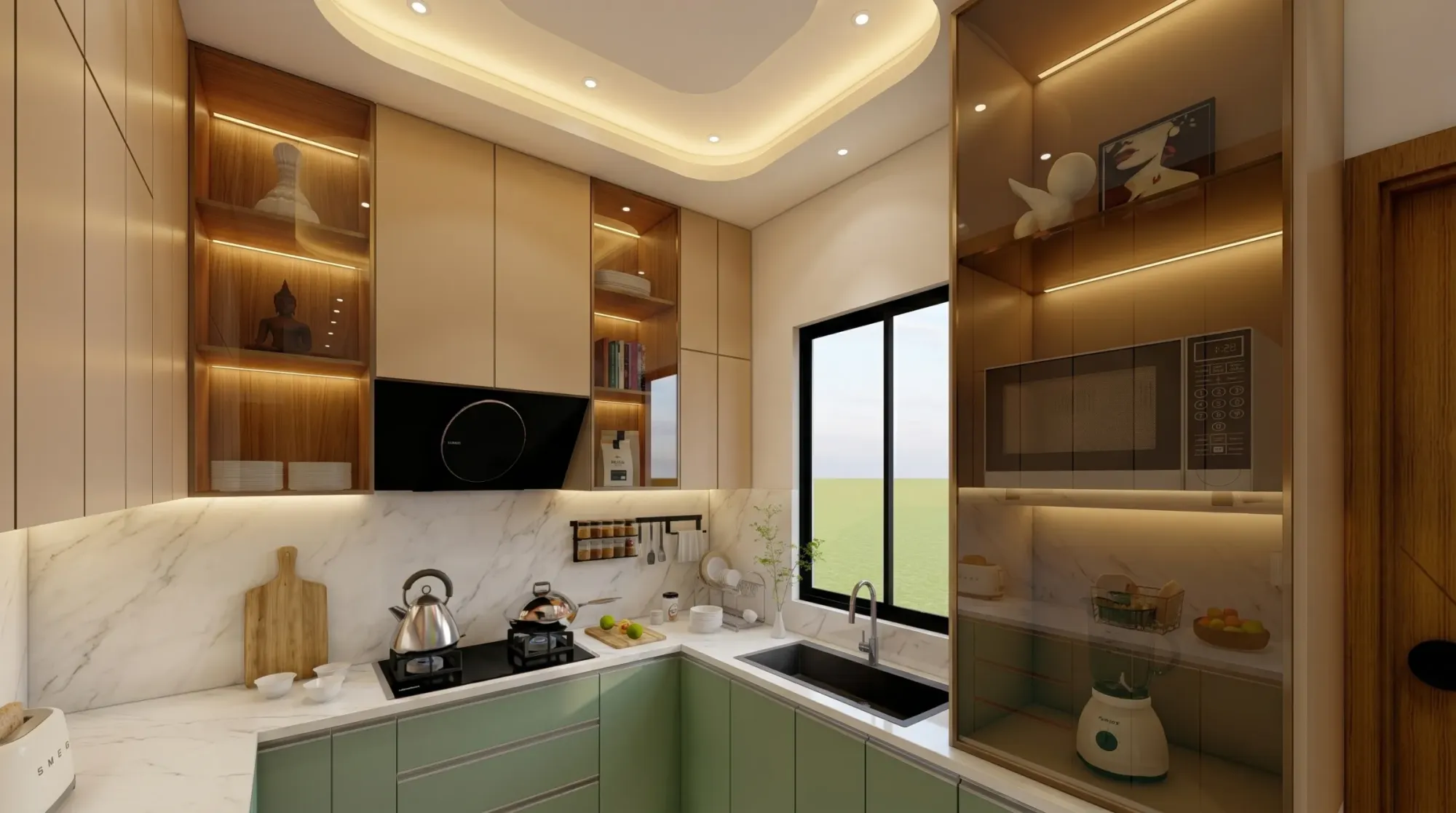
If you own a service apartment or a rental unit anywhere between Action Area I and Action Area III, you already know the kitchen is where a tenant forms their opinion of the whole flat within the first ninety seconds of walking in, and it's also the room that takes the worst beating over a two or three year tenancy cycle. We've fitted kitchens for landlords leasing to IT professionals on short corporate postings near Sector V, for owners running short-stay units close to Eco Park, and for families who bought a second flat purely as a rental asset in the newer blocks off Major Arterial Road, and the brief is never quite what you'd get designing a kitchen for your own home.
A kitchen you live in for fifteen years can absorb a few design compromises because you'll fix them eventually, on your own time, in your own way. A kitchen that turns over tenants every eleven to eighteen months, or hosts a different set of guests every four nights, has no such luxury, right, because every scratch, every loose hinge, every water stain under the sink turns into a maintenance call at 9pm on a Sunday, and every one of those calls costs you money whether it's your own time or a technician's callout fee. So this piece is about what actually holds up in New Town's climate and rental economics specifically, not the generic kitchen inspiration you'll find on any interiors blog.
We've delivered 330+ buildings across New Town and Salt Lake since we started in 2014, and a meaningful chunk of that work has been for landlords, property managers, and owners of multi-unit rental buildings who needed kitchens that could take punishment from strangers and still look presentable to the next prospective tenant. Below is what we've learned works, what doesn't, and how to think about the budget so you're not overspending on finishes that won't survive a tenant anyway.
Why a rental kitchen needs a different brief than a family kitchen
The first mistake we see owners make is hiring the same aesthetic sensibility they'd use for their own residence and applying it to a rental unit, which usually means soft-close hinges that a careless tenant will still slam until they fail, open shelving that looks lovely in a showroom and collects grease and dust within three months of nobody dusting it, and light-coloured stone counters that show every turmeric stain a subletting tenant leaves behind. A rental kitchen brief should start from the opposite direction: what is the worst-case daily use this room will see, and what materials and layout survive that without needing your intervention every few weeks.
That means thinking about durability first and aesthetics second, though the two aren't actually in conflict as often as people assume. A well-specified modular kitchen design using the right base materials looks good and holds up, it's really about which grade of material and hardware you pick within the modular system, not about abandoning good design for something that looks institutional. We generally push rental clients toward engineered stone counters over natural stone for this exact reason, since engineered stone resists staining and chipping far better than granite or marble at a comparable price point, and it doesn't need periodic sealing that a tenant will simply never do.
| Feature | Owner-occupied kitchen | Rental/service apartment kitchen |
|---|---|---|
| Can use delicate natural stone | Needs stain-resistant engineered stone | Soft-close everything is a nice-to-have |
| Soft-close hinges fail fast under careless slamming, budget hardware from a reliable brand outlasts premium hinges under abuse | Open shelving reads as design-forward | Closed [cabinetry](https://en.wikipedia.org/wiki/Cabinetry) hides mess and survives neglect |
| Owner maintains it themselves | Landlord needs zero-maintenance materials because nobody else will maintain it | Personal style can dominate |
Materials that actually survive New Town's humidity and tenant turnover
Kolkata's monsoon humidity is brutal on any material with exposed edges or poor sealing, and it's worse in a rental unit because a tenant isn't going to wipe down the backsplash after every cooking session the way you might. We specify exterior-grade plywood with BWP or marine-grade water resistance for every carcass in a rental kitchen, never the cheaper commercial-grade board, because the price difference over a full kitchen is modest but the difference in how the boxes hold up against five years of humidity and the occasional leaking pipe is enormous. We've replaced enough swollen, delaminating cabinet boxes in older Salt Lake flats to know this is not a place to economise.
Hardware is the second place tenants destroy a kitchen fastest, so we spec heavier-gauge channels and hinges rated for higher cycle counts than a standard residential job would need, because a rental kitchen sees more open-close cycles per week across multiple tenants than a family kitchen sees in a month. Flooring should be anti-skid and grout should be as tight and mold-resistant as the budget allows, since standing water near the sink is a near-daily occurrence in any kitchen and doubly so where nobody's being careful about it.
- Exterior-grade plywood carcasses rated for humidity, not commercial board
- Engineered stone or laminate counters, never porous natural stone
- Anti-skid flooring with mold-resistant grout at the sink zone
- Heavy-duty hinges and channels rated for high-frequency use
- Neutral, light-reflective finishes that photograph well for rental listings
- A dedicated exhaust point sized for the kitchen, not an afterthought
Layout decisions that work when the tenant didn't choose the flat
In an owner-occupied kitchen you design around how one family actually cooks. In a rental unit you're designing for an unknown occupant who will use the space however they use it, possibly badly, and won't tell you what's wrong until the lease is up or the flat goes back on the market looking worse than it should. That pushes us toward simpler, more forgiving layouts, keeping the kitchen work triangle between the sink, stove, and storage tight and obvious rather than clever, because a clever layout that needs explaining is a layout tenants will misuse.
We also design storage generously even in compact service apartment kitchens, since a tenant with nowhere to put things will leave them on the counter, and cluttered counters are what age a kitchen fastest between tenancies. Good ergonomics in the placement of the hob, counter height, and reach zones matters here too, not as a luxury consideration but because an awkward layout gets used awkwardly, and awkward use is what breaks things. For multi-unit rental buildings we've handled everything from single-bedroom service apartments to full apartment blocks, including a recent apartment building we delivered in New Town where every unit's kitchen needed to hold up identically across dozens of different tenants over the building's life, which is really the same brief scaled up.
Budgeting sensibly: where to spend and where not to
Owners often ask us to spec the cheapest possible kitchen for a rental unit, and we understand the instinct, but the cheapest kitchen is rarely the lowest lifetime cost once you account for repair calls, early replacement, and the effect a shabby kitchen has on rent you can actually charge or on how fast a service apartment fills between guests. The smarter approach is to spend where failure is expensive to fix, meaning carcass material, hardware, and waterproofing at the sink and hob zones, and economise where failure is cosmetic and cheap to fix later, like handle styles or the exact laminate finish.
If you're weighing a full renovation against a lighter refresh, that decision usually comes down to how old the existing carcasses are and whether the plumbing and electrical points behind the kitchen are still sound, which is a conversation worth having with a professional before you commit either way, and it's the kind of scoping call our renovation and remodeling team walks landlords through regularly across New Town and Salt Lake. For anyone weighing the numbers on a broader flat renovation before deciding what to prioritise, this breakdown of bathroom renovation costs in Kolkata is a useful reference point for how material grade moves the budget, even though it's written for bathrooms, the same cost logic applies to kitchens.
Fittings, layout, and the practical extras that reduce landlord headaches
A few smaller decisions save an outsized amount of hassle over a rental unit's life. We fit deeper, better-sealed sinks with solid single-lever taps rather than delicate two-tap fixtures that loosen fast under rough daily use, and we push for a proper exhaust solution sized correctly for the kitchen's volume rather than whatever undersized fan came with the flat, since Kolkata's humidity plus poor ventilation is a recipe for mold on cabinet undersides within a year. Lighting matters more than owners expect too, since a well-lit kitchen with a sensible colour temperature photographs better for listings and simply feels more cared-for to a prospective tenant walking through, and a clean false ceiling detail around the kitchen zone with concealed wiring looks tidier and lasts longer than surface-mounted fixtures a tenant might knock loose.
If you're managing several units and want furniture that's built to the same rugged spec across all of them, whether that's a breakfast counter, a compact utility unit, or extra storage in a smaller service apartment, our custom furniture design work lets us standardise materials and joinery across multiple flats so you're not reinventing the spec for every unit and every tenant. And if you're deciding whether to bring in an architect or an interior designer first for a larger renovation involving structural changes, this guide on who to hire first in New Town lays out the distinction clearly.
- 01Site visit and measurement
- 02Material and hardware selection built for durability
- 03Fabrication and fitting, typically 8-12 weeks
- 04Handover with a maintenance checklist for your property manager
What we'd tell any landlord before they start
The single biggest lever you have on long-term kitchen cost in a rental or service apartment isn't the design, it's the material grade behind the design, and that's the part that's invisible once the kitchen is installed and looks finished either way. We've walked into enough New Town flats where the previous kitchen looked fine in photos and fell apart within eighteen months, swollen boxes, sagging shelves, hinges that wouldn't hold a door shut, to know that the up-front spec decision is where the real savings or the real losses happen. If you're planning multiple units, standardising your spec across a whole building also gives you real economies of scale on both material cost and future repairs, since your maintenance team only has to learn one system.
If you own a plot or a flat anywhere in New Town or Salt Lake and you're weighing a kitchen refresh, a full apartment renovation, or fit-outs across a multi-unit rental building, we'd rather talk through the specifics of your property and your tenant profile than sell you a generic package. Reach out through our contact page and we can walk you through what a durable, low-maintenance kitchen actually costs for your situation, and how it fits into the rest of the unit if you're renovating more than just the kitchen.