








How to Fix a Closed Kitchen That Still Smells of Smoke and Oil After Cooking
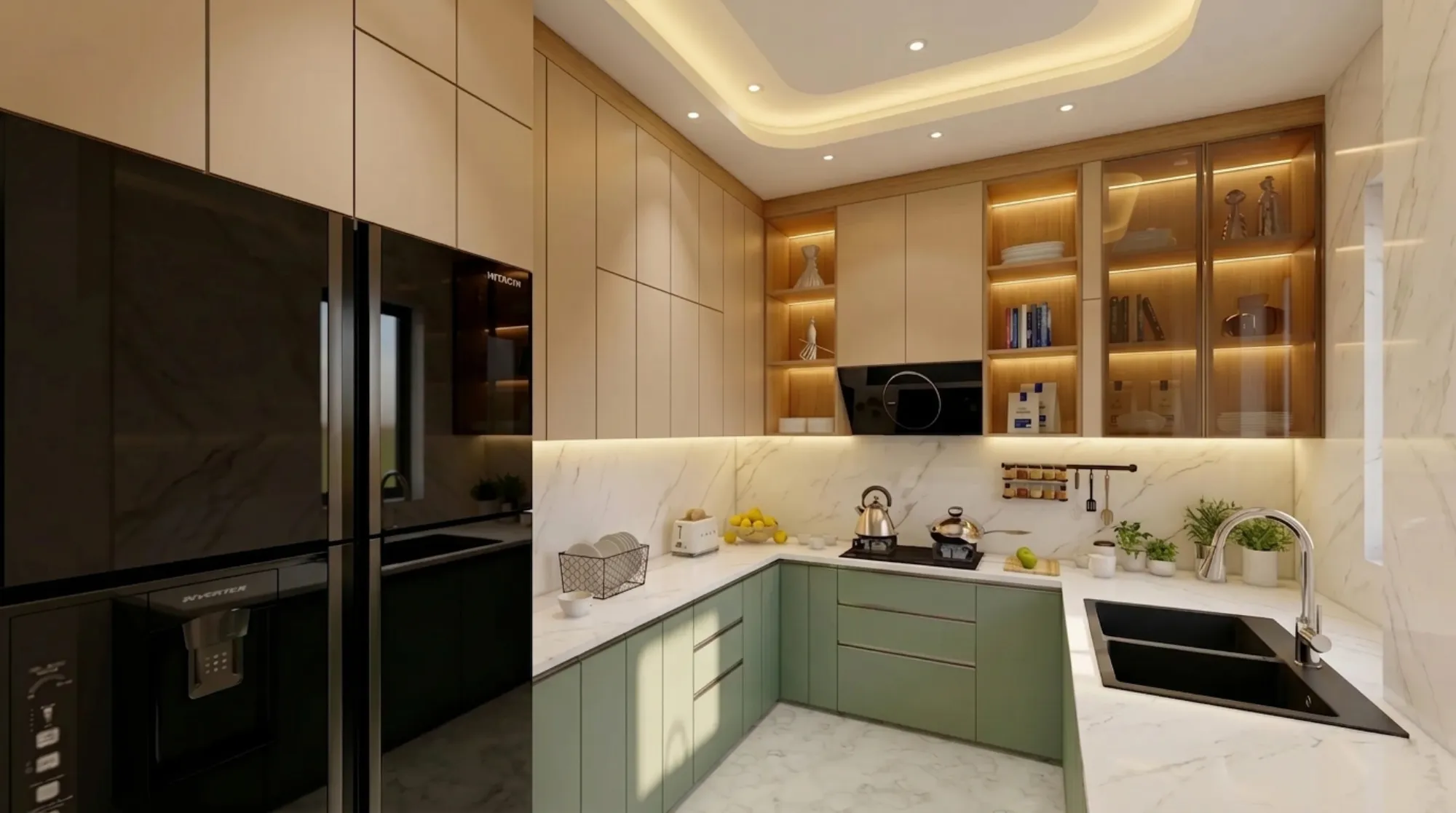
A client in a Rajarhat flat called us in exactly this situation a few months ago, a closed kitchen with a chimney installed by the original interior contractor, and yet the smell of mustard oil and fried fish still lingered in the room three to four hours after cooking, seeping out into the dining and living area every time the kitchen door opened, and when we walked through the space with them it took under twenty minutes to identify why, because the problem was never the chimney's suction power, it was the duct route the chimney was tied into, which ran nearly six metres with two sharp ninety-degree bends before it reached an outlet on the building's shared shaft, a configuration that kills airflow so badly the chimney was doing perhaps a third of the extraction its rated capacity suggested, and this is a pattern we see repeatedly enough in closed-kitchen flats across Kolkata that it deserves a proper diagnostic sequence rather than a guess-and-replace approach.
Why a Sealed Kitchen Traps Smoke Even With a Working Chimney
The closed kitchen format, a fully enclosed room with a door rather than an open-plan layout flowing into the living area, is extremely common in New Town, Rajarhat and Salt Lake flats, both because many buyers still prefer keeping cooking smells and mess contained and because a large share of the existing housing stock was built with this layout as the default before open kitchens became fashionable in the last decade, and there is nothing inherently wrong with a closed kitchen from a ventilation standpoint provided the exhaust system is sized and routed to actually clear the volume of smoke and steam a Bengali or Indian cooking style generates, which involves considerably more oil, higher stovetop temperatures and more particulate matter than the cooking styles most imported chimney models were originally engineered for. The core physics problem in a sealed room is straightforward, every cubic metre of air the chimney extracts has to be replaced by an equal volume of air coming in from somewhere, and in a tightly sealed closed kitchen with a solid door, minimal gap under the door and no dedicated fresh air inlet, that replacement air simply cannot enter fast enough, so the chimney's motor works against a partial vacuum, its actual extraction rate drops well below its rated capacity, and the smoke and oil particulates that should have been pulled out instead recirculate within the room and settle on cabinet surfaces, ceiling and fabric before slowly diffusing out whenever the door is opened.
The Duct Route Is Usually the Real Culprit
Before recommending any new appliance, we insist on physically tracing the duct route from the chimney's exhaust point to wherever it finally vents outside, because in the majority of closed kitchens we have inspected where an existing chimney is "not working," the appliance itself is functioning correctly and the actual fault sits entirely in the ducting, most commonly a run that is too long, has too many bends, uses an undersized diameter pipe, or vents into a shared shaft that has poor natural draw or is itself partially blocked by other flats' ducting tied into the same shaft. Every ninety-degree bend in a duct run creates meaningful resistance, roughly equivalent in airflow terms to adding several metres of straight duct length, so a run with three or four sharp bends squeezed through a false ceiling void to reach a distant external wall can behave, from the chimney motor's perspective, like it is trying to push air through a duct twice as long as it visually appears, and pairing that with the common cost-saving choice of a narrower diameter flexible aluminium duct instead of a properly sized rigid duct compounds the resistance further. Our fix in these cases almost always starts with re-routing to the shortest, straightest practical path to an external vent, replacing flexible ducting with rigid duct wherever the ceiling void allows it, and increasing the duct diameter to match what the chimney manufacturer actually specifies rather than whatever happened to fit conveniently through the existing false ceiling cavity.
| Long, Bent Duct Run | Short, Straight Duct Run |
|---|---|
| Multiple 90 degree bends through the false ceiling void | One or two gentle bends at most, routed directly to an external wall |
| Narrow flexible aluminium ducting | Rigid duct sized to the chimney manufacturer's specification |
| Actual extraction often 30 to 50% below rated capacity | Extraction close to the chimney's rated cubic metre per hour figure |
| Smell and smoke linger for hours after cooking | Smoke and odour clear within 15 to 20 minutes of cooking ending |
| Cheaper to install initially, expensive to diagnose and fix later | Slightly higher ducting cost upfront, avoids a costly re-route later |
Give the Room a Way for Air to Get Back In
Once the duct route is corrected, the next fix we specify for a sealed closed kitchen is a dedicated make-up air path, because without one, the improved duct will still fight the same partial vacuum problem even if less severely, and this does not need to be complicated or compromise the room's closed feel, a simple undercut of roughly 15 to 20mm beneath the kitchen door, sized to the chimney's rated airflow, is often enough on its own to let replacement air enter from the rest of the flat, and where the door fits too tightly against the floor for that, we specify a small louvred transfer grille set into the door or the adjoining wall instead, positioned low enough that it does not become a direct path for kitchen smells to travel back out into the dining area under normal conditions. For kitchens with a window, even a small operable pane cracked open during cooking dramatically improves how quickly the room clears, and we routinely recommend clients simply keep that window open through the cooking window and for ten to fifteen minutes after, since a closed kitchen with a window that stays shut through the process is fighting the ventilation system rather than helping it.
Matching Chimney Capacity to Actual Cooking Style
A genuine mismatch we see often is a chimney sized by general room volume rather than by cooking intensity, since a standard sizing formula based purely on the kitchen's cubic footage will consistently undersize the unit for households doing regular high-heat frying, tempering and grilling, which is the norm rather than the exception in most Bengali kitchens, and for a closed kitchen of roughly 80 to 120 square feet doing daily oil-heavy cooking, we generally push clients toward a chimney rated well above the bare minimum the room's volume alone would suggest, since the extra capacity gives the system headroom to still perform adequately even with some duct resistance built in, rather than a marginally sized unit that only meets the room's needs under perfect ducting conditions that rarely exist in practice. Baffle filters, which use a series of curved metal plates to separate oil particles from the air stream, generally handle the oil-heavy load of Indian cooking better over time than mesh filters, which clog with a sticky oil film far faster and, once clogged, choke airflow through the entire unit even if the duct route and make-up air are both correct, so filter type and, just as importantly, the discipline of cleaning that filter every one to two weeks rather than monthly, form the last piece of a properly functioning system.
- Trace the full duct route physically rather than assuming the appliance is at fault
- Count bends and measure duct length, since anything beyond two bends or four to five metres meaningfully cuts extraction
- Confirm duct diameter matches the chimney manufacturer's specification rather than whatever fit the ceiling void
- Add a door undercut, transfer grille or operable window as a dedicated make-up air path
- Size chimney capacity to cooking intensity and oil use, not just room volume
- Clean or replace baffle filters every one to two weeks during regular oil-heavy cooking
A Practical Order of Operations
For anyone dealing with this problem right now rather than planning a fresh kitchen, we generally recommend working through the fix in this order, physically inspecting the duct route first, then correcting the routing and diameter, then adding a make-up air path, and only after all of that considering a chimney upgrade, since jumping straight to buying a more powerful chimney before checking the duct route wastes money on a bigger motor pushing air through the same restrictive path, and most of the closed-kitchen cases we have diagnosed this way get resolved within a single weekend of re-routing work without needing to touch the appliance at all.
Ventilation problems in a closed kitchen rarely stay isolated from the rest of a flat's comfort, and a fair number of our Rajarhat and New Town clients who come to us about lingering kitchen smells also mention the general stuffiness of the flat, which sometimes traces back to a similarly sealed building envelope that is also letting in traffic noise on the bedroom side, a related fix we cover in reducing traffic noise in an EM Bypass facing bedroom. If your building also floods at the entrance every monsoon, that is a separate but equally common New Town complaint we address in fixing a waterlogged building entrance during monsoon, and for anyone in Salt Lake dealing with both cooking smells and street noise together, our comparison of double-glazed versus single-glazed windows for traffic noise covers the window side of that combined problem. If the smell issue has you reconsidering the kitchen's layout altogether rather than just fixing ventilation, our before-and-after piece on shifting a closed kitchen to an open layout is worth reading before you decide which direction makes sense for your flat, and where the kitchen sits close to a bathroom sharing the same exhaust shaft, our bathroom design service page covers how we plan shared ventilation risers to avoid this same trapped-odour problem on that side of the flat too.
Get Your Closed Kitchen's Ventilation Diagnosed Properly
If your closed kitchen still smells of smoke and oil hours after cooking despite having a chimney installed, send us a few photos of the duct run through the false ceiling along with your kitchen's approximate size via our contact page, and we will walk you through exactly where the airflow is being lost before you spend money replacing an appliance that was likely never the actual problem.