






How to Reduce Traffic Noise in an EM Bypass-Facing Bedroom
We hear a version of the same complaint from almost every client whose bedroom windows face EM Bypass or VIP Road directly, and it is rarely about a single loud incident, it is the constant low hum of trucks, buses and private traffic that never fully stops even past midnight, a sound that seeps through a closed window and sits in the room as a background pressure that makes deep sleep genuinely difficult even for people who otherwise sleep well, and the fix for this specific kind of noise is not the same as the fix for an occasional loud neighbour or a construction site next door, because continuous low-frequency road noise from a six-lane arterial road behaves differently in a room than intermittent noise does, and it needs to be tackled in a specific sequence starting with the window, moving to the wall gaps around it, and only then to soft furnishing, rather than jumping straight to heavy curtains and hoping for the best.
Why EM Bypass Noise Is Harder to Block Than Ordinary Street Noise
The traffic moving along EM Bypass and VIP Road runs at higher average speeds than the internal lanes of a residential block, and a large share of that traffic is commercial, buses, trucks and container vehicles headed toward the airport or the southern parts of the city, which means the noise reaching an eighth or twelfth floor bedroom on a tower along this stretch is dominated by low-frequency engine and tyre noise rather than the higher-pitched horn honking that dominates narrower internal roads, and low-frequency sound is physically harder to block because it carries more energy per wavelength and passes through lightweight materials, including ordinary window glass, far more readily than high-frequency sound does. This is the single biggest reason clients tell us they put up thick curtains and still hear the hum through the night, since curtains are genuinely effective against higher-pitched sound and almost useless against the deep, continuous rumble a bedroom facing an arterial road actually receives, and it is why our approach for any bedroom on this kind of facade starts at the glazing rather than the fabric.
Start With the Glazing, Not the Curtains
For any bedroom we are treating on EM Bypass or a similarly busy stretch of VIP Road, the first and most consequential decision is the window glazing itself, and a single pane of standard 4mm or 5mm float glass, which is what the vast majority of New Town and Rajarhat towers ship with as standard, offers very little resistance to low-frequency road noise regardless of how well it is sealed. Moving to a double-glazed unit with an asymmetric configuration, meaning two panes of different thickness such as 6mm and 8mm separated by a 12mm to 16mm air gap rather than two identical panes, genuinely changes the acoustic performance because matched panes tend to resonate at the same frequency and let sound pass through more easily at that shared frequency, while mismatched thickness breaks that resonance and blocks a wider band of the traffic noise spectrum. Laminated acoustic glass, which sandwiches a soft PVB interlayer between two panes, performs even better against the specific low-frequency rumble of heavy vehicles, and for a bedroom sitting within roughly 40 to 60 metres of the carriageway, which describes most of the towers we have worked on along this corridor, we consider acoustic laminated glass the baseline rather than an upgrade, even though it typically adds a meaningful premium over standard float glass for the same window opening.
| Standard Double Glazing | Acoustic Laminated Glazing |
|---|---|
| Two panes of matched or near-matched thickness with an air gap | Two panes of differing thickness with a soft PVB interlayer bonded between them |
| Reduces mid and high frequency noise reasonably well | Reduces low frequency traffic rumble noticeably more effectively |
| Lower upfront glazing cost | Meaningfully higher upfront glazing cost |
| Sufficient for internal-road facing bedrooms with lighter traffic | Recommended default for bedrooms within 40 to 60 metres of EM Bypass or VIP Road |
Seal the Frame Gaps Before Anything Else
Here is where a genuinely expensive glazing upgrade gets undermined by something that costs almost nothing to fix, because even the best acoustic glass unit performs poorly if the aluminium or UPVC frame around it has gaps at the sill, jamb or where two sliding sashes meet, and in a large number of the flats we inspect along this corridor, the original builder-installed windows have exactly this problem, a visible or near-invisible gap of a few millimetres at the sliding track that lets sound leak through almost as if the glass were not upgraded at all. Before recommending any glazing change, we check the frame for exactly this kind of leakage using a simple method, closing the window at night with the room lights on and checking from outside whether any light escapes at the joints, because sound and light leak through the same gaps, and if light gets through, so does the traffic hum. Fixing this involves proper EPDM or silicone gasket seals at every moving joint, weatherstripping at the sliding track, and in some cases replacing a worn sliding mechanism entirely with a tighter-tolerance track, and this single step alone, done properly, has resolved a noticeable share of the "I upgraded my glass and it barely helped" complaints we get from clients who did the glazing work through a different vendor before calling us.
What the Wall Cavity and False Ceiling Contribute
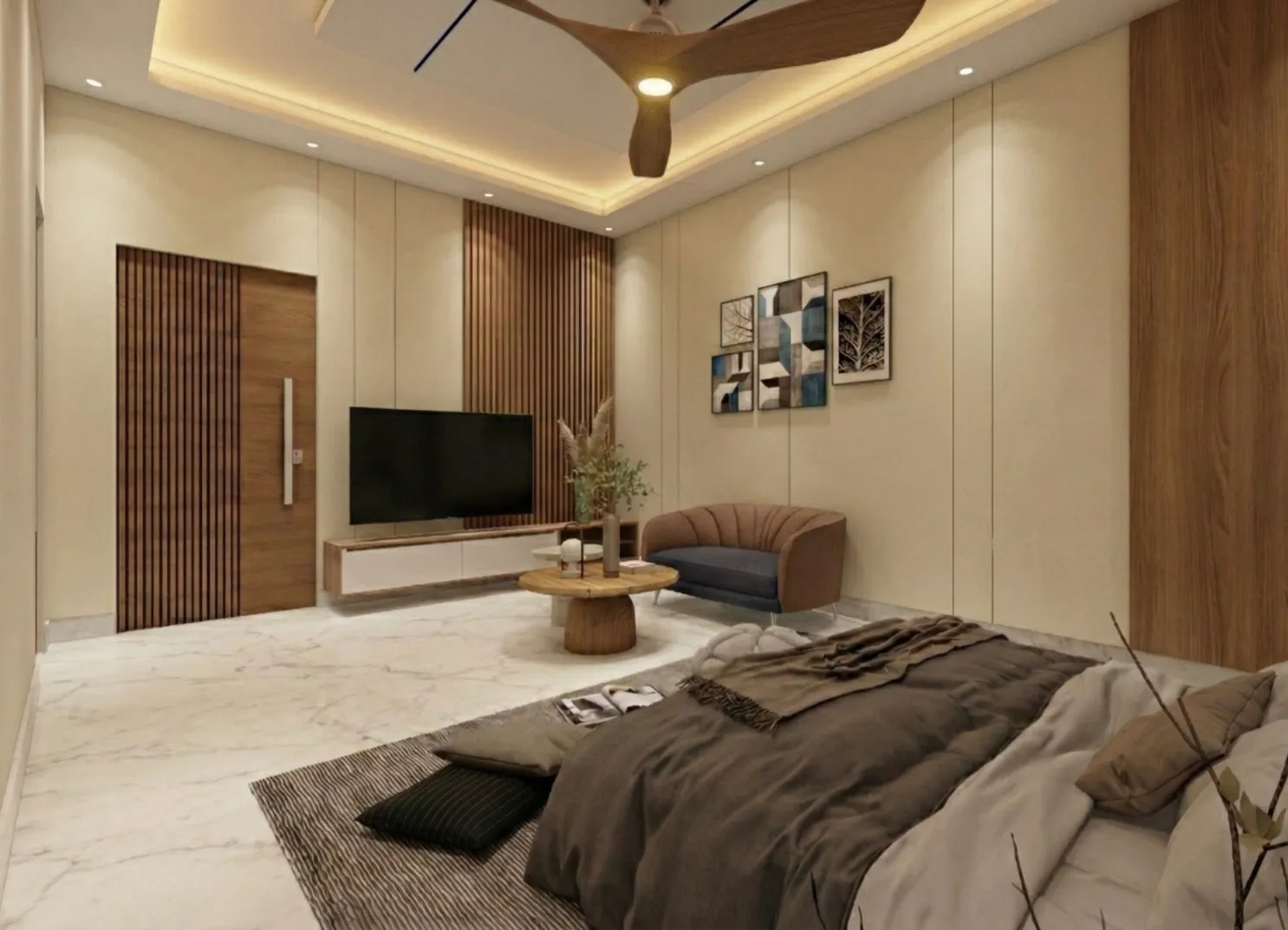
Once the window and its frame are handled, the next weak point in most towers along EM Bypass is the wall itself where it meets the external facade, because many buildings in this belt use a lightweight block or a thinner-than-ideal RCC section for external walls to save on structural load, and sound can travel through this wall mass at a level that surprises clients once the window stops being the dominant noise path. For bedrooms where the client's budget allows a deeper renovation, we sometimes recommend a acoustic-rated false ceiling section running along the external wall's edge combined with a thin layer of mineral wool or rockwool insulation set into a stud framing against that wall, covered with a fabric-wrapped acoustic panel or a perforated wood-look panel finish, which both improves the room's sound absorption and gives the wall a genuinely finished, designed look rather than a bare treated surface, and this is one of the few acoustic fixes that also functions as a visual feature wall, which most clients appreciate since a purely functional-looking treatment is a harder sell in a bedroom meant to feel calm rather than clinical.
Curtains, Panels and Soft Furnishing Come Last, Not First
Once the glazing is upgraded and the frame is sealed properly, soft furnishing genuinely does add a final, noticeable layer of improvement, particularly for the higher-frequency component of traffic noise such as horns and closer conversation, and we specify a heavyweight, tightly woven curtain fabric in the 300 to 400 GSM range hung with a fuller pleat and, where the budget allows, doubled with a sheer layer behind it, mounted on a track that extends past the window frame on both sides so the curtain overlaps the wall rather than just covering the glass, because any gap at the edge of a curtain lets sound bypass the fabric entirely. For clients who want to go further, an upholstered headboard wall that runs the full width behind the bed, combined with a rug on the floor rather than exposed tile, both reduce reflected sound within the room itself, which matters because even after outside noise is reduced at the window, a hard-surfaced room with tile flooring, a bare wall and a glass-fronted wardrobe will bounce whatever sound does get through around the space longer than a room with more absorptive surfaces would, making the residual noise feel more present than it actually is.
- Confirm whether the window uses single float glass or an already-upgraded double glazed unit before ordering any acoustic glass
- Test frame and sliding track seals at night using the light-leak method before assuming the glass alone is the problem
- Specify asymmetric or laminated acoustic glazing rather than two matched panes for any window within 60 metres of the carriageway
- Budget separately for EPDM gasket sealing and track replacement, since this is often skipped by glazing vendors focused only on the glass
- Add heavyweight curtains with full-width overlap and a rug or upholstered surface only after the glazing and sealing work is done
A Realistic Sequence and What It Tends to Cost
For a typical New Town or VIP Road facing bedroom of around 140 to 180 square feet with one or two windows to treat, we generally sequence the work as glazing and frame first since that is where the bulk of the noise reduction happens, followed by any wall-side acoustic panelling if the budget and the room's proportions support it, and finally the soft furnishing layer, working in that order from the window outward rather than starting with curtains, because doing the sequence in reverse means paying for curtains and panels twice once the client realises the underlying window was never actually fixed, and a typical project of this scope runs somewhere between three and five weeks from the first site measurement to the final curtain installation depending on how much of the wall panelling stage the client chooses to include.
None of this needs to happen in isolation from the rest of the bedroom's design, and a lot of our EM Bypass and VIP Road facing clients end up planning the acoustic work at the same time as a lighting refresh, since the same window wall that needs new glazing usually also anchors the room's layered lighting plan, a subject our piece on layering light properly in a master bedroom covers in more depth. If your flat sits on a middle floor where the same tall towers that block the worst of the traffic view also block a good share of the daylight, our guide to bringing natural light into a dark middle-floor New Town flat tackles that adjacent problem, and for the kitchen side of a similarly enclosed New Town flat, our post on fixing a closed kitchen that still smells of smoke and oil after cooking walks through a comparable diagnose-before-you-spend approach for ventilation. If your kitchen shutters happen to face the same humid, road-facing side of the building, membrane shutters versus acrylic shutters for a Kolkata kitchen's humidity is worth a read too, and for the lighting layer specifically, our false ceiling and lighting design service page covers how we integrate acoustic panelling into that same ceiling detail.
Get Your EM Bypass Facing Bedroom Assessed Properly
If your bedroom sits along EM Bypass, VIP Road or a similarly busy stretch and the traffic hum has become the thing standing between you and a decent night's sleep, tell us the floor level, the approximate distance from the carriageway and whether your current windows are single or double glazed through our contact page, and we will walk you through the specific glazing, sealing and panelling sequence that fits your bedroom rather than a one-size treatment that was never built for a six-lane arterial road in the first place.