






BWP vs BWR vs MR Plywood: Which Grade Your Kolkata Kitchen Carcass Needs
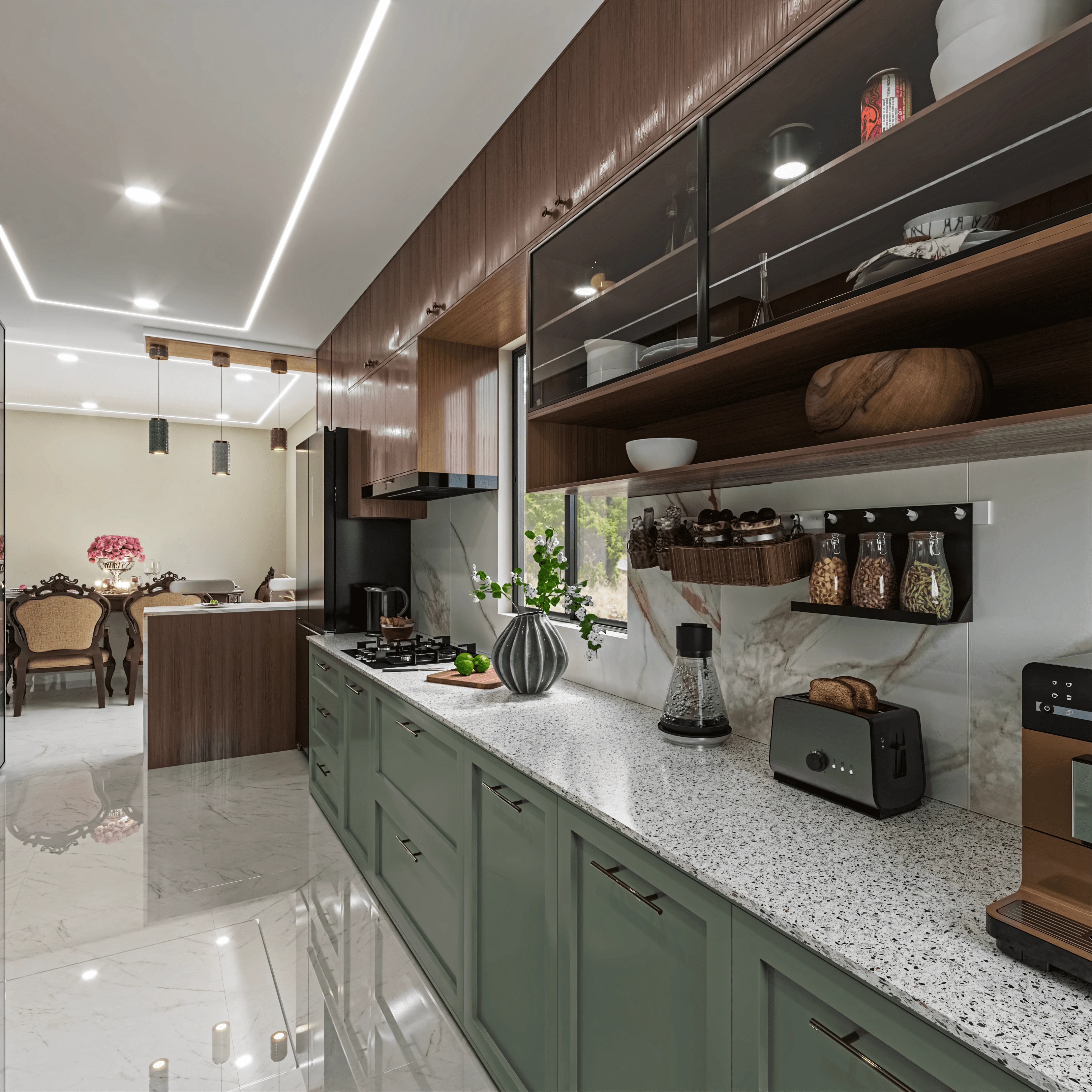
When a client sits across from us at our New Town studio and asks whether their kitchen carcass really needs BWP plywood or whether BWR grade will do the job in Kolkata's humidity, we do not give a one-line answer, because the honest answer depends on which part of the kitchen we are talking about, and getting this specification wrong is one of the most expensive mistakes a homeowner can make without ever realising it until the swelling shows up two monsoons later. Over more than a decade of fitting out kitchens across New Town, Salt Lake, and Rajarhat, we have settled on a zone-by-zone approach to plywood grading rather than a blanket rule, and this piece walks through exactly where BWP earns its premium and where BWR genuinely does the job just as well.
What BWP, BWR, and MR Actually Mean on the Sheet
Plywood grading in India runs on Bureau of Indian Standards codes, and the letters stamped on the edge of a sheet tell you far more than any showroom description ever will. BWP stands for Boiling Water Proof and is manufactured to IS 710, which requires the sheet to survive a boiling water test cycle without the glue lines failing, which is why the trade also calls it marine plywood, since the same construction is used below the waterline on boats. BWR stands for Boiling Water Resistant and is built to IS 303, using the same phenol-formaldehyde resin family as BWP but tested to a shorter, less punishing cycle, so it resists humidity and occasional splashing well but was never engineered for sustained submersion. MR, or Moisture Resistant, sits a full tier below both, uses urea-formaldehyde resin that breaks down when it stays wet, and in our view has no place anywhere near a Kolkata kitchen sink, no matter what a supplier's price sheet suggests. Plywood construction itself, thin layers of wood veneer glued together with the grain running at alternating angles, is what gives any of these boards their strength and dimensional stability in the first place, a manufacturing principle documented in detail on Wikipedia's plywood entry, and it is the quality and formulation of that glue bond, not the wood species, that separates BWP from BWR from MR.
Where BWP Earns Its Premium: The Zones That Cannot Compromise
In a modular kitchen, three zones sit close enough to standing water or continuous steam that we will not build them in anything but IS 710 BWP plywood, and the first of these is the base unit directly under the sink, where a slow leak from a tap fitting or a P-trap can pool unnoticed for days before anyone opens the cabinet door to check, and by the time it is discovered a BWR or MR carcass has already delaminated at the base joints. The second is any cabinet or countertop return sitting immediately beside the hob and wash area, where daily splashing and the steam from boiling pots create a low-grade but relentless moisture load that accumulates over years rather than weeks. The third is any wardrobe or storage unit that shares a wall with a bathroom, a configuration we see constantly in the compact three-bedroom layouts common across New Town's Action Area developments, because vapour migrates through masonry walls far more readily than most homeowners expect, and a wardrobe backing onto a bathroom wall behaves, for material purposes, almost like it is inside a wet zone itself.
Where BWR Genuinely Suffices, and Where We Draw the Line
Outside those three wet zones, we are comfortable specifying BWR grade for the bulk of a kitchen's carcass, including wall-mounted cabinets above the counter line that never see direct water contact, loft units sitting above eye level that store dry goods and occasional-use crockery, and the dry end of an L-shaped or parallel kitchen layout that sits well away from the sink and hob run. BWR handles Kolkata's ambient humidity, which averages well above seventy percent for a good six months of the year, without difficulty, and the phenolic resin bond means it will not delaminate the way MR board does when the monsoon season pushes indoor humidity even higher for weeks at a stretch. The distinction we keep coming back to with clients is that BWR is built to resist moisture in the air, while BWP is built to survive moisture in contact, and a kitchen carcass genuinely needs both kinds of protection in different places rather than one grade specified uniformly across the whole unit.
| BWP, Boiling Water Proof | BWR, Boiling Water Resistant |
|---|---|
| Certified to IS 710 with marine-grade phenolic bonding | Certified to IS 303 with the same resin family, shorter test cycle |
| Survives direct and sustained water contact without delaminating | Handles humidity and occasional splashing but not standing water |
| Roughly twelve to eighteen percent costlier per sheet | Our standard, more economical choice for dry-zone carcass work |
| Mandatory under sinks, beside hobs, and on any wardrobe backing a bathroom wall | Perfectly adequate for wall units, lofts, and dry-side base cabinets |
What the Grade Choice Actually Costs Across a Real Kitchen
For a typical ten to twelve foot L-shaped kitchen run in a New Town or Salt Lake apartment, we generally see nineteen millimetre BWP sheet priced between ninety five and one hundred twenty rupees per square foot before lamination, against sixty five to eighty five rupees per square foot for BWR of the same thickness, so the difference is real but not dramatic once you look at where it actually applies. Because the wet zones we described above typically account for only a third to two fifths of the total carcass area in most kitchen layouts, mixing grades correctly usually adds somewhere between eight and fifteen percent to the total carcass cost compared with building the entire kitchen in BWR, which is a far smaller premium than most clients expect when they first hear the word marine plywood, and it is a fraction of what a full carcass replacement costs after MR board fails in year three or four.
Why We Will Not Build a Kitchen in MR Grade, Full Stop
We get asked, usually by clients working to a tight budget, whether MR grade can substitute for BWR in the driest parts of a kitchen just to save a little more, and our answer has stayed the same across every project we have delivered since 2014, which is no. MR board is fine for a coat rack or a shoe cabinet in a covered, dry corridor, but Kolkata's ambient humidity alone, without any direct leak or splash, is enough to start swelling MR-grade cores within two to three monsoon cycles, and once the layers begin separating there is no repair that restores the original strength, only replacement. The saving on MR versus BWR is typically only ten to fifteen rupees per square foot, which on an average kitchen amounts to a few thousand rupees against a carcass that we know, from having pulled apart failed installations in client homes, will need to be rebuilt within three to four years rather than lasting the twelve to fifteen years a properly graded BWP and BWR combination reliably delivers.
- Specify IS 710 BWP for every base unit under the sink and beside the hob
- Use BWR for wall cabinets, loft units, and dry-side base cabinets
- Treat any wardrobe backing a bathroom wall as a wet zone requiring BWP
- Ask to see the IS stamp on the sheet edge before installation, not just the invoice
- Budget an extra eight to fifteen percent on carcass cost for correct zone-wise grading, not the full kitchen
- Never accept MR grade anywhere within splash distance of water
The same logic extends past the kitchen into bathroom vanities and wet-adjacent storage, and if you are weighing up materials for a bathroom renovation alongside your kitchen we cover the fittings and finishes side of that in more depth on our bathroom design service page. For a broader look at how humidity shapes every material decision in a Kolkata home, not just plywood, our earlier piece on choosing the right waterproof materials and finishes for Kolkata's climate is worth reading alongside this one.
Getting the Rest of the Kitchen Right
Plywood grade is one decision in a kitchen fit-out that involves dozens of interlocking choices, and two of the most common follow-up questions we get from clients once the carcass conversation is settled are about ventilation and hardware. If you are also deciding between a ducted or ductless chimney for an apartment kitchen, we have laid out the tradeoffs in detail in Ducted vs Ductless Kitchen Chimney: Which Suits Kolkata Apartment Kitchens, and if your kitchen or utility balcony carries exposed railing hardware that takes monsoon weather directly, our piece on MS, SS, or Glass? Choosing Balcony Railing Hardware That Survives Kolkata Monsoons covers the same grade-versus-cost logic applied to metal rather than wood. We have also written about the layout constraints that come with narrower footprints in newer pockets of the city in Builder Floor Design for Narrow Plots in Chinar Park, Rajarhat, which touches on how kitchen carcass planning changes when floor plate width is tight. And for anyone building or renovating specifically in Rajarhat, our location page for the area has more on the projects we have delivered there.
Talk to Us Before You Sign Off on Your Kitchen Carcass Spec
If you are staring at two competing quotes right now, one built around BWR throughout and one insisting on BWP everywhere, and you are not sure which zones actually justify the higher grade, send us your kitchen layout and we will mark up exactly where we would spend the premium and where we would not. You can reach our team through our contact page, by email at studiocontour.mail@gmail.com, or by calling +91 98312 50307, and we are happy to review a plywood specification sheet even before you have committed to us for the full project.