






Kitchen Backsplash Materials That Handle Kolkata's Humidity and Cooking Oil Together
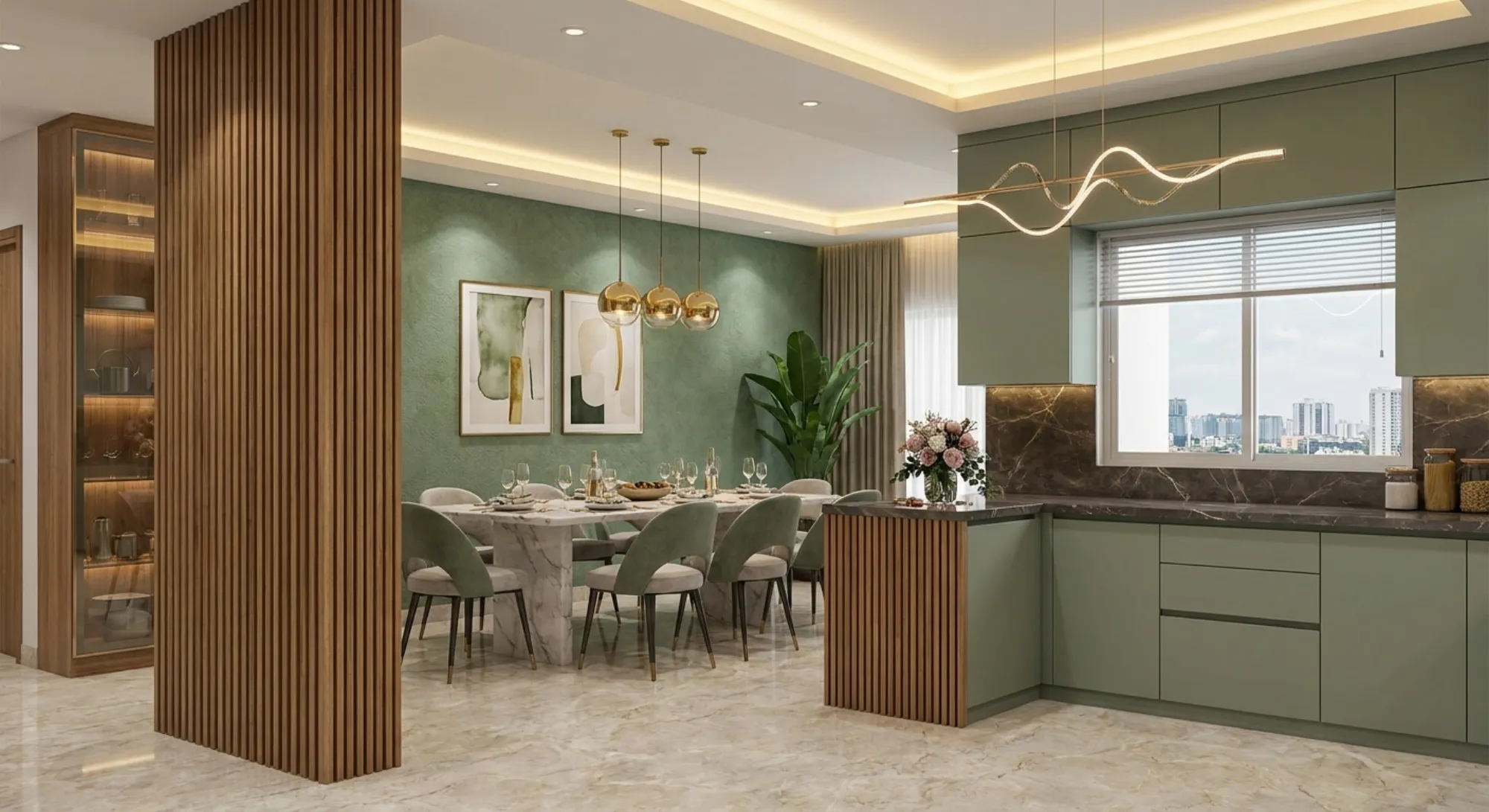
Almost every client who sits down with us to plan a modular kitchen in New Town or Salt Lake asks the same underlying question in different words, whether it is phrased as "what backsplash won't stain" or "what wall finish behind the hob will actually last," and the honest answer is that a Kolkata kitchen backsplash has to survive two separate attacks at once, sustained ambient humidity that regularly sits above 80 percent for a good six months of the year, and the specific reality of Bengali cooking, where mustard oil is heated to a smoking point for tempering, fish is fried at close range, and the wall directly behind the stove takes a fine, sticky film of oil that ordinary paint or a porous surface will never fully release once it has soaked in, so the material choice here genuinely cannot be the same generic recommendation you would give a kitchen in Pune or Bangalore where humidity is a lesser factor for most of the year.
Why Natural Stone Fails Behind a Kolkata Hob
We steer almost every client away from unsealed natural stone, whether it is a warm sandstone, a textured slate, or a porous marble offcut left over from the countertop, as a backsplash material for the zone directly behind the cooking range, because natural stone is inherently porous at a microscopic level, and that porosity is precisely what makes it vulnerable to a combination Kolkata delivers in abundance, oil that seeps into the stone's pore structure before it has a chance to be wiped away, and ambient humidity that keeps the wall from ever fully drying out between cooking sessions, so what starts as a faint sheen after a few months of daily mustard oil tempering becomes a permanent, blotchy discoloration within a year or two that no amount of scrubbing reverses because the staining has migrated below the surface rather than sitting on top of it. Even sealed natural stone needs the sealant reapplied on a schedule that most households simply do not keep up with once the kitchen is finished and life gets busy, and a lapsed seal in a hob-adjacent zone in this climate fails faster than it would in a drier city, which is why we tell clients directly at the material selection stage that natural stone belongs on the countertop or an accent wall away from direct oil exposure, not on the two feet of wall immediately behind the burners.
Glazed Ceramic and Vitrified Tile: The Dependable Default
For the overwhelming majority of our kitchen projects, we specify a glazed ceramic or vitrified tile for the backsplash zone, because the glaze fired onto the tile surface creates an effectively non-porous layer that neither oil nor ambient moisture can penetrate, meaning a splatter of hot mustard oil during tempering sits on top of the glaze rather than soaking into it, and a damp cloth wipe after cooking removes it completely rather than leaving a ghost mark behind. Glazed tile also handles the humidity side of the equation cleanly since the fired ceramic body underneath the glaze does not swell, warp, or hold moisture the way a timber-based or cementitious surface would, so across a full monsoon season the wall performs identically to how it performed in the dry months, and this consistency is exactly what we want behind a stove that gets used daily. Where glazed tile does need attention is the grout line between tiles, since standard cement grout is porous and will discolor from both oil and humidity faster than the tile itself does, which is why we now specify epoxy grout as the default for any backsplash zone directly behind a hob rather than treating it as a premium upgrade, a point we go into in more depth in our piece on bathroom tile grout that won't turn black during Kolkata's monsoon months, because the underlying porosity problem with cement grout is identical whether the wet zone in question is a shower or a stovetop wall.
Glass Backsplash: When It Earns Its Premium
Toughened glass backsplash panels, whether painted on the reverse side (back-painted glass) or printed with a pattern, have become a genuinely popular request among our New Town clients over the past few years, and there is good reason for that beyond aesthetics, because a single sheet of toughened glass has zero grout lines across an entire backsplash run, which means there is no porous joint anywhere for oil or moisture to find a way in, and the glass surface itself is completely non-absorbent, so a splatter wipes off in one pass and the wall looks the same after five years of daily cooking as it did on installation day. The trade-off is cost, since a back-painted glass panel typically runs meaningfully higher per square foot than glazed tile once you account for the toughening process, the custom cutting around switchboards and the hob outlet, and professional installation, and glass does show fingerprints and water spots more visibly than a textured tile finish would, which matters to some households and not at all to others. We generally recommend glass for kitchens where the backsplash is a genuine design statement, an open kitchen visible from the living or dining area where the wall is doing double duty as decor, and glazed tile for enclosed or utility kitchens where the wall is functional first and the cost difference matters more to the client's overall budget.
| Glazed Ceramic or Vitrified Tile | Toughened Glass Backsplash |
|---|---|
| Lower material and installation cost per sqft | Meaningfully higher cost per sqft once toughening and custom cutting are factored in |
| Grout lines present, need epoxy grout to stay oil and humidity resistant | Zero grout lines, no porous joint anywhere on the surface |
| Wide range of textures, patterns, and price points | Sleek, seamless look, especially strong in open-kitchen layouts |
| Very good stain resistance when properly glazed | Excellent stain resistance, completely non-porous |
| Standard choice for enclosed and utility kitchens | Popular for open kitchens visible from living or dining space |
Where Plywood and Laminate Panels Fit, and Where They Don't
Some clients ask about a laminate or acrylic panel backsplash instead of tile or glass, usually because it can be color-matched precisely to the cabinetry for a seamless look, and while the finished laminate surface itself is reasonably resistant to oil when it is a proper acrylic or PVC laminate, the substrate underneath it matters enormously in this climate, since a laminate panel is typically bonded onto a core board, and if that core board is anything other than BWP-grade plywood or a genuinely moisture-resistant HDHMR board, ambient humidity working its way in through the edges and the switchboard cutouts over several monsoons will eventually delaminate the panel from the inside, a failure mode that has nothing to do with the oil resistance of the surface and everything to do with what is hidden behind it. Plywood itself, as Wikipedia's overview of the material explains, is manufactured by gluing thin layers of wood veneer with the grain of each layer rotated relative to its neighbors, which is what gives it dimensional stability compared to solid timber, but that stability depends entirely on the grade of adhesive used between layers, and only marine-grade BWP (Boiling Water Proof, per the IS 710 standard) adhesive genuinely holds up to sustained kitchen humidity and occasional water exposure at the counter edge. We do specify laminate panel backsplashes on request, particularly for clients wanting a monochrome, handleless kitchen look, but we insist on BWP-grade substrate underneath and we are direct about the fact that the panel needs to be resealed at the seams and switchboard cutouts periodically in a way that a fired glaze on tile or glass simply never requires.
Practical Notes We Give Every Client at the Selection Stage
Beyond the core material decision, a handful of details make a measurable difference to how a backsplash actually performs across a Kolkata cooking season, and we walk through these with every client whether they are doing a full modular kitchen or just replacing an old backsplash during a renovation, because the material alone does not guarantee the outcome if these details are skipped.
- Extend the backsplash height to at least 24 inches above the counter directly behind the hob, since standard 18-inch coverage leaves the upper wall exposed to rising oil vapor during frying
- Choose a matte or lightly textured glazed tile rather than a high-gloss finish for the hob zone specifically, since gloss surfaces show every fingerprint and oil smear far more visibly under kitchen lighting
- Specify epoxy grout, not standard cement grout, for any tiled backsplash zone that sits within splash range of the stove
- Confirm the exhaust hood or chimney is sized correctly for the kitchen's cooking volume, since a well-functioning exhaust reduces how much oil vapor ever reaches the backsplash in the first place
- Ask for a continuous sheet or minimal-seam panel if choosing glass or laminate, since every seam is a point where oil and humidity can eventually find a way behind the surface
- Avoid unsealed natural stone anywhere within direct splatter range of the hob, reserving it instead for the countertop or a dry accent wall
How This Connects to the Rest of a Humidity-Smart Kitchen
A backsplash is only one surface in a kitchen that faces this combined humidity-and-oil challenge, and we generally walk clients through the whole space rather than one wall in isolation, since the same porosity logic that rules out unsealed stone on a backsplash also governs cabinet carcass and countertop choices a few feet away, a topic we cover in fuller depth in our guide to choosing interior materials that hold up against Kolkata's humidity. If the kitchen sits in a flat where cooking smells and oil vapor tend to linger rather than clear out through an open window, that same ventilation question extends beyond the backsplash into whether the kitchen has adequate exhaust in the first place. And because humidity in a Kolkata flat rarely respects room boundaries, clients renovating a kitchen often ask us in the same breath about a bathroom wall nearby losing its grout to black mold, which we address in bathroom tile grout that won't turn black during Kolkata's monsoon months, or about the balcony grill just outside the kitchen window starting to rust, covered in which balcony railing material won't rust through a Kolkata monsoon season, or about a middle-floor flat where the kitchen and adjoining rooms feel dim for most of the day, which our piece on bringing natural light into a dark middle-floor New Town flat addresses directly. For a client working across a full home rather than a single kitchen, our residential interior design service folds all of these material decisions into one coordinated brief rather than leaving them to be solved room by room.
Let's Get Your Backsplash Right the First Time
If you are planning a new modular kitchen or replacing a backsplash that has already started staining and discoloring behind the hob, send us a few photos of the space and the direction it faces through our contact page and we will walk you through exactly which material and grout combination we would specify for your kitchen, so the wall behind your stove looks the same after five Kolkata monsoons as it did on the day the tiler left.