
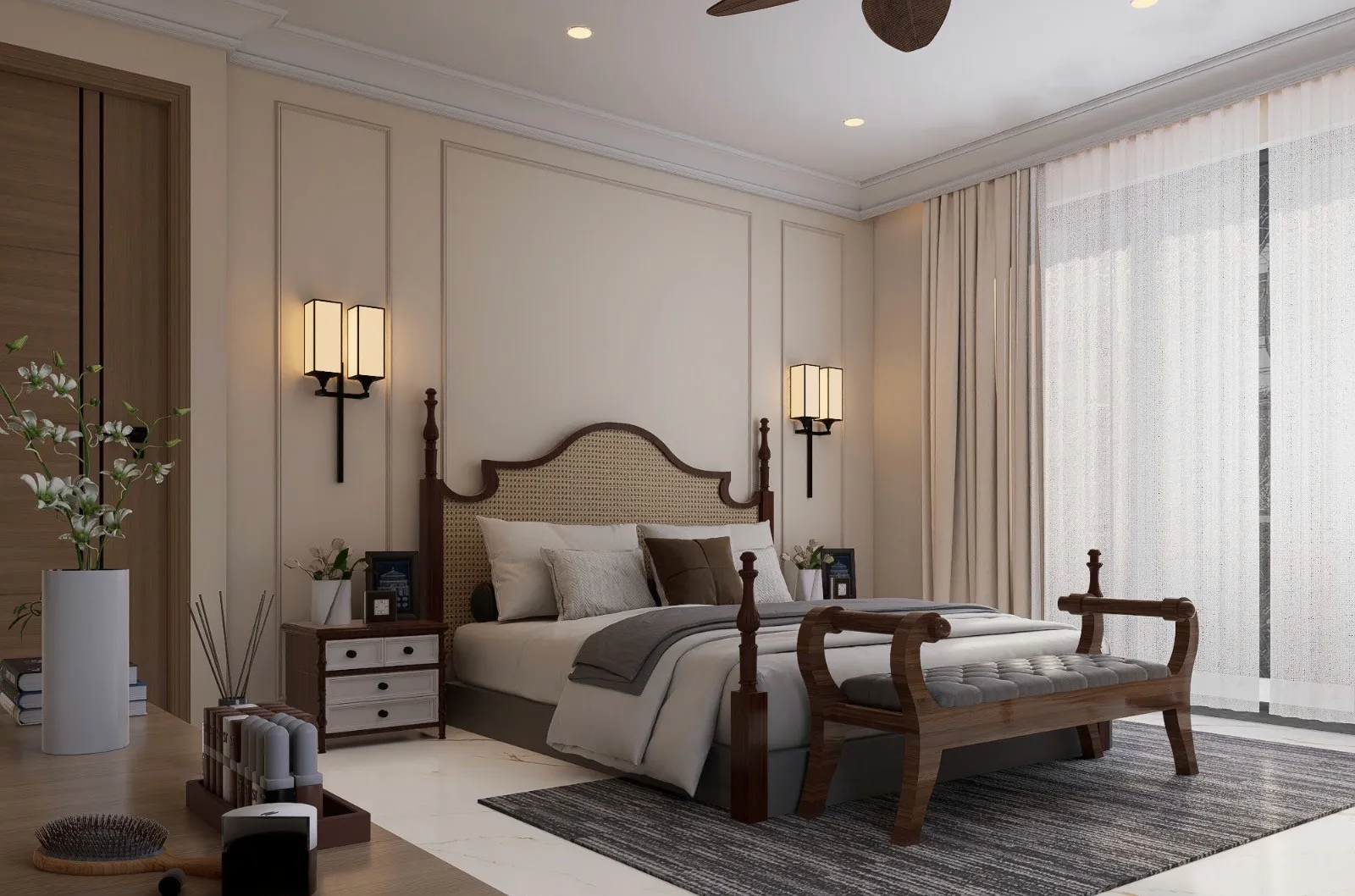






Upholstered Headboard Designs: A Complete Guide
Ask any homeowner in Kolkata what they remember about a bedroom they loved, and nine times out of ten it is the headboard, not the bed. A tufted velvet panel against a bottle-green wall, a wide channel-stitched arch in oatmeal boucle, a simple floating rectangle wrapped in linen that just makes the whole room feel finished right down to the last inch. At Studio Contour we have specified and built upholstered headboards across a good chunk of the 330+ buildings we have delivered since 2014, from compact apartments in Salt Lake to sprawling duplexes in New Town, and if there is one thing we know it is that this one piece of furniture carries more design weight per square foot than almost anything else in the bedroom.
This guide is us putting down, in one place, everything we actually tell clients when this conversation comes up during a residential fit-out. What the real style categories are and how they differ in construction, not just looks. Which fabrics survive a Kolkata summer and which ones will regret themselves by the second monsoon. How sizing and mounting actually work so the headboard does not look like an afterthought bolted onto an existing bed. What things genuinely cost here, broken down by size and fabric grade, so you are not guessing. And the maintenance realities nobody mentions in the glossy inspiration photos, right down to how our humidity changes the calculus on foam density and fabric choice.
We are writing this as the people who get called in when a client's DIY headboard has sagged, or when a carpenter's version looked nothing like the reference photo, so consider this the version with the mistakes already priced in.
The Real Style Categories, and Why Construction Matters More Than Looks
Most people shopping for an upholstered headboard start with a Pinterest image and end up asking a carpenter to "copy this," and this is exactly where things go wrong, because the visual style and the underlying construction are two different decisions. A panel headboard, which is basically a flat rectangular or slightly shaped board wrapped in fabric over foam, is the most forgiving option structurally and the easiest to get a clean, tailored look from, and it is what we default to for smaller bedrooms where a busy silhouette would eat into the sense of space. Channel-tufted headboards, with their vertical or diagonal stitched channels, need a stiffer internal frame and more foam depth to hold the ridges without them flattening in a year, so the carpentry underneath is doing a lot more work than the fabric on top suggests. Button or diamond-tufted headboards go a step further and need buttons anchored through the frame itself, not just glued to the foam surface, because a client's old tufted headboard we were asked to fix last year had exactly this problem, buttons popping loose within eight months because they were never secured to the ply base.
Wingback and arched headboards add height and a more traditional, almost hotel-suite feel, and these work particularly well in bigger master bedrooms in bungalows and duplexes where there is wall height to spare. Floating or "cushion" headboards, upholstered panels mounted directly to the wall independent of the bed frame, are what we reach for most often in contemporary apartment interiors because they let the bed frame stay low and minimal while the headboard does all the visual heavy lifting, and they are also the easiest to resize if a client changes their mind about bed dimensions later. If you are planning a full room around this decision rather than retrofitting one, it is worth reading through as part of a broader residential interior design plan rather than picking the headboard in isolation, because the wall treatment, the false ceiling line and the headboard height all need to agree with each other.
| Panel / Floating | Tufted / Channel |
|---|---|
| Simple flat silhouette | Ridged, sculptural silhouette |
| Lower carpentry cost | 20-35% more due to internal framing |
| Easiest to reupholster later | Harder to redo without full rebuild |
| Best for smaller or minimalist rooms | Best for larger, traditional-leaning rooms |
Fabric, Colour and How Both Behave in a Bengal Bedroom
Velvet is still the fabric clients ask for by name, and for good reason, it photographs beautifully and reads as soft luxury against most wall colours, but we always flag that a real cotton or silk-blend velvet needs a room that is not directly under a window with harsh afternoon light, because Kolkata sun will fade an unprotected velvet headboard faster than people expect. Boucle and textured weaves have become the more practical favourite over the last two years, they hide dust and daily contact marks far better than a flat velvet, and they pair well with the warm wood tones common in our custom furniture design work. Linen and linen-blend fabrics give a relaxed, almost coastal feel and breathe better in humidity, which matters more than people think, a fully synthetic fabric over a thick foam pad in a non-air-conditioned room can trap heat and feel unpleasant against skin on a June night. Performance fabrics, the stain-resistant, moisture-treated weaves originally built for commercial use, are what we now specify by default for family bedrooms with young kids or pets, because they take a coffee spill or a crayon mark without becoming a five-year regret. Leather and leatherette headboards work well in more masculine, study-adjacent bedroom schemes but need a slightly cooler room to stay comfortable to lean against.
On colour, the mistake we see most often is choosing the headboard fabric to match the bedsheet rather than the wall and the light. A north-facing bedroom with cooler colour temperature daylight can carry a deeper charcoal, forest green or rust without feeling heavy, while a west-facing room that already gets warm afternoon sun tends to look better in a cooler-leaning neutral, oatmeal, dove grey, or a dusty blue, so the light doesn't stack warmth on warmth. Deep jewel tones, emerald, teal, burgundy, remain the most requested statement colours for headboards specifically because unlike a wall colour they are easy to change out later if the fabric is done as a removable slip cover over the frame, something we increasingly recommend to clients who like to refresh a room every few years without touching the carpentry.
Sizing, Mounting and the Ergonomics Nobody Asks About
A headboard that is exactly the width of the mattress almost always looks undersized once the bed is dressed with pillows, so our rule of thumb is 4 to 8 inches of overhang on each side for a queen or king bed, more for a dramatic wingback style, less for a tight floating panel in a compact room. Height is where ergonomic furniture thinking actually comes in, because a headboard is not purely decorative, people lean against it to read, to work on a laptop, to sit up with a cup of tea, and if the top edge sits too low relative to where your shoulders land when seated in bed, it stops being usable and becomes just a backdrop. We generally size the usable cushioned zone to sit 8 to 12 inches above the mattress top at minimum, and for households planning ahead for older family members or long-term comfort, this is worth reading alongside our piece on aging-in-place retrofits, since seating height and back support logic overlaps more than people expect.
Mounting matters just as much as sizing. Wall-mounted floating headboards need proper wall anchors rated for the panel weight, not just adhesive strips, especially once foam and fabric add real mass to a 6 foot wide panel, and we always check the wall construction before finalising this, because a partition wall behaves very differently from a load-bearing one. Frame-attached headboards that bolt directly to the bed frame are more forgiving on the wall but limit you if you ever want to rearrange the room, and floating panels give the most flexibility if the bed's position might change down the line, which is a real consideration for anyone thinking through furniture layout planning for a room that might get reconfigured as a family grows.
- Confirm overhang beyond mattress width (4-8 inches typical)
- Set usable height 8-12 inches above mattress top
- Verify wall type before choosing mounting method
- Choose fabric grade based on sun exposure and room use
- Decide if a removable slip cover is worth the small extra cost
Price Bands and What Actually Drives the Number
Clients almost always ask for a single number, and we almost always have to explain why there isn't one, because an upholstered headboard's cost is really three separate line items stacked together, the frame carpentry, the foam and fabric, and the finishing detail work like tufting or piping. A straightforward panel headboard in a mid-grade fabric for a queen bed typically lands in the more accessible band, a channel-tufted or button-tufted version in the same size runs meaningfully higher purely because of the extra frame reinforcement and stitching labour, and a full wingback in a premium velvet or performance fabric for a king bed sits at the top of the range. Custom sizing for non-standard mattress dimensions, which is common in older Kolkata flats with slightly odd room proportions, adds a modest premium over off-the-shelf sizing. If you're weighing this against a broader room renovation budget, it helps to look at it the way we break down bathroom renovation costs elsewhere on this site, as one line item inside a larger, sequenced spend rather than an isolated purchase.
Durability, Care and the Kolkata Humidity Question
This is the section most guides skip entirely, and it is arguably the most important one for our climate specifically. Kolkata's humidity and monsoon months put real stress on any upholstery piece that isn't specified correctly, high-density foam holds its shape far longer than budget-grade foam in sustained humidity, and a fabric with even a light moisture-resistant treatment will noticeably outlast an untreated one against a wall that sees any dampness at all. We always recommend leaving a small air gap, even half an inch, between a wall-mounted headboard and the wall surface rather than having it sit flush, purely so air can circulate behind it during the monsoon months and moisture doesn't get trapped against the fabric backing. Vacuum-brush cleaning every couple of weeks and a proper fabric-safe spot cleaner for spills goes a long way, and for anyone particularly attached to symmetry and room balance in their bedroom layout, this is also usually the point where a Vastu Shastra consultation comes up, since headboard wall placement is one of the more commonly asked-about elements in that framework, and it's something we factor into our Vastu-compliant design work when clients want it considered from the start.
How We Actually Approach This With Clients
When a headboard comes up in one of our residential projects, it is never treated as a standalone furniture order, it gets folded into the same design and execution pipeline as the rest of the room, so the fabric, the wall colour, the lighting temperature and the frame carpentry are all decided together rather than bolted on afterward. You can see this play out in a recent serene master bedroom project we delivered, where the headboard fabric, the wall panelling and the lighting were all specified in the same design pass so nothing fought with anything else once installed. We source frame timber and plywood core material ourselves, we don't leave fabric grade selection to a local carpenter's default catalogue, and our in-house team handles the tufting and detailing work that tends to fail fastest when subcontracted out cheaply.
- 01Room consultation and style, fabric, budget alignment
- 02Frame carpentry and internal structure build
- 03Fabric selection, foam grading and upholstery
- 04On-site mounting and final room styling
At the end of the day, an upholstered headboard is a small enough purchase that it feels low-stakes until it's installed badly, and then it's the one thing in the room you notice every single night. If you're planning a bedroom refresh, a full home interior, or a new build anywhere across Kolkata or West Bengal, whether that's a flat in New Town or a bungalow further out, our team at Studio Contour would rather walk you through the fabric swatches and frame options in person than have you guess from a catalogue photo. Get in touch with us and we'll talk through what actually makes sense for your room, your light, and your budget.