






Cooking for Fifty: Kitchen Capacity Planning for Durga Puja Bhog in a New Town Flat
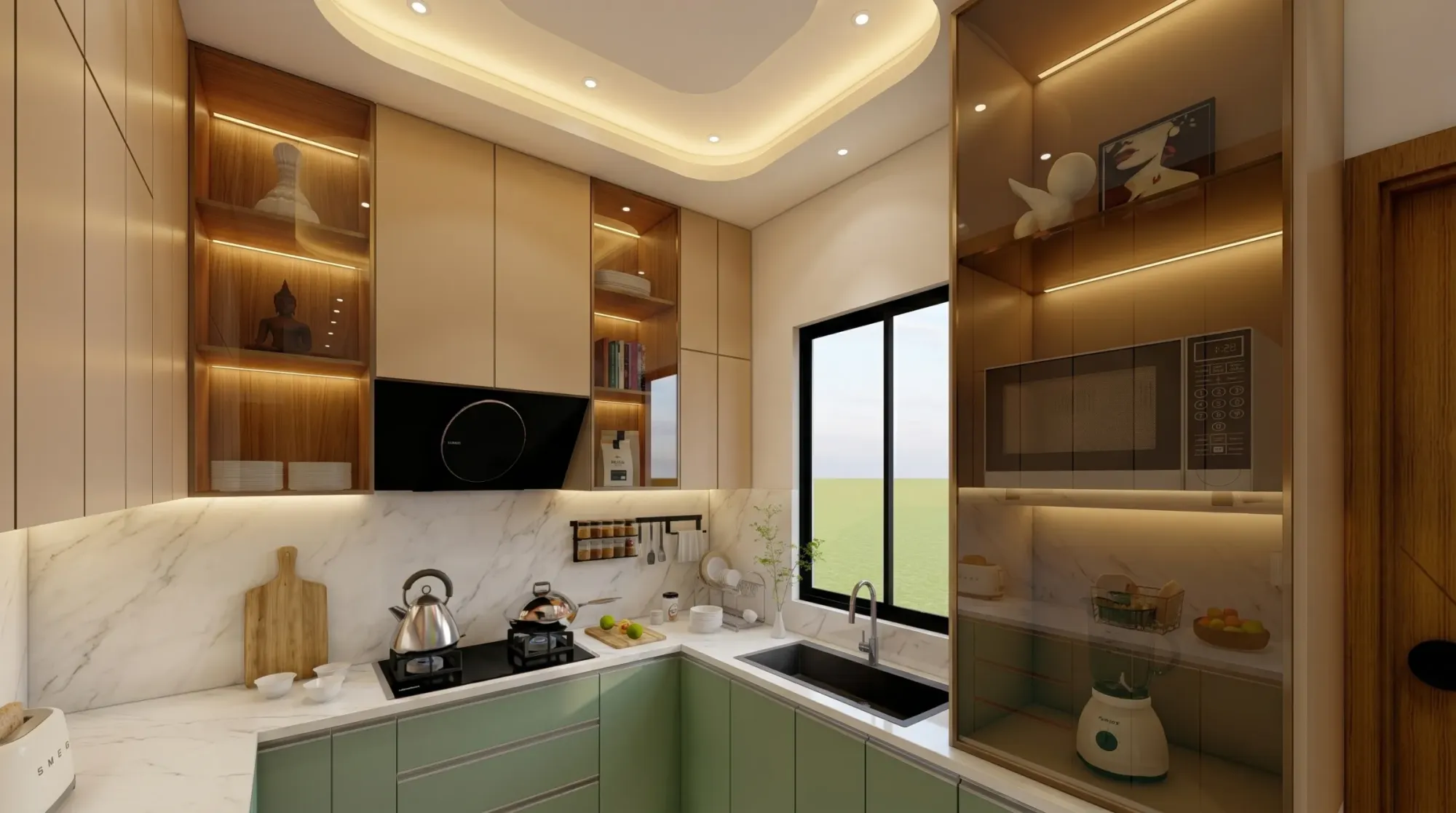
If you have ever stood in a New Town flat kitchen on Ashtami morning trying to plate khichuri bhog for fifty guests while your mother-in-law fights you for counter space and the exhaust fan gives up somewhere around the second batch of labra, you already know the problem this article is about. Most kitchens in New Town, whether in a G+3 residence in Action Area I or a mid-rise flat closer to Eco Park, are designed for a family of four cooking three meals a day, not for four days of community-scale festival cooking where the pot count triples and the guest list doubles.
We have worked on 330+ buildings across New Town and Salt Lake since 2014, and Durga Puja bhog planning comes up almost every August and September in some form, whether it is a housing block organising a joint bhog, a large joint family hosting relatives who fly in for the puja, or a single flat that has become the informal gathering point for the building. The kitchen that works fine in June is rarely the kitchen that survives an Ashtami bhog for fifty, and the fix is not always a full renovation. Sometimes it is a counter reconfigured, an exhaust point relocated, or a storage wall added in the right place.
This piece walks through how we actually think about capacity planning for a kitchen that needs to feed a crowd a handful of days a year while staying comfortable and efficient for the other 360, specific to the flats and building types we see in New Town.
Why a Normal New Town Kitchen Breaks Under Bhog Load
Most New Town kitchens, especially in flats built over the last ten to fifteen years, are sized around a compact L-shaped or parallel layout with roughly six to eight feet of usable counter run. That is enough for the kitchen work triangle to function well for daily cooking, sink to stove to fridge, short walking distances, nothing in the way. The moment you add bhog-scale cooking, that triangle collapses because you are no longer cooking one dish at a time, you are running two or three burners simultaneously, prepping vegetables for fifty portions on a counter sized for four, and storing raw ingredients in volumes the fridge and shelving were never meant to hold.
The catch here is that the failure point is rarely the stove itself, most Indian kitchen stoves can handle the burner load. What actually breaks down is counter space for staging, floor space for extra gas cylinders or induction units, ventilation capacity for four days of continuous steam and oil smoke, and a clear path for people to move pots in and out without colliding. We have seen kitchens that looked perfectly adequate on a floor plan turn into a genuine bottleneck the day fifty plates need to go out within a two-hour window.
Sizing the Kitchen for Fifty: What the Numbers Actually Look Like
As a rough planning baseline for a bhog-style cook for fifty guests, we typically work backward from three numbers: how many simultaneous cooking stations the layout can support, how much staging counter is needed per station, and how much cold and dry storage the pre-puja shopping requires. A single home cook managing three dishes for fifty people generally needs at least two active cooking points running in parallel, four to five linear feet of clear counter per station for chopping and plating, and enough shelf or crate space near the kitchen entry to hold two to three days of vegetables, rice, and dals without them ending up on the kitchen floor.
These are not fixed rules, a flat with a decent utility balcony can shift a lot of the prep load outside the kitchen entirely, and a duplex with a separate wet kitchen changes the math again. But if your current kitchen cannot fit two people working at right angles to each other without stepping on each other's feet, that is the first sign the layout needs rethinking before the next puja season, not during it.
Storage, Prep Zones, and Where People Actually Stand
The single biggest planning mistake we see in New Town flats is treating the kitchen as the only cooking zone when the dining area, balcony, and even the living room edge often end up doing informal prep work during a big cook anyway. Rather than fighting that, we design around it, a fold-out or wall-mounted prep counter just outside the kitchen door, cabinetry that opens up extra dry storage only when needed, and a clear, uncluttered path from the kitchen to wherever the serving table is set up on puja day.
| Everyday Kitchen Layout | Bhog-Ready Kitchen Layout |
|---|---|
| Single 6-8 ft counter run | Counter run plus a fold-out or adjoining prep surface |
| One cooking station in daily use | Layout supports two stations working in parallel |
| Fridge sized for weekly groceries | Extra dry storage zone activated for festival stock |
| Standard exhaust hood | Exhaust sized for sustained multi-burner use |
This is also where ergonomics genuinely matters and not as a buzzword, if the person plating khichuri has to twist ninety degrees and reach over someone else's shoulder every time, that fatigue compounds over four days of Ashtami through Dashami cooking. We usually recommend a walk-through with the actual people who will be cooking, not just a floor plan review, because the person who has done bhog cooking for fifteen years knows exactly where the traffic jam happens before we ever put pen to paper.
- Map where fifty guests will actually sit or stand while eating
- Identify a second prep surface outside the main kitchen for overflow chopping
- Confirm cold storage can hold two to three days of festival-quantity vegetables and dairy
- Check exhaust and window ventilation against continuous four-day cooking, not daily use
- Plan a clear pot-to-serving-table path with no sharp turns or narrow doorways
For families hosting other large gatherings through the year, the same planning logic applies well beyond Durga Puja, we have written separately about hosting an annaprashan or rice ceremony in a small flat, and the counter and storage principles carry over almost exactly.
Ventilation and Heat: The Part Everyone Underestimates
Four days of continuous cooking in an enclosed New Town kitchen generates a heat and humidity load that a standard exhaust fan, sized for daily household cooking, was never built to clear. We routinely see kitchens where the exhaust is adequate for a normal evening meal but leaves the room uncomfortably warm and the walls visibly damp by the second day of bhog prep, particularly in flats where the kitchen window opens onto an internal shaft rather than open air. Getting natural ventilation working alongside mechanical exhaust, rather than relying on the exhaust fan alone, makes a real difference here, and it is worth checking your exhaust fan's actual CFM rating against the room volume before puja season rather than after, a topic we cover in more detail in our piece on bathroom exhaust fan CFM for Kolkata humidity, and the same CFM logic applies directly to kitchens under sustained load.
- 01Site walk-through and current kitchen assessment
- 02Layout and storage plan sized for peak-load cooking
- 03Material and fixture selection, counters, exhaust, cabinetry
- 04Execution over the standard 8-12 week interior timeline
- 05Final walk-through before the next festival season
Building It In Without Losing the Kitchen the Rest of the Year
The kitchen you build for fifty guests on Ashtami has to also work as a normal kitchen for a family of four on a random Tuesday in March, so the goal is never to permanently oversize the space, it is to build in flexibility that activates only when needed. That usually means fold-away or extendable counters rather than permanently wider ones eating into circulation space, modular storage units that can be reconfigured rather than fixed shelving, and an exhaust and ventilation system sized for peak load that does not feel oversized or noisy on an ordinary day. Our approach to modular kitchen design in New Town flats leans heavily on this kind of dual-mode thinking, because almost every family we work with has some version of the fifty-guest problem, whether it is Durga Puja, a wedding season, or simply a large extended family that visits together.
Many families also want the kitchen and the adjoining dining space to work together as one flow during large gatherings, which is really a question of overall residential interior design rather than the kitchen alone, and for families who care about the direction of the cooking and dining zones, we build this into our Vastu-compliant design work from the earliest planning stage rather than retrofitting it later. If you are still deciding whether this needs an architect, an interior designer, or both, our guide on who to hire first in New Town walks through that decision in more detail, and our broader guide to apartment and flat interiors in New Town covers the layout fundamentals this article builds on.
At the end of the day, a kitchen that can genuinely handle bhog for fifty is not about building something enormous, it is about understanding exactly where the current layout breaks under load and fixing those specific points, the counter that is six inches too narrow, the exhaust that clears smoke for one burner but not three, the storage wall that has no room for festival-quantity dals. We recently worked through a very similar brief on a residence in Action Area II, where the family wanted a kitchen that could host both daily cooking and large joint-family gatherings, and the project details are here if you want to see how the layout logic played out in a real flat.
If your kitchen has been the source of Ashtami morning stress for a few years running and you would rather fix it properly before the next puja season than patch around it again, get in touch with us and we will walk the space with you, the same way we have for families across New Town and Salt Lake since 2014, and tell you honestly what needs to change and what does not.