






Curated vs Catalogue: Why Studio Contour Does Not Sell You a Package
When a homeowner in New Town or Salt Lake starts calling around, the quotes come back in two very different shapes, and the shape matters more than the number. One shape is a package, so you get a per-square-foot rate, a tier name, a list of inclusions, and a timeline that was printed before anybody looked at your plot. The other shape is a scope, so you get a set of questions first, a site visit, a read of what your land and your sanction route actually allow, and only then a price. Both shapes are legitimate businesses, and the packaged one is genuinely faster to buy, but they produce different houses, and most people do not realise that until the walls are up.
We are Studio Contour, an architecture and interior practice in New Town Kolkata, working since 2014, with 330+ buildings delivered across New Town, Salt Lake, Rajarhat and greater Kolkata. We do not sell packages, and this post is basically our honest explanation of why, including where a package would serve you better than we would. The real decision in front of you is not which brand is nicer, right, it is whether your project is standard enough that a catalogue fits it, or particular enough that a catalogue will quietly force your family to live around its assumptions.
What a package model is actually optimising for
A catalogue or package provider is optimising for repeatability, and that is not a criticism, that is the whole engineering achievement of the model. If a firm prices a fixed three-bedroom layout with a fixed material set and a fixed drawing count, it can train a large team on one system, buy materials in volume, and quote in a day instead of a fortnight. To keep that machine running, the design has to be treated as mostly settled before you arrive, so what you are choosing is which pre-solved version you want, and the variables you get are finishes, colours and add-ons rather than the plan itself.
The catch here is what happens when your plot does not match the assumption. A corner plot in Action Area II with a road on two sides, a plot where the buildable envelope is squeezed after setbacks, a family that needs a ground-floor bedroom for an elderly parent, a client who wants the kitchen oriented a particular way for Vastu reasons, any of these pushes against the fixed plan, and a fixed plan can only absorb so much push before it becomes a change order or a compromise you agreed to at 11 pm over WhatsApp.
| Package or catalogue model | Curated per-project model |
|---|---|
| What you choose | Which pre-priced tier fits closest |
| What you choose | What the plot, brief and budget actually allow |
| Layout | Largely pre-set, finishes are the variable |
| Layout | Drawn from your plot, family and orientation |
| Pricing | Quoted fast from a rate card |
| Pricing | Scoped after site study, so slower to quote |
| Your daily contact | Often a coordinator or junior, by design of scale |
| Your daily contact | The principal architect stays attached |
| Sanction work | Frequently a separate vendor or your job |
| Sanction work | Handled in-house alongside design |
| Best for | Standard plot, standard brief, speed matters |
| Best for | Odd plot, specific brief, long-term fit matters |
What curated actually means in our process, not as a slogan
Curated is an easy word to print, so here is the mechanical version. Before we price anything, we visit the plot and record what is real, so road width and approach side, neighbouring construction and where it will block light in ten years, existing trees, soil and level, and the direction the main frontage faces. Then we work out the buildable envelope, because the floor area ratio and coverage limits applicable to your plot decide how much you can build and on how many floors, and those parameters vary by plot and category and do get revised, so we confirm them against the current rules with the relevant authority rather than assuming last year's numbers. Only after that do we draw, and the first drawings are options, not a single take-it proposal.
Personalised, similarly, means the line items are yours. On one project the money goes into a double-height living volume and a good staircase because that is what the family gathers around, and on another it goes into three properly ventilated bathrooms and a utility yard because that is what they will use daily. The same budget produces genuinely different houses, and a tier card cannot express that difference, which is the core of our residential architecture work and equally of how we scope residential interior design when interiors follow.
- 01Plot and brief study on site
- 02Buildable envelope confirmed with current rules
- 03Two or three layout options, openly compared
- 04Scope and indicative budget agreed line by line
- 05Sanction drawings prepared and filed
- 06Site stage with the same team still attached
Why the handoff problem matters more than the design problem
Most of the pain we are called in to rescue is not aesthetic, it is coordination. When architecture sits with one party, interiors with a second, and the sanction paperwork with a third, every gap between them becomes your problem, because the interior team says the beam position is wrong, the architect says the interior team changed the layout, and the paperwork stalls because a revised drawing never travelled. That is textbook scope creep, and it costs weeks, not hours.
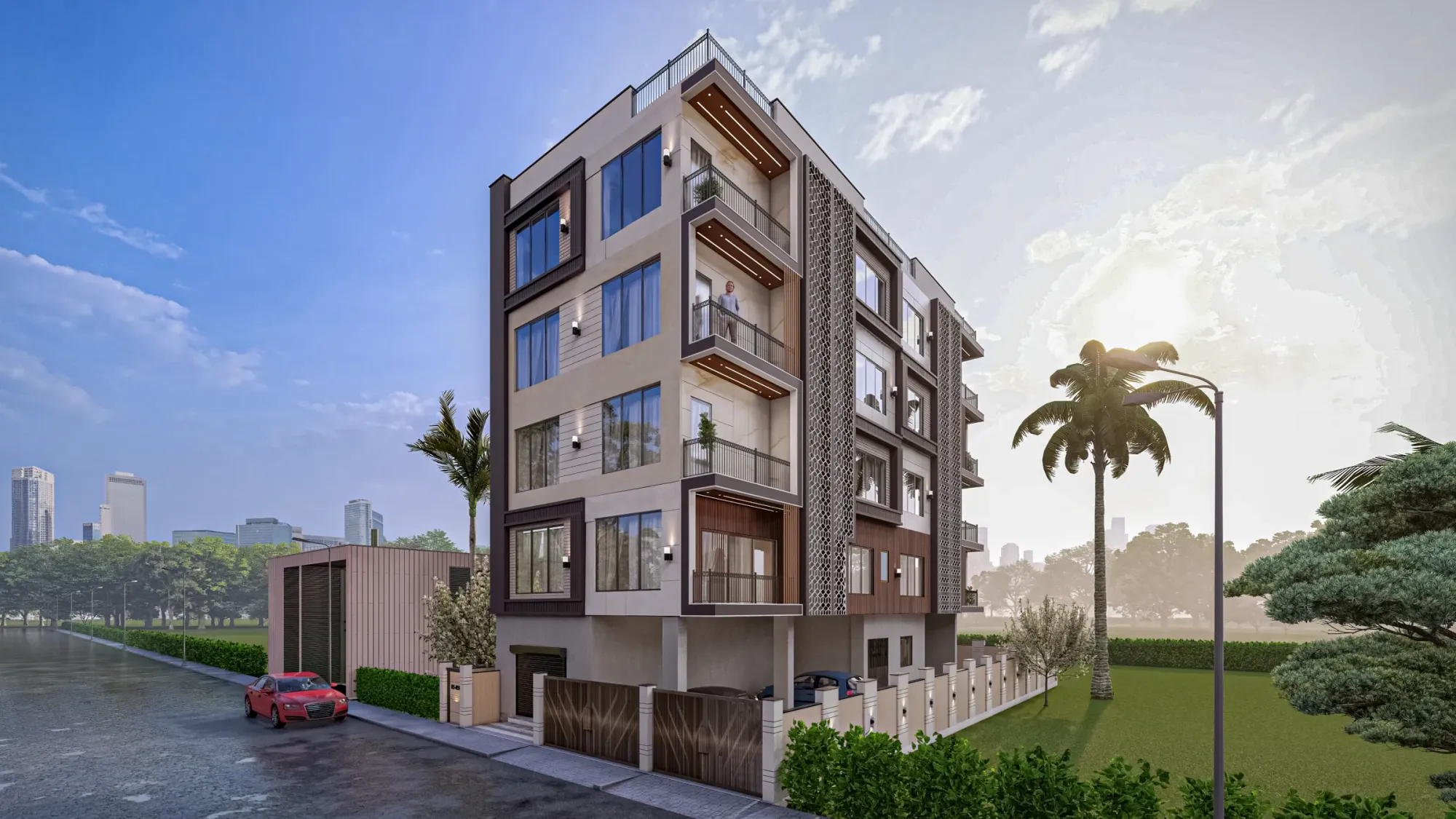
We keep architecture, interiors, elevation design, 3D visualisation, Vastu-compliant design, renovation and commercial fit-outs under one roof, and we take projects through the NKDA, KMC and Bidhannagar sanction processes ourselves, precisely so there is nobody to blame sideways. Practically, that means one drawing set feeds sanction, structure and interiors, one team answers the site questions, and when the mason calls at 8 am about a wall that does not agree with the drawing, the person who drew it picks up. Principal architect Sumana Kumar stays attached from first sketch to handover instead of the project dropping to a junior after signing, which is the single structural difference most clients feel, and you can see how that plays out at scale on the Filigree House project in New Town.
When a package is honestly the better call
We lose enquiries to package providers and some of those losses are correct. If your plot is a regular rectangle in a planned block, your brief is a conventional three-bedroom home, your budget is tight enough that design fees genuinely hurt, and speed matters more than fit, then a fixed package is the rational buy. You will get a competent standard house faster and for less coordination effort than a curated process needs.
A package also suits people who do not want to make many decisions, and that is a real preference, not a weakness. A curated process asks you to choose repeatedly, sit through option reviews, and hold opinions about things you had not thought about, and for some families that is a burden rather than a pleasure. Similarly, if you are doing a small cosmetic refresh rather than reworking how the house functions, paying for a full design study is overkill.
- Regular plot in a planned block, no unusual constraints
- Conventional brief with no accessibility or multi-generation needs
- Speed and low decision load matter more than long-term fit
- Cosmetic refresh rather than a change in how the home works
- Comfortable with a coordinator rather than a named architect on site
If two or more of those are false for you, a catalogue will fight your project, and you will end up paying for customisation anyway, just later and less coherently. Before you decide, it is worth reading how to compare two architecture proposals that look identical and how architect fees in Kolkata are actually structured, because fee shape and scope shape are the same conversation.
What this means for your budget conversation
Indicative only, and never a quote, but the pattern we see holds across projects. Package pricing looks lower at signing and then moves, because anything outside the tier is priced as an extra, and the extras arrive when you are emotionally committed and least able to say no. Curated scoping looks higher at signing and moves less, because the study that would have produced those extras happened before the number was written. Neither is automatically cheaper at completion, so compare landed cost and not signing cost, and our cost to build a house in New Town guide walks through the heads that usually get left out.
Deciding, without being sold to
At the end of the day the question is not curated versus catalogue as an argument about quality, it is a question about fit, and a reader can always tell when a page is only selling, so we would rather you self-select correctly than hire us and be mismatched. If your project is standard and you want speed, buy the package with clear eyes and get on with it. If your plot is awkward, your family has specific needs, your orientation matters to you, or you simply want the person who designed the house to still be answering the phone in month nine, then a scoped process is what you are looking for, and our guide to choosing an architect in New Town Kolkata sets out what to verify before you commit to anyone, including us. When you are ready to talk about your actual plot rather than a tier, get in touch with the studio and bring your land documents, and we will tell you honestly whether your project needs us or does not.