






Vendor Sourcing Transparency: A Question Every Kolkata Homeowner Should Ask Before Hiring
Vendor Sourcing Transparency: A Question Every Kolkata Homeowner Should Ask Before Hiring
Ask any interior design firm in Kolkata where your modular kitchen shutters are coming from and watch what happens to the conversation, because most of them will give you a brand name, a vague markup percentage, and a change of subject, and that reaction alone tells you more about how they run projects than their portfolio ever will. We have been asked this question hundreds of times since we started Studio Contour in 2014, and we answer it the same way every time, with the actual vendor name, the actual rate we negotiated, and the actual margin we add on top, because at the end of the day a client who cannot see where their money is going is a client who has handed over control of their own home.
This is not a small issue dressed up as a big one. Vendor sourcing is where a large share of every interior fit-out budget actually lives, plywood and laminate, modular kitchen carcasses and shutters, sanitaryware, tiles, hardware, false ceiling gypsum and grid systems, lighting fixtures, and the labour that assembles all of it on site, and if the person managing that spend has no obligation to show you the paper trail, you are trusting a stranger with a six or seven figure decision on faith alone. We have delivered 330+ buildings across Kolkata, New Town and Salt Lake since 2014, and the one thing that separates the clients who walked away happy from the ones who called us mid-project in a panic about a different firm was almost always this exact question, asked too late or not asked at all.
What Vendor Sourcing Transparency Actually Means on a Live Site
The phrase sounds abstract until you put it against a real bill of quantities, so let us make it concrete. On a typical 3 or 4 BHK interior project in New Town, the material and vendor spend usually runs somewhere between 55 and 65 percent of the total project cost, with the rest going to design fees, site labour, and project management overhead, and inside that material spend there are dozens of individual vendor relationships, from the plywood supplier in Topsia to the modular hardware importer to the local tile showroom on the New Town-Rajarhat stretch. A transparent studio shows you which vendor supplies which item, what the studio's negotiated rate is versus retail, and what margin, if any, sits on top of that rate before it reaches your invoice. A studio that is not transparent bundles all of this into a single lump-sum line item called "materials" and asks you to trust the total, and the catch here is that you have no way to independently verify that number unless you go vendor shopping yourself, which most homeowners simply do not have the time to do while also managing a full-time job and a young family.
We built our residential interior design process around itemised vendor disclosure from day one, not because we are trying to look virtuous, but because it is genuinely the only way we know to keep a client's trust over an 8 to 12 week build, which is our typical turnaround for a full interior fit-out in New Town or Salt Lake. When a client can see that their false ceiling gypsum board is coming from a specific named vendor at a specific rate, they stop second-guessing every invoice, and we stop having to defend every line item after the fact, so it genuinely makes the whole engagement faster and less adversarial for both sides.
Freelancer, Builder Package, or Independent Studio: A Fair Comparison
It would be dishonest of us to pretend every alternative to hiring a studio like ours is bad, because that is not true, and a homeowner deserves a genuinely balanced picture before deciding. Hiring a solo freelancer designer for a New Town flat can work well if your project is small, your taste is already decided, and you are comfortable managing vendors and site labour yourself, and it is usually the cheapest route on paper. Going with the builder's in-house interior package, common in gated developments across Action Area 1 and 2, saves coordination effort because everything sits under one contract, but you almost never see itemised vendor rates in that model, since the builder has already baked their markup into the package price before you even see a quote. An independent studio with an in-house execution team sits in the middle on cost but gives you the most control, because a proper studio should be showing you architect drawings, vendor quotations, and site progress at each stage rather than a single bundled number at the end.
| Builder Package | Independent Studio (like us) |
|---|---|
| Single bundled quote, vendor names rarely disclosed | Vendor-wise cost breakup shared before work begins |
| Markup baked in before you see any number | Negotiated vendor rates shown alongside our margin |
| Limited flexibility on brand substitutions | You can approve or swap vendors at key stages |
| Site visits often restricted or scheduled by builder | Site access whenever you want it, on a working New Town or Salt Lake project |
The honest answer is that no route is automatically wrong, but the amount of genuine transparency you get scales with how much the studio has to lose by hiding something, and a studio with a 330+ building track record and repeat referral business in the same neighbourhoods has far more to lose from a client feeling cheated than a one-off freelancer or a builder who has already collected their package fee. We would rather earn the next project through an honest invoice than the current one through a hidden markup, and that is genuinely the calculation behind how we price vendor work.
How This Plays Out on an Actual New Town Site
We can talk about principles all day, but the clearest way to explain vendor transparency is to walk through how it actually looks on a project we have delivered. On our Salasar G4 Residence build in Action Area 1, New Town, the client's biggest cost concern going in was the exterior finish and the false ceiling package across the ground and first floor, both items where vendor selection genuinely swings the budget by a significant margin depending on brand and grade. We shared the vendor-wise quote for both categories before ordering a single sheet of material, including the two alternate vendors we had shortlisted and why we recommended the one we ultimately used, and the client signed off on the exact rate before we placed the order, not after the material had already arrived on site.
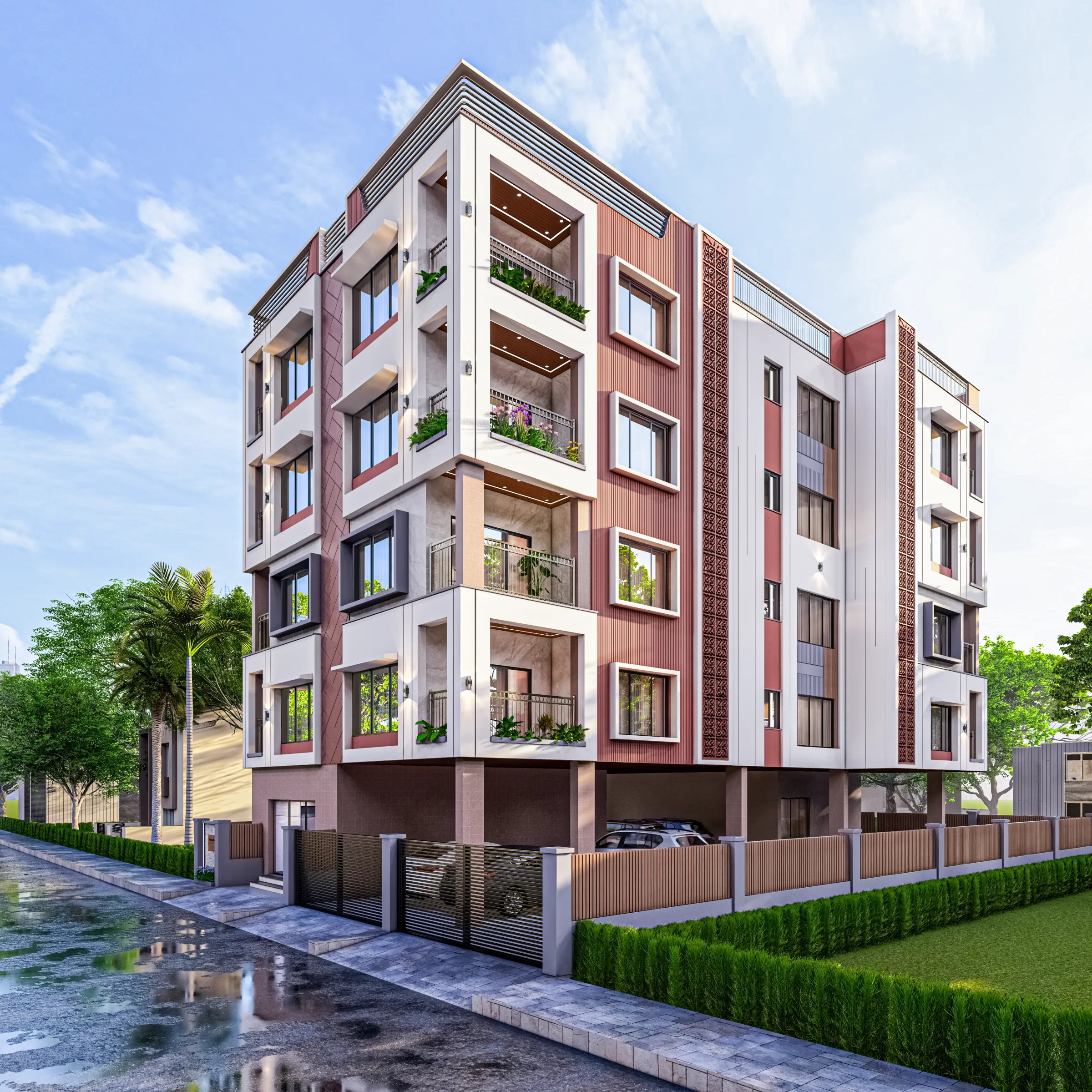
That level of detail is what we mean when we talk about custom furniture design and fit-out work being done the right way, because the moment a client sees the actual vendor invoice next to the studio's quoted rate, the relationship shifts from "trust me" to "verify this yourself if you want," and almost nobody exercises that option once they realise it is genuinely available to them. You can see more of how this project came together on the Salasar G4 Residence project page, and it is one of several examples in our full project portfolio where vendor documentation was part of the deliverable, not an afterthought.
Why Local Regulatory Knowledge Feeds Directly Into Vendor Choices
Vendor sourcing transparency does not exist in a vacuum, and in New Town and Salt Lake it is tied directly to how well a studio understands the sanction and compliance environment those materials have to sit inside. NKDA and Bidhannagar both have specific expectations around structural material grades, fire-rated materials in common areas, and finish specifications that get referenced during completion inspections, so a vendor choice that looks fine on a spec sheet can create a compliance headache later if the studio picking it was not also thinking about the sanction file. We have handled enough NKDA approvals across New Town to know which vendor certifications actually hold up during a completion certificate inspection and which ones look good on paper but cause delays, and that knowledge only helps a client if we are actually sharing it rather than treating vendor selection as a closed-door decision.
- Vendor name and GST registration disclosed for every major line item
- Negotiated rate versus retail rate shown side by side
- Studio's margin stated as a percentage, not hidden inside the total
- Material grade specifications matched to NKDA or Bidhannagar compliance needs
- Site visit access to verify material delivery against the invoice
This is also where the gap between a general contractor working off a fixed lump sum and a design studio managing vendors transparently becomes most visible, because a contractor incentivised purely by finishing under budget has every reason to substitute a cheaper material quietly, while a studio whose reputation depends on repeat referrals across the same New Town and Salt Lake blocks has the opposite incentive. If you are renovating an older flat rather than building new, the same logic applies even more sharply, and it is worth reading through the common red flags to watch for when hiring an interior designer in New Town before you sign anything, because vendor opacity is consistently one of the earliest warning signs people miss.
What 330+ Buildings Have Taught Us About Trust
Twelve years and 330-plus buildings is not a number we put on a website to sound impressive, it is genuinely the reason our vendor relationships work the way they do, because a supplier who has done business with us across a hundred-plus New Town and Salt Lake projects has no incentive to quote us inflated rates on project 331, and that compounding trust is what lets us pass real savings back to clients instead of pocketing the difference. A newer studio, or a freelancer working alone, simply has not built that volume of repeat vendor relationships yet, so they either pay closer to retail rate or they have to take a bigger margin to make the arithmetic work, and neither of those situations helps the client sitting across the table.
- 01Vendor-wise BOQ shared before ordering
- 02Client approves rate and vendor per category
- 03Material delivered and verified against invoice on site
- 04Final account matches the disclosed vendor rates, no surprises
This pattern holds whether we are doing a full residential architecture build from the ground up or a targeted interior refresh, and it is a large part of why we can commit to an 8 to 12 week turnaround on most interior fit-outs, because we are not spending the first few weeks re-negotiating vendor relationships from scratch on every single project. If you want a sense of how this shows up across a larger body of work, the trust signals worth checking before hiring a Kolkata interior designer cover several of the same due diligence points we are describing here, vendor transparency being one of the most consistently overlooked ones.
The Questions Worth Asking Before You Sign Anything
| Question to Ask | What a Transparent Answer Sounds Like | What a Red Flag Sounds Like | ||||
|---|---|---|---|---|---|---|
| "Can I see the vendor-wise cost breakup?" | "Here it is | vendor name | rate | and our margin" | "Trust us | it's all included in the quote" |
| "What's your markup on materials?" | "A stated percentage | usually 10-15%" | "Vague deflection or 'industry standard'" | |||
| "Can I visit the site during material delivery?" | "Yes | anytime | here's the schedule" | "Site visits are restricted to weekends only" | ||
| "Do you have a completed project I can see in person?" | "Here are three | with addresses" | "We're just starting out | no portfolio yet" |
None of this is complicated once you know to ask it, and that is exactly the problem, because most homeowners walk into their first design consultation assuming professionalism implies transparency, when the two are not actually the same thing, and plenty of well-spoken, well-reviewed studios still run a closed-book vendor process. Doing basic due diligence on this one question before signing a contract will tell you more about how a project will actually go than almost anything else in the pitch meeting, including the mood board.
If you are planning a turnkey interior fit-out anywhere in New Town or Salt Lake and you want a studio that will show you the vendor invoice next to the quote rather than asking you to take the total on faith, that is exactly how we have built our process since 2014, across more than 330 buildings and counting. We would rather have that conversation with you now, before any material is ordered, than defend a line item to you six weeks into a build, so get in touch through our contact page and we will walk you through what vendor sourcing transparency actually looks like on a project sized and scoped for your home.