







Architect Credentials in India: CoA Registration and What It Means
If you are about to hand a plot in New Town or a family house in Salt Lake to somebody who calls themselves an architect, the single cheapest piece of due diligence available to you takes about four minutes and costs nothing, and almost nobody does it. We are talking about checking whether the person is actually registered with the Council of Architecture, which is the statutory body set up under the Architects Act, 1972, and which is the only thing in India that legally entitles a person to call themselves an architect at all.
We say this as a studio that has been working out of New Town since 2014 and has delivered 330+ buildings across New Town, Salt Lake, Rajarhat and greater Kolkata, and in that time we have been called in to clean up a fair number of projects that started with a drawing set from somebody whose credentials nobody checked. The pattern is depressingly consistent, right, the plot owner met somebody through a contractor, the fee quoted was low, drawings appeared quickly, and then the sanction application ran into trouble at the municipal counter and suddenly nobody was picking up the phone. The catch here is that by the time you discover the problem you have usually already paid an advance and lost a construction season.
So this piece is not a lecture about professional ethics, it is a practical explainer on what CoA registration means, what it does not mean, how you verify it yourself in a few minutes, and what other credentials actually matter when you are choosing an architect for a plot in New Town, Kolkata or an old house in Salt Lake. Our principal architect Sumana Kumar has taken residential and commercial projects through the NKDA, KMC and Bidhannagar Municipal Corporation sanction processes for over a decade now, and the questions in this article are the ones we wish more clients asked us on day one.
What CoA registration actually is
The Council of Architecture is a statutory body constituted under the Architects Act, 1972, and its core job is to maintain the Register of Architects for India and to regulate the profession and architectural education. Under that Act, a person who is not registered with the CoA cannot use the title and style of architect, so the word itself is legally protected in a way that words like designer, consultant, planner and draughtsman are not. That distinction matters more than most people realise, because a business card that says interior designer or building consultant is completely legal and completely unregulated, and a business card that says architect is a claim about a specific entry in a national register.
To get on that register a person has to hold a recognised professional degree in architecture from an institution the Council approves, and then apply for registration, and then keep that registration current through renewal. The Council issues each registered architect a registration number, which is the identifier you can look up. Practically speaking, when you ask a prospective architect for their CoA registration number and they give it to you within a minute without any fuss, you have learned something useful, and when the question produces vagueness or a change of subject, you have learned something even more useful.
How to verify registration yourself, in about four minutes
Verification is genuinely simple and you do not need any insider access to do it. Ask for the full name as registered and the CoA registration number, then look that up on the Council of Architecture's own online register of architects, and confirm that the name, the number and the registration status all line up with the person sitting in front of you. Cross-check the name against the firm they say they practise with, because plenty of perfectly legitimate practices have one registered principal and a team of assistants, and that is normal, but you want to know which named person is professionally responsible for your drawings.
The second half of verification is about currency rather than existence, so confirm the registration is live and renewed rather than lapsed, and confirm the person you are actually going to work with day to day is the registered one or reports to them. We have written a longer walkthrough of this in our guide to verifying an architect's registration in Kolkata, including what to do when the name on the certificate and the name on the invoice do not match, which happens more often than you would expect.
- Ask for the full name exactly as registered with CoA
- Ask for the CoA registration number in writing, on email or WhatsApp
- Look the number up on the Council of Architecture register yourself
- Confirm the registration is current, not lapsed
- Confirm the registered person is the one signing your sanction drawings
- Ask which of their built projects you can physically visit
What CoA registration does not tell you
Here is where we will be honest in a way that is slightly against our own interest, because registration is a floor and not a ceiling. A valid CoA number tells you the person cleared a recognised professional education and is legally entitled to practise, and it tells you there is a professional body they answer to, and that is genuinely worth something. What it does not tell you is whether they have ever taken a building through NKDA, whether they understand how floor area ratio is calculated on a Rajarhat plot with an odd shape, whether their drawings survive contact with a Kolkata contractor, or whether they will still be answering your calls in month eighteen of a twenty-four month build.
Registration is national and uniform, and building approval is intensely local and not uniform at all, so the same registered architect who is excellent in Pune can be genuinely slow in New Town simply because the sanction workflow, the document set and the site conditions are different. The Kolkata Municipal Corporation sanction process and the NKDA building plan sanction process in New Town are two different animals with different document requirements and different review habits, and a Bidhannagar file is different again. So verify the credential, then separately verify the local track record, because they are two distinct questions and conflating them is how people end up disappointed.
| What CoA registration proves | What it does not prove |
|---|---|
| Recognised professional education | Familiarity with NKDA or KMC document sets |
| Legal entitlement to the title architect | Ability to price a build realistically for Kolkata |
| Accountability to a statutory body | Site supervision quality once construction starts |
| A national identity you can independently verify | Whether they have built anything near your plot |
The credentials that matter alongside CoA in New Town and Salt Lake
Once the registration checks out, the questions that actually predict how your project will go are local and specific. Ask how many buildings the practice has taken through sanction in your specific jurisdiction, ask to see a completed document set from a recent project so you can see what a real submission looks like, and ask what happened on a project where the file got queried, because everybody gets queried eventually and the useful signal is how they handled it rather than whether it happened. A practice that has never had a query is either very new or not telling you everything.
Ask about the boundary of scope too, because this is where a lot of Kolkata projects quietly go wrong. Find out whether the fee covers only drawings, or drawings plus sanction liaison, or drawings plus sanction plus site supervision through completion, and get that written down. The related question people ask us constantly is about the difference between engaging an architect and engaging an empanelled engineer for a sanction file, and the honest answer is that they are different roles with different scopes and the right choice depends on how complex your building is and how much design intent you want protected through construction.
Then there is the document reality, which is boring and decides everything. Most delays we see are not design delays at all, they are paperwork delays, so it helps enormously to know upfront what the documents required for an NKDA building sanction actually are and which of them sit with you as the owner rather than with the architect. Title papers, mutation status and possession documents are yours to sort out, and no architect however good can draw around a gap in your land records, so starting that in parallel with design saves weeks.
- 01Verify CoA registration
- 02Check local sanction track record
- 03Agree written scope and fee
- 04Design and drawings
- 05Sanction submission
- 06Construction and supervision
How we handle this at our studio, plainly
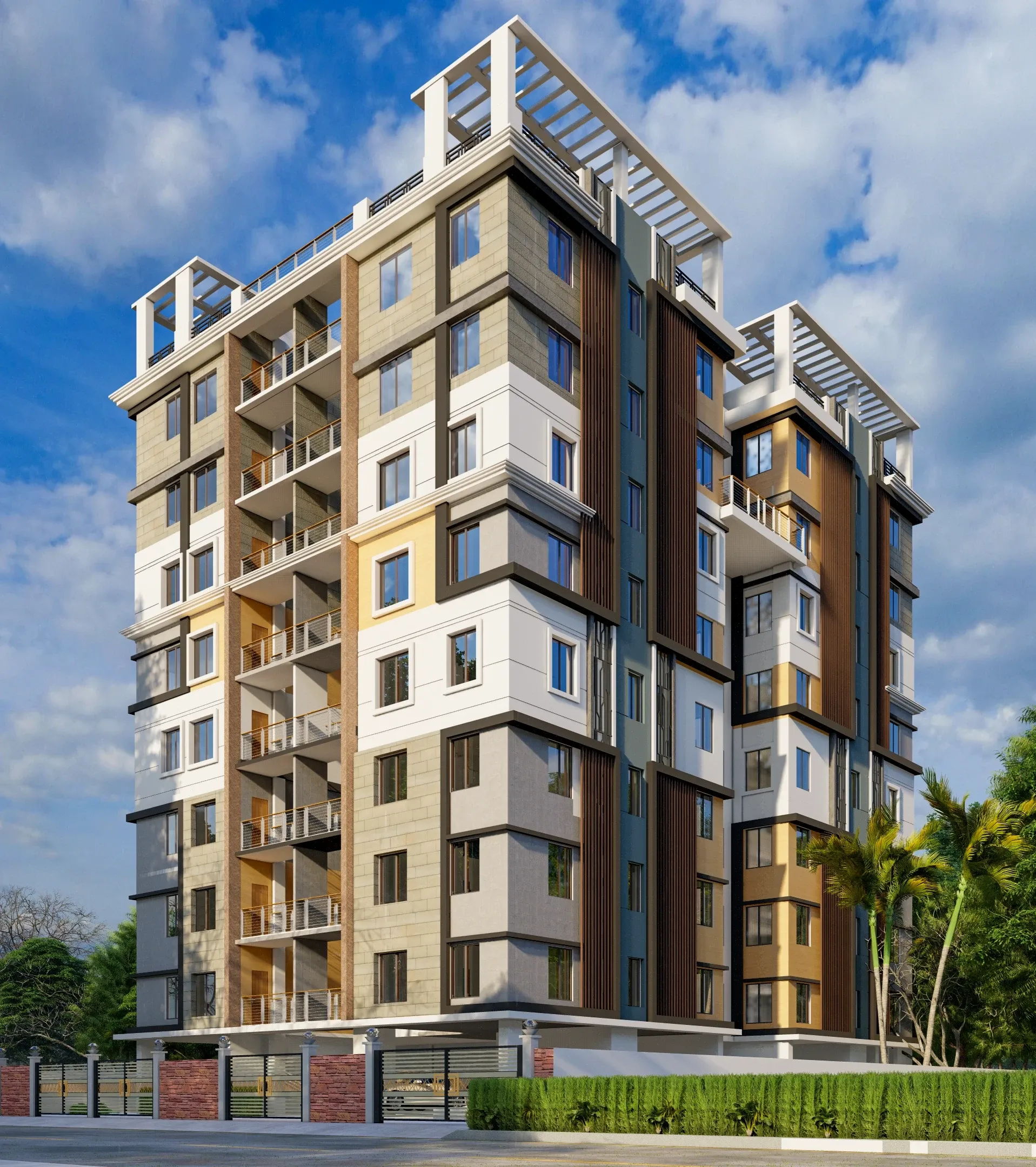
When a plot owner comes to us we expect to be asked for credentials, and we would rather the question came early than late. Beyond the registration itself, what we put on the table is the work, so we will show you drawing sets, we will show you what the same design looked like in 3D visualisation before a single brick moved, and we will point you at buildings you can go and stand in front of, like our DE Block residence in New Town, because a finished building on a real plot is a harder thing to fake than a portfolio image.
Sumana's view on this, and it is a view the whole studio works to, is that the design conversation and the compliance conversation should never be separated, because a beautiful plan that eats into your setback is not a design, it is a delay. That is why our residential architecture work starts with the plot rules rather than with a mood board, and why our renovation and remodelling work on older Salt Lake houses begins with what the existing structure and the current rules will actually permit. Basically, we would rather have the awkward conversation in week one than in month nine.
At the end of the day, checking CoA registration is the easy part and you should absolutely do it, and then you should do the harder part, which is finding out whether the person understands your jurisdiction, your plot and your budget well enough to carry the project all the way to a completed, occupiable building. If you are at that stage with a plot in New Town, Salt Lake or Rajarhat and you want to ask us these questions directly, including the uncomfortable ones, get in touch with our studio and we will walk you through the credentials, the process and a realistic timeline for your specific site before you commit to anything.