






Black Modular Kitchen Designs: 14 Ideas That Look Expensive
Black modular kitchens are having a real moment in Kolkata right now, and when clients bring us this brief we know exactly what they are actually asking for, which is not just a colour change but a kitchen that photographs like it belongs in a five-star property while still holding up to daily dal-chawal cooking, humidity, and the general wear of a working Bengali household.
The honest answer is that black reads expensive faster than almost any other colour in cabinetry, because it hides nothing and forgives nothing, so the finish, the hardware, and the lighting around it have to be right or the whole thing looks flat and cheap instead of moody and premium. We have designed and delivered enough of these across New Town, Salt Lake, and the wider city to know exactly where that line sits.
This piece walks through the shade variants, the material choices that actually matter, fourteen design directions we keep coming back to, what these kitchens realistically cost in West Bengal right now, and the practical stuff around maintenance and layout that nobody mentions until the kitchen is installed and the first fingerprint shows up on day three.
Why black reads expensive when it's done right, and cheap when it isn't
The thing about black cabinetry is that it has zero tolerance for bad light and bad proportion, so a matte black kitchen under one tube light in a boxy 8x10 room looks like a cave, while the same colour under a well-planned false ceiling with layered lighting looks like a spread from a design magazine. This is the single biggest lever in this whole category, and it costs less than most people assume.
For instance, a continuous cove light along the top of the wall units, task lighting tucked under the wall cabinets at counter level, and a warm accent inside any open shelving does more to make black cabinetry look premium than upgrading the shutter material by one entire tier. Our false ceiling and lighting design work on these projects is basically half the reason a black kitchen looks rich instead of heavy, and it's worth budgeting for before you even pick the shutter finish. Warm white at around 2700-3000K colour temperature is what keeps black from reading cold and clinical, especially against warm countertops.
The second lever is contrast. An all-black kitchen wall to wall, floor to ceiling, with no relief anywhere, tends to shrink a room and make it feel like storage rather than a place you want to cook in. Almost every expensive-looking black kitchen we've built pairs it with something lighter, whether that's a pale stone counter, a wood-tone island, or simply a white or off-white ceiling and backsplash that gives the eye somewhere to rest.
The shade and finish variants that change everything
Not all black is the same black, and this is where a lot of budget goes wasted on the wrong finish for the wrong space. Matte black, sometimes called anti-fingerprint or soft-touch, is what most of our clients end up choosing for daily-use kitchens because it hides smudges, doesn't show water spots the way gloss does, and gives a quieter, more architectural look. Glossy black is the more dramatic, more reflective option, and it genuinely looks stunning in photographs and in larger kitchens with good natural light, but it shows every fingerprint, every water droplet, and every bit of dust, so it needs more upkeep than most households expect going in.
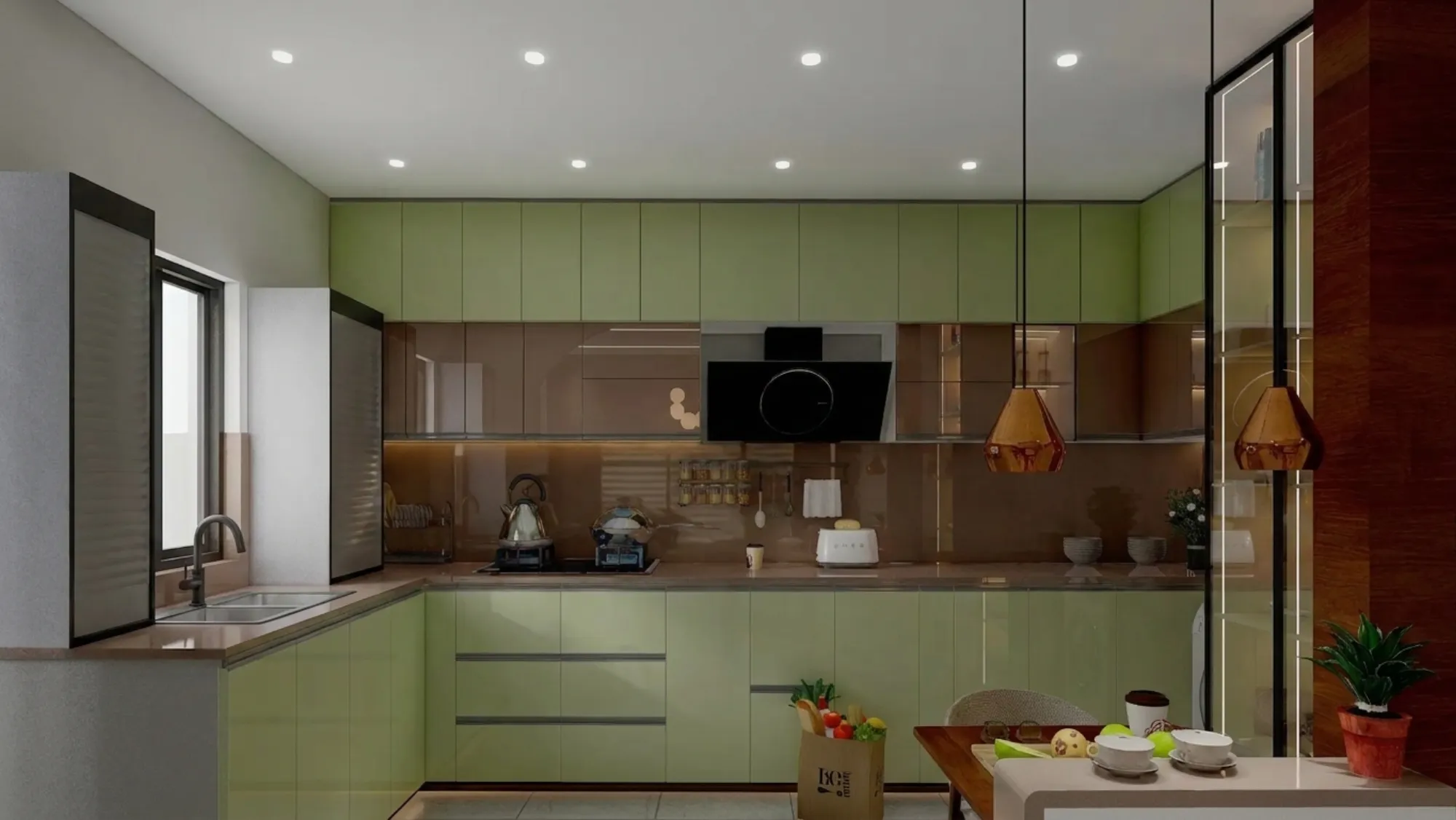
Then there's the two-tone route, which is honestly what we recommend to most first-time black-kitchen clients, where black sits on the lower cabinets or the island and a lighter shade, often warm white, sage, or a wood laminate, takes the upper cabinets. This keeps the kitchen from feeling heavy overhead, plays well with lower ceiling heights common in Kolkata apartments, and gives you an easy visual break if you ever want to update the space later without redoing everything.
Black paired with brass or gold hardware is the finish combination that reads most expensive per rupee spent, because the warm metal against matte black creates the kind of contrast that photographs beautifully and costs comparatively little since it's just handles, hinges, and maybe a tap. Black paired with warm wood tones, whether that's the counter, the island, or open shelving, is the other combination we'd call foolproof, and it tends to feel more grounded and less showroom-like than black with chrome or steel.
| Matte Black | Glossy Black |
|---|---|
| Hides fingerprints and water spots well | Shows every fingerprint and smudge |
| Softer, more architectural look | More dramatic, high-shine look |
| Lower maintenance for daily cooking | Needs frequent wiping to stay sharp |
| Slightly more forgiving on budget hardware | Reflects light, needs less overhead lighting |
Fourteen design directions worth considering
Rather than listing fourteen near-identical kitchen photos, here are the actual directions that cover most of what our clients ask for, and each one solves for a different kind of home. Matte black slab-front cabinetry with a single continuous handle groove instead of visible hardware gives the cleanest, most minimal look and works well in compact apartments. Black lower cabinets with white or cream uppers and open wood shelving in between breaks up the mass and adds warmth without losing the black identity of the kitchen.
A black island against white or pale wood perimeter cabinetry is a strong choice for larger kitchens and open-plan homes, since the island becomes the visual anchor of the room. Full-height black cabinetry that runs floor to ceiling, including a tall unit for the fridge and pantry, gives a genuinely luxury, built-in look but needs excellent lighting to avoid feeling like a cave. Black with a light engineered stone or quartz countertop in white or cream veining is probably our most-requested combination right now, because the veining softens the black and the surface is practical for daily cooking.
Black cabinetry with a textured or fluted front adds depth under side lighting and hides fingerprints better than a flat matte panel. Black lacquered high-gloss islands paired with matte black perimeter units give you drama in one focal piece without the maintenance headache across the whole kitchen. A black and terracotta or rust-toned palette works particularly well in homes leaning into Bengal's warmer, earthier material language, especially with exposed brick or handmade tile accents. Black cabinetry with brushed gold or antique brass handles, taps, and pendant lights over the island is the combination we mentioned earlier, and it remains the highest-impact, lowest-cost upgrade in this entire list.
For smaller kitchens, black upper cabinets left open-shelved rather than fully enclosed keep the room from feeling boxed in while still delivering the black aesthetic overhead. A black-framed glass cabinet door, whether smoked or clear, adds a boutique, almost bar-like quality and works well for display-worthy crockery. Black cabinetry combined with a patterned ceramic tile backsplash, whether geometric or a Moroccan-inspired print, gives the kitchen a focal point that keeps the black from feeling flat. A dark, near-black granite or marble-look counter paired with matte black cabinetry creates a monochrome, editorial look for clients who want maximum drama and are comfortable with a higher maintenance surface. And finally, black cabinetry with integrated, handle-free appliances, where the fridge and dishwasher fronts match the cabinetry, is the most seamless, most expensive-reading option of the fourteen, though it does carry the steepest price tag of the group.
Materials that actually determine how the kitchen ages
This is the part that matters most and gets discussed least. Cabinetry in black generally comes in laminate, PU (polyurethane) lacquered, acrylic, or membrane finishes, and each behaves differently over five to ten years of use in Kolkata's humidity. Laminate is the most budget-friendly and holds up reasonably well, though cheaper laminates can show seams and edge-lifting in humid months if the core board underneath isn't properly sealed plywood.
PU lacquered finishes give you that deep, almost liquid matte or gloss look and are what most premium black kitchens actually use, but they need a genuinely skilled applicator, because a rushed PU job shows brush marks and uneven sheen almost immediately. Acrylic is the highest-gloss, most scratch-resistant option and tends to be the priciest, while membrane finishes sit in between on cost but can be more prone to edge peeling over time if the substrate moves with humidity. We generally steer clients toward marine-grade or BWP-grade plywood carcasses regardless of the shutter finish chosen, since Kolkata's monsoon humidity is simply not kind to lower-grade boards, and this is one place we never let clients cut cost, even when the budget is tight elsewhere.
- Confirm carcass is BWP or marine-grade plywood, not particle board
- Ask for a physical sample of the exact shutter finish, not a catalogue photo
- Check hinge and channel brand and warranty terms in writing
- Verify counter material seam placement before fabrication
- Ask how the [kitchen work triangle](https://en.wikipedia.org/wiki/Kitchen_work_triangle) between stove, sink, and fridge has been planned for your actual cooking habits
What these kitchens actually cost in West Bengal
Pricing on black modular kitchens varies more than most categories because the colour itself doesn't cost extra, it's the finish, hardware, and lighting layered around it that moves the number. As a rough sense of where budget typically goes on a mid-to-premium black kitchen project, hardware and fittings, the shutter finish itself, and the countertop tend to be the three biggest line items after the base carcass and installation labour.
The catch here is that a lot of quotes look similar on paper until you compare what's actually included, so two kitchens both labelled matte black PU can differ by 30-40% in real cost depending on plywood grade, hinge brand, and whether soft-close mechanisms are genuinely soft-close or just marketed that way. This is exactly the kind of thing our modular kitchen design process walks through line by line before any order is placed, because a client should never discover the gap between two quotes after installation has started.
At the end of the day, most homeowners in Kolkata researching this get more clarity from understanding overall project economics first, and our guide on the interior designer in Kolkata landscape and our breakdown of architect fees in Kolkata are both useful starting points before you commit to a black kitchen specifically, since the kitchen budget doesn't exist in isolation from the rest of the home.
Layout, ventilation, and the practical decisions nobody plans for
A black kitchen amplifies every layout mistake, so the planning stage matters more here than in lighter colour schemes. We always insist on proper exhaust and chimney planning before finalising cabinet layout, because grease and soot show up faster and more visibly on black surfaces than on lighter ones, and retrofitting ventilation after installation is expensive and disruptive. Natural ventilation and daylighting from an existing window should shape where the black cabinetry sits relative to where direct sun hits, since strong afternoon sun on glossy black can create glare at the counter.
For clients building or renovating in New Town specifically, our guide on apartment and flat interiors in New Town covers how kitchen layouts typically map onto the floor plans common in that part of the city, which is worth a look if you're still at the planning stage. And if Vastu Shastra considerations matter to your family, black in the kitchen is generally workable when balanced correctly with the fire and water elements in the space, and our team factors this into the layout conversation early rather than as an afterthought once cabinets are already ordered.
Custom pieces, whether that's a black island with an integrated breakfast counter, a tall pantry unit with a specific internal configuration, or bespoke open shelving, tend to be where a black kitchen goes from good to genuinely custom-feeling, and this is where our custom furniture design team gets involved alongside the core kitchen scope. We recently completed a project along these lines that's worth a look if you want to see the two-tone, wood-and-black direction executed end to end, in our sleek modular kitchen project in Kolkata.
Maintenance reality check before you commit
We'd be doing readers a disservice if we didn't say this plainly: a black kitchen, especially in glossy or high-contrast finishes, needs more regular wiping down than a lighter kitchen, basically daily if you cook often, because water spots and fingerprints show immediately under kitchen lighting. Matte and textured finishes forgive this considerably better than gloss, which is why we steer most working households, especially those without daily domestic help, toward matte or two-tone rather than full high-gloss black.
The upside is that black doesn't yellow or discolour with age the way some lighter laminates can, and scuffs are genuinely easier to touch up on a dark, uniform surface than on a pale one where every mark stands out. If you're weighing this against a full home renovation timeline, our piece on AI furniture layout optimisation is a useful adjacent read on how modern layout planning tools are changing kitchen and furniture decisions generally, even outside the colour question.
Why homeowners across Kolkata and West Bengal hire us for this specifically
We've been designing and building interiors and full residences out of New Town since 2014, and across 330+ buildings delivered, kitchens are genuinely one of the categories where the gap between a good execution and a mediocre one is the widest, because so much of what makes a black kitchen look expensive comes down to decisions most homeowners never get shown until it's too late to change them cheaply. That's the value we bring to the table, right from the first material sample to the final hinge check before handover.
Our typical interior project runs 8-12 weeks from design lock to handover, and we manage the shutter finish, hardware sourcing, lighting integration, and countertop fabrication as one coordinated scope rather than as separate vendors you have to chase individually. If you're planning a kitchen renovation as part of a larger home refresh, our renovation and remodeling team can also fold the kitchen into a broader scope so the black cabinetry doesn't end up mismatched with the rest of the home's material language. Whether you're in New Town or anywhere else across Kolkata and West Bengal, and whether you already have a Pinterest board full of black kitchen ideas or you're still deciding if black is even right for your space, get in touch with our team and we'll walk you through what's realistic for your layout, your budget, and your household's actual cooking habits, not just what looks good in a photograph.