







How Many Design Revision Rounds Should a Kolkata Interior Firm Actually Offer

How Many Design Revision Rounds Should a Kolkata Interior Firm Actually Offer
A client called us in March asking why her previous designer had charged her extra for the fourth round of kitchen layout changes, and the honest answer is that most firms in Kolkata never tell you the number up front, so you find out only when you hit the wall and the invoice shows up with a new line item on it. That is the actual question behind "design revision rounds interior firm Kolkata" and it deserves a straight answer instead of a sales pitch, so here is what we have learned running 330+ projects across New Town, Salt Lake and the wider city since we started Studio Contour in 2014.
What "Revision Rounds" Actually Means, and Why the Number Alone Is Misleading
A revision round, in practice, is any point in the design process where you look at a layout, a moodboard, a 3D render or a working drawing and ask for changes before we move to the next stage, and the mistake most homeowners make is treating "unlimited revisions" as the best possible offer without asking what counts as a revision versus what counts as scope creep. A firm that says three rounds but defines a round generously, covering full layout swaps, material changes and elevation tweaks within each pass, is usually more useful than a firm that says unlimited but treats every WhatsApp message as its own separate mini-round with a two-week wait attached. At the end of the day, the number matters less than the structure around it, and that structure is what we spend most of this article on, because it is the part nobody advertises.
What We Actually Offer at Studio Contour
Our standard residential engagement runs three structured revision rounds built into the base fee, one after the concept layout and mood direction, one after the detailed 3D visualization, and one after the working drawings go out for execution sign-off, and we have set it up this way because our own project data across hundreds of homes in New Town and Salt Lake shows that genuine, well-scoped feedback tends to converge by the third pass if the brief was solid at the start. Anything beyond that is usually not a design problem anymore, it is a decision problem on the client's side, and we would rather be upfront about that distinction than let a project drift for six months under the banner of "unlimited" while nothing actually gets built. On a recent apartment interior in New Town, for instance, the client used all three rounds on the living-dining layout alone because she kept reconsidering the TV wall orientation against the balcony, and we simply extended that one round rather than penalizing her, because the intent was still genuine refinement, not new scope.

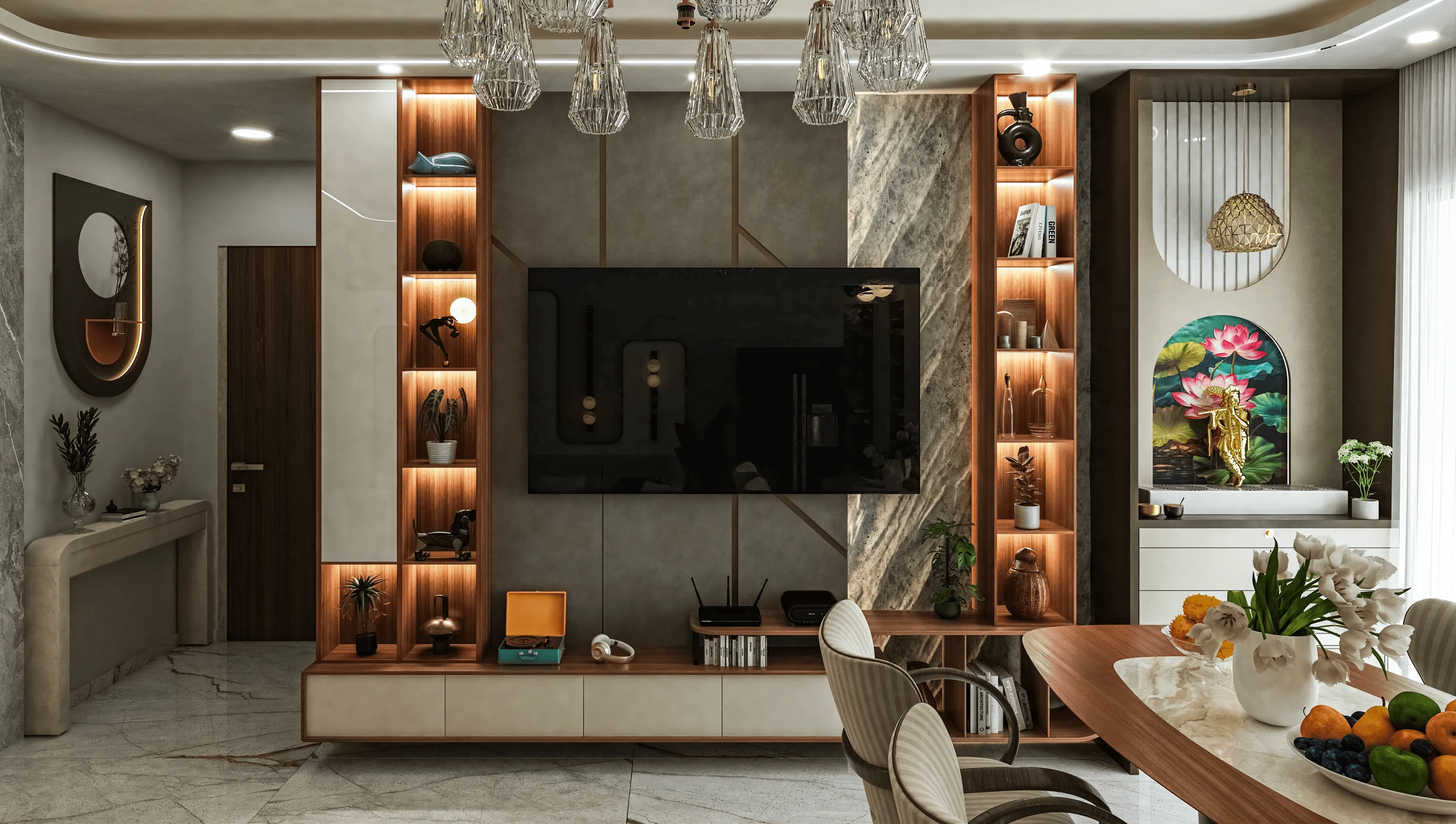
That project, the DE Block residence in New Town, is a decent example of how the revision process actually plays out on the ground, because the family wanted three iterations on the false ceiling and cove lighting layout before they were happy, and our false ceiling and lighting design team folded that into the second round without treating it as a paid add-on, because ceiling and lighting changes at that stage are still core to the concept, not an afterthought bolted on later.
Why Firms Cap Rounds at All, and What Happens When They Don't
The catch here is that unlimited revisions sound generous but they change the incentive structure in a way that rarely benefits the client, because a firm billing a fixed fee with no revision cap has every reason to move slowly, since speed only costs them money and delay costs them nothing, so projects drift, designers get reassigned to newer, more profitable clients, and the original brief gets diluted across six or seven partial passes instead of resolved in three focused ones. A capped, structured round system, by contrast, forces both sides to commit at each stage, which is closer to how proper project management is supposed to work on a build of this size, right, with defined milestones rather than an open-ended conversation that never quite closes.
| Independent Freelancer | Established Firm |
|---|---|
| Revision limit often undefined verbally | Revision count fixed in written scope of work |
| Rounds tend to expand informally with no cost clarity | Extra rounds priced transparently if genuinely needed |
| Single person, so feedback loops depend on their calendar | Studio team can absorb a heavy revision round without stalling other stages |
| No structured sign-off between stages | Formal sign-off at concept, 3D and drawing stage |
We are not going to pretend every independent freelancer in Kolkata runs a loose process, some are excellent and disciplined, but the structural risk is real and it is worth knowing before you sign anything, and if you want a fuller breakdown of what separates a solid freelance designer from a studio setup, our piece on how to hire an interior designer in New Town goes into that comparison in more depth than we can cover here.
Where Revisions Actually Go Wrong on Kolkata Projects Specifically
Local sanction rules are the part outsiders underestimate, because a design that looks finished on paper can still need a fresh round of changes once it runs into New Town Kolkata Development Authority requirements or Bidhannagar's building bylaws, particularly around setbacks, floor area ratio and the placement of load-bearing walls relative to what was originally sanctioned. We have handled enough sanction-adjacent revisions that we built a dedicated internal checklist for it, and if you are earlier in the process and still sorting out approvals, our guide on the NKDA building plan sanction process in New Town is worth reading before you even start the interior brief, because a layout that has to be redrawn for compliance reasons eats into revision rounds that should have gone toward actual design refinement. This is also where a firm with deep local sanction experience earns its fee, because we are not discovering Bidhannagar or NKDA requirements for the first time on your project, we have run into most of the edge cases already across New Town, Kolkata and Salt Lake over the last decade.
- 01Concept layout and moodboard, round one sign-off
- 02Detailed 3D visualization, round two sign-off
- 03Working drawings and material specs, round three sign-off
- 04Execution handoff to site team
The Track Record Behind This Process
Three structured rounds is not a number we picked arbitrarily, it comes out of running this exact process on 330+ buildings since 2014, enough repetition that we can usually tell within the first client meeting whether a brief is going to need a heavier first round of concept work or whether it is tight enough to move fast, and that pattern recognition is genuinely hard to replicate without the volume. Our 3D visualization and rendering team, for instance, has built enough render libraries across Salt Lake apartments and New Town villas that a second-round revision on materials or lighting mood usually takes days rather than the two or three weeks it might take a smaller outfit starting from scratch each time. If you want a sense of the range of homes this process has covered, our full project portfolio has case studies across apartment interiors, bungalows and full-scale residential builds, and it is worth browsing before you commit to any studio, us included, because seeing actual completed work tells you more than a revision policy on paper ever will.
- Ask exactly how many rounds are included at each stage, not just a total number
- Ask what counts as a "round" versus a quick clarification
- Ask what happens, in writing, if you need a round beyond the cap
- Ask whether sanction-driven redraws count against your design revision rounds
- Ask to see a real project timeline from a comparable home, not a template
How to Read a Firm's Revision Policy Before You Sign Anything
A written scope of work should spell out the round count, what triggers a new round versus a minor tweak, and what the cost structure looks like if you genuinely need more, and any firm that gets vague when you ask this directly is telling you something about how the rest of the project is going to go. This is a basic form of due diligence that buyers do instinctively for a flat purchase but often skip for the interior contract that follows it, even though the sums involved can be comparable on a full home. We would also flag that a firm's comfort with Vastu Shastra adjustments matters here too, since Vastu-driven changes late in the process are one of the more common reasons a client needs an extra round, and our Vastu-compliant design service is built to catch most of that at the concept stage rather than after the 3D renders are locked. For readers weighing this decision more broadly, our guide on questions to ask an interior designer for a New Town flat has a longer list worth going through line by line, and if your project sits closer to Howrah or the western side of the city, our Howrah locality guide has notes on how sanction and renovation timelines tend to differ there.
Where This Leaves You
So three structured, clearly scoped revision rounds, sign-off at each stage, and complete transparency about what happens if you genuinely need a fourth, that is the honest answer to how many rounds a Kolkata interior firm should offer, and it is also exactly what we run at Studio Contour on every one of the 330+ buildings we have delivered since 2014. If your brief is tight, most projects resolve well within that structure, and if it needs more, you will know the cost and reason before you agree to it rather than after the invoice lands. If you are weighing this against your own budget and timeline, our guide on the cost to build a house in New Town is a useful companion read, and when you are ready to talk through your specific layout, sanction status and revision needs with our team directly, get in touch with us here and we will walk you through exactly how the process would run on your home.