





Why an Interior Designer's Local Building Count Matters More Than Their Instagram Following
Every few months we get a call from a family in New Town or Salt Lake who tell us, almost apologetically, that they nearly hired someone else first because that designer's Instagram page had forty thousand followers and beautifully lit reels of finished living rooms. Then the conversation turns to what actually went wrong, usually something like the designer had never filed a plan with NKDA before, or didn't know that a Category II plot in Action Area II has different setback rules than a Category I plot two streets away, and the project stalled for months while someone figured it out on the client's dime. That gap between what looks convincing on a phone screen and what actually gets a building approved and built is the entire subject of this post, and it's why we think local building count is the number that should decide who you hire, not follower count.
Instagram following measures attention, not competence
A following is a proxy for content production and algorithmic luck, nothing more. Someone can post consistently, hire a good videographer, run some paid promotion, and build fifty thousand followers within a couple of years without ever having personally taken a project through a Bidhannagar Municipal Corporation approval, without ever having argued a floor area ratio calculation with a sanctioning authority, and without knowing that the soil in parts of New Town's Action Area III behaves differently under foundation load than the reclaimed land closer to Salt Lake's older sectors. None of that shows up in a reel. A ninety-second video of a finished kitchen tells you the designer can shoot good video and pick a good editor, and honestly that's a real skill, but it says almost nothing about whether they can manage a general contractor, hold a timeline, or navigate a plan rejection without the client losing three months and a lakh or two in redrawn drawings.
We're not saying social presence is worthless, because it isn't, and a firm with zero visible work anywhere is its own kind of red flag. The point is narrower than that: following count and competence are two different variables that happen to correlate poorly, and in a market like ours where every project eventually has to clear a municipal desk, the variable that actually matters is the one social metrics don't measure at all.
What a building count actually proves
330 buildings delivered across New Town and Salt Lake since we started in 2014 isn't a vanity number we lead with because it sounds impressive, it's the number that represents 330 separate instances of a plan being drawn, submitted, questioned, revised, approved, built, and handed over to a family or a business that then had to live or work in it. Each one of those cycles taught us something specific about how NKDA reviews drawings, how Bidhannagar's process differs on the older Salt Lake side, which sectors have drainage quirks that affect basement and ground floor detailing, and which action areas are stricter about height and setback than the sanctioned rulebook alone would suggest. That's the kind of knowledge that doesn't compress into a portfolio photo, and it's also the knowledge that determines whether your project finishes in the 8-12 week range we typically quote for interior work, or drags on for six months because nobody on the team anticipated a documentation issue that we would have caught on day one.
We've written before about how architect fees in Kolkata tend to correlate more with process discipline than with raw design talent, and building count is really a stand-in for that same idea. A firm that has taken 330 projects through sanction, construction, and handover has necessarily built internal systems for tracking documentation, coordinating with a general contractor, and catching the kind of small errors that turn into large delays. A designer with a large following and a handful of completed projects hasn't had the repetitions to build those systems yet, and that's not a character flaw, it's just math.
The honest tradeoffs, laid out plainly
We'd rather give you the real comparison than pretend it's a clean win on every axis, because it isn't. A freelance designer or a small solo practice with a strong Instagram presence often has a lower base fee, more flexible scheduling since there's no studio overhead to cover, and sometimes a more experimental design sensibility because they're not managing a pipeline of 15-20 concurrent projects. What they often lack is redundancy, meaning if that one person gets sick, gets overbooked, or simply hasn't dealt with your specific building typology before, there's no institutional backup. A studio with a real project count has more overhead built into the pricing, but it also has people who've solved your exact problem before, whether that's a narrow corner plot in New Town or a cooperative housing renovation in one of Salt Lake's older blocks.
| Social-Media-First Designer | Local Track-Record Studio |
|---|---|
| Portfolio built for engagement, may skip less photogenic work | Portfolio built from delivered projects across sanction to handover |
| Limited exposure to NKDA/Bidhannagar-specific rejections | Repeated exposure to sanction quirks in both jurisdictions |
| Fee often lower, timeline less predictable | Fee reflects overhead, timeline benchmarked at 8-12 weeks |
| Single point of failure if the designer is unavailable | Studio team with backup coverage across a project pipeline |
| Design risk-taking can be higher | Design choices tempered by what's actually buildable locally |
Neither column is universally right, and if your project is small, low-stakes, and you're comfortable managing the sanction process yourself, a freelancer with a great eye can be a genuinely good choice. But for most residential and commercial builds in this region, where a rejected plan or a missed floor area ratio calculation can cost weeks and real money, the track record column is doing more work than it looks like on paper.
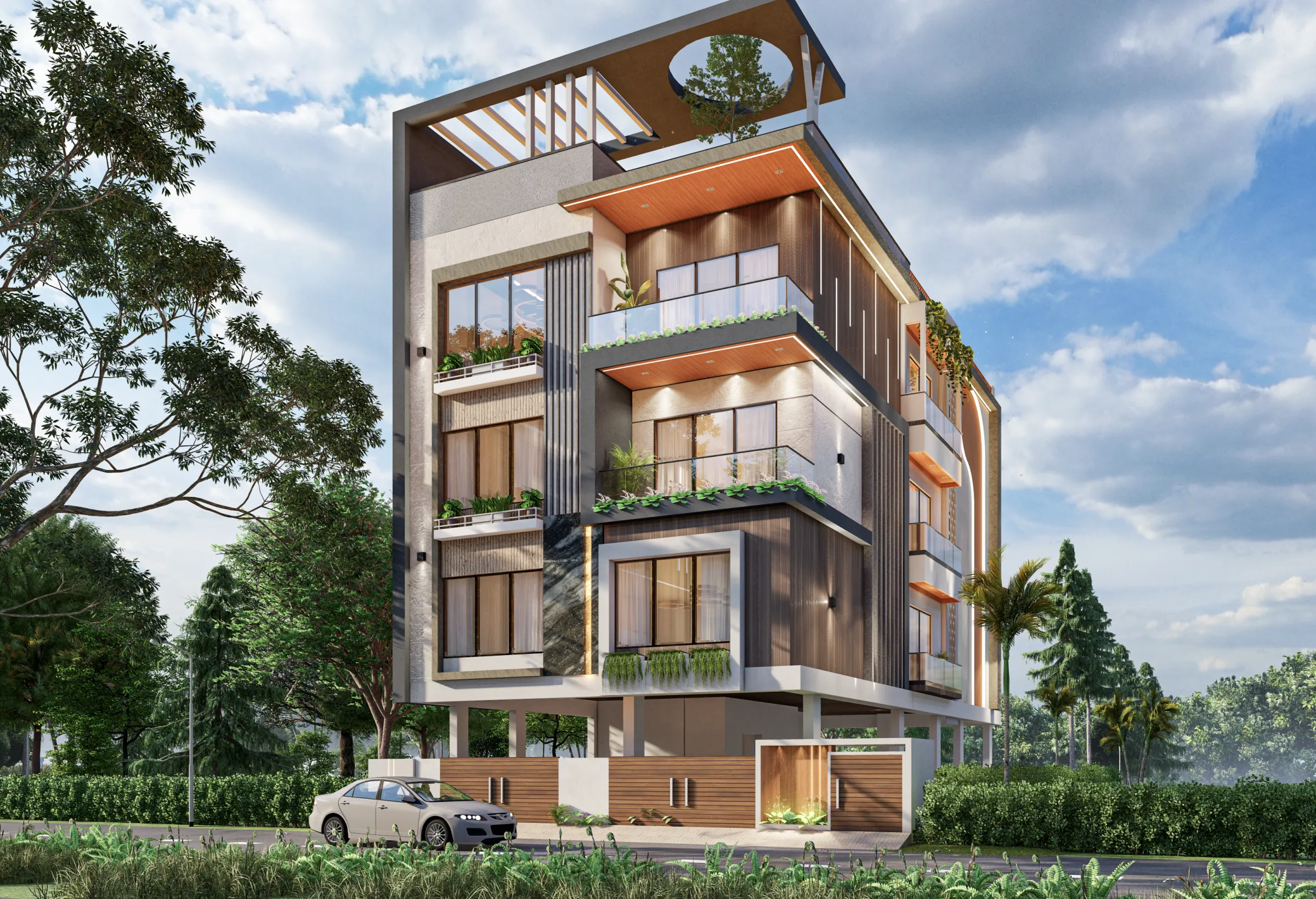
That CJ Block project in Salt Lake, which you can see more of on our CJ Block Residence page, is a decent example of what we mean by local specificity mattering. Salt Lake's older sectors have their own cooperative housing bylaws, different from the newer NKDA-governed action areas in New Town, and a design that ignores that distinction tends to hit friction at the sanctioning stage regardless of how good it looks on a moodboard.
New Town and Salt Lake are not the same market, and treating them as one is a mistake
This is a distinction that a lot of outside designers, even talented ones, get wrong, because New Town and Salt Lake look similar from a distance but run on different rulebooks and different soil and infrastructure realities. New Town falls under NKDA jurisdiction, with its own nkda building plan sanction process and action-area-specific rules that vary between Action Area I, II, and III. Salt Lake falls under Bidhannagar Municipal Corporation, an older and more established grid with its own approval quirks, cooperative housing considerations, and infrastructure that in places is forty-plus years old and behaves very differently during renovation work than a plot being built from scratch. We've put together a dedicated interior designer in Salt Lake Sector 5 guide specifically because commercial fitouts in that corridor have their own set of practical constraints, from building age to parking allocation, that don't apply the same way three kilometers away in New Town.
A studio that's actually delivered 100+ Kolkata projects across both of these areas has, by necessity, built separate mental models for each, and that shows up in small but consequential decisions, like which structural approach to recommend for a Salt Lake cooperative renovation versus a ground-up New Town build, or which drainage detailing to specify given how each area's civic infrastructure actually performs during monsoon season. This is the kind of judgment that a portfolio can't communicate and that only comes from having actually done the work, repeatedly, in the specific geography you're building in.
What the process actually looks like when experience is doing the work
We think it's worth walking through what a project with an experienced local studio actually looks like end to end, because the difference isn't abstract, it shows up at every stage.
- 01Site visit and documentation review, where we check plot category, existing sanctions, and any prior violations before design even starts
- 02Design development against known NKDA/Bidhannagar constraints, so the concept we show you is one that's actually approvable
- 03Sanction submission and coordination, drawing on relationships and process familiarity built over 330+ prior filings
- 04Construction and handover within the typical 8-12 week window for interior scopes, with a general contractor relationship the studio already trusts
At each of those stages, a firm's project count functions almost like a form of insurance. When our team reviews a site in New Town's Action Area I or a resale flat in Salt Lake, we're not starting from zero, we're pattern-matching against several hundred prior cases, and that's what keeps the 8-12 week timeline honest instead of aspirational. For clients who want to go deeper into what to check before signing with anyone, we've laid out a broader architect in New Town Kolkata guide and a companion piece on the best interior designers in New Town that covers how to evaluate a shortlist honestly rather than by follower count alone.
What to actually check before you hire anyone
At the end of the day, whether you go with us or someone else, there's a basic level of due diligence that protects you either way, and we'd rather you do it than skip it because a portfolio looked polished.
- Ask how many buildings they've personally taken through NKDA or Bidhannagar sanction, not just designed on paper
- Ask for the address or block of at least three completed local projects you can actually see or verify
- Ask what happens if a plan gets rejected on first submission, and how many times that's happened to them
- Confirm they're working within the framework the [Council of Architecture](https://en.wikipedia.org/wiki/Council_of_Architecture) recognizes, not operating purely as an unlicensed freelancer
- Get a written timeline benchmarked against real past projects, not a general estimate
Any studio that's genuinely done the work will answer these without hesitation, because the answers are just facts about their history. A studio that's built its reputation mainly on content will often get vague here, not because they're being dishonest, but because they simply haven't accumulated the specific track record the questions are asking about.
Why this adds up to us
We started Studio Contour in 2014 with the plan of being genuinely embedded in New Town and Salt Lake rather than treating Kolkata as one more market to post about, and 330+ delivered buildings later, that local depth is still the thing that actually moves projects from idea to occupancy without the delays that come from unfamiliarity. We offer residential architecture and residential interior design as an integrated service specifically because splitting design from sanction handling is where a lot of projects lose months, and our team handles both under one roof so nothing falls through the gap between "designed" and "approved." You can browse the range of what that's produced across both areas on our projects page, and if you want to see how it plays out geographically, our Salt Lake locality hub has a fuller picture of the work concentrated in that market specifically.
If you're currently choosing between a designer with a large following and a studio with a real local track record, we'd genuinely encourage you to ask both sides the questions above before deciding anything. And if what you're looking for is a team that's already solved the specific sanction and construction problems your plot in New Town or Salt Lake is likely to throw up, get in touch with us and we'll walk you through what a realistic timeline and process looks like for your project, based on the 330 we've actually built, not the ones we've merely photographed.