








Mustard Yellow Kitchen Cabinets: How to Use the Colour Without Overdoing It
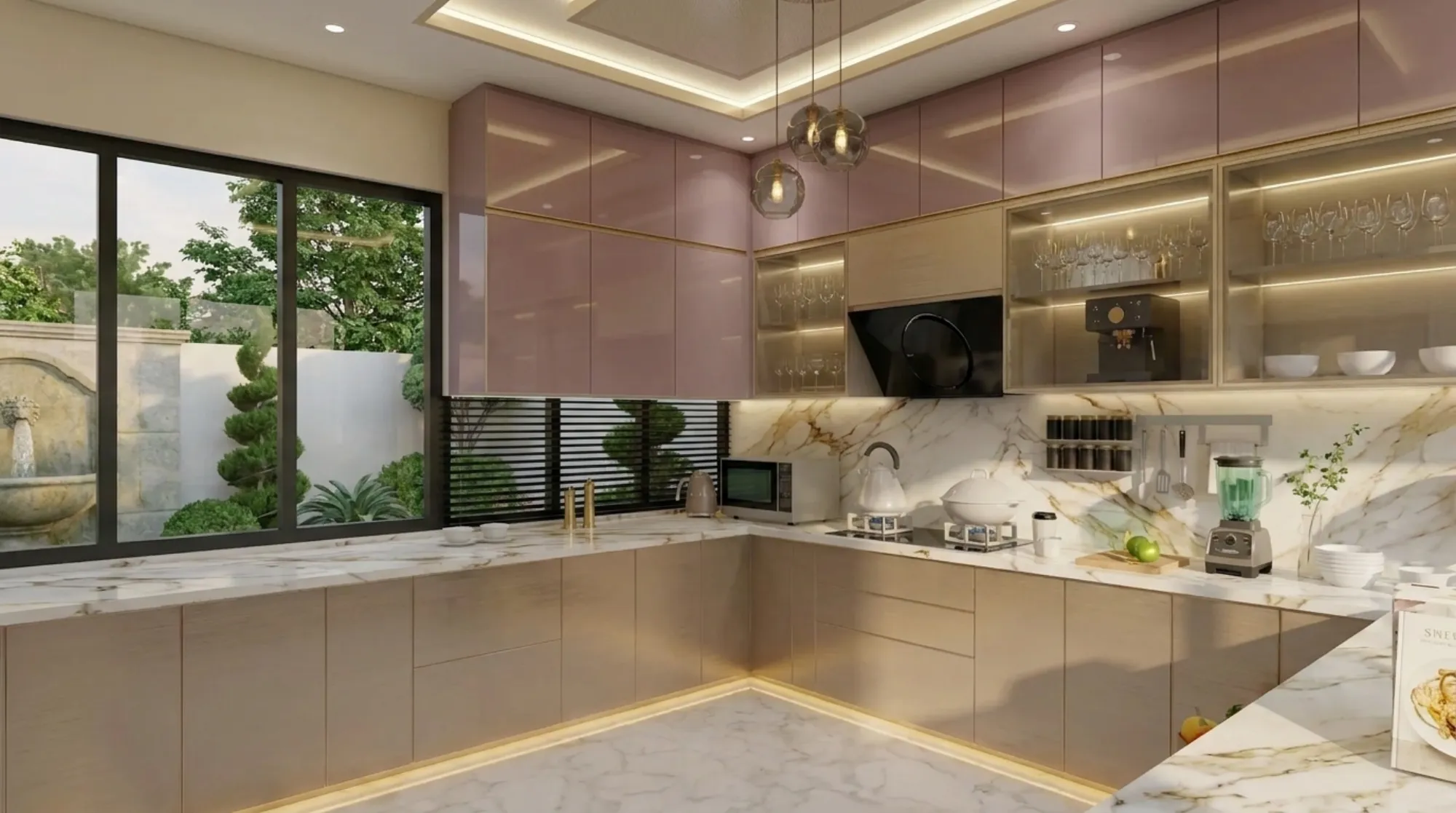
Every third homeowner who walks into our New Town studio with a Pinterest board these days has at least one mustard yellow kitchen saved on it, and the question that follows is almost always the same, which is whether the colour will look dated in three years or whether it will hold up as something they actually love living with. We have delivered enough kitchens across Kolkata and the wider West Bengal region since 2014, 330+ buildings and counting, to have a fairly settled point of view on this, and the short version is that mustard works brilliantly when it is treated as an accent decision rather than a wall-to-wall commitment, and it goes wrong almost every time someone tries to make the whole kitchen mustard.
This piece walks through the actual mechanics of pulling this off, which shade family suits which kind of light, which cabinet finishes carry the colour best, how much mustard is the right amount before it starts fighting your countertop and your flooring, what it costs to execute properly in this market, and the mistakes we see repeated across client briefs. If you are researching mustard yellow kitchen cabinets for a flat in Salt Lake, a duplex in New Town, or a renovation anywhere in the state, the goal here is to give you enough to brief a designer intelligently, or to do it yourself with fewer regrets.
The catch here is that mustard is a genuinely difficult colour to get right because it sits at the intersection of yellow, ochre, and brown, and small shifts in undertone completely change how it reads in a room. A shade that looks warm and inviting in a paint swatch under daylight can turn sickly under the tube lighting a lot of older Kolkata kitchens still run on, so this is not a colour you pick from a chip and walk away from.
Getting the Undertone Right Before You Pick a Shade
Mustard yellow sits on a spectrum, and the two broad families we work with are the warmer, more amber-leaning mustards that pull toward ochre and honey, and the cooler, more olive-leaning mustards that pull toward khaki. In our experience the warm-amber family suits kitchens with generous natural light and warm wood tones nearby, so a New Town flat with a west-facing kitchen window or one with teak or walnut flooring nearby will carry it well, right through the afternoon. The olive-leaning family suits kitchens that lean more contemporary, with concrete-look tiles, black hardware, and cooler artificial lighting, and it tends to read more sophisticated and less rustic. Before we commit a client to either, we insist on testing the actual laminate or paint sample in the kitchen itself, under both daylight and the evening lighting the space will actually use, because a colour temperature shift from a 3000K warm-white to a 4000K neutral-white bulb can visibly change how yellow or how brown the same mustard appears. This is one of those decisions where a five-minute site test saves months of second-guessing later.
Material and Finish: Where Mustard Actually Lives Best
The finish you choose changes the personality of the colour more than most homeowners expect. A matte or soft-touch lacquer on mustard reads calm and a little muted, closer to a spice-rack ochre, and it hides fingerprints and daily kitchen grime far better than a gloss finish does, which matters a lot in a working Bengali kitchen with regular tempering and frying. A high-gloss acrylic or PU finish on the same mustard shade turns almost citrus-bright and throws light around the room, which we use sparingly, usually just on an island face or a run of upper cabinets, never across an entire kitchen wall. For the substrate itself, we default to marine or BWP grade plywood carcasses with laminate or lacquered shutters rather than MDF, given how much humidity swings through a Kolkata monsoon, and mustard laminates from the major Indian brands hold colour consistency far better on ply than on cheaper particleboard that can telegraph unevenness through the finish over a couple of years. If your brief runs toward a more bespoke look, open shelving in a warm wood tone breaks up a mustard run nicely and gives the eye somewhere to rest, and this is exactly the kind of detailing our custom furniture design team handles alongside the core cabinetry.
How Much Mustard Is Actually the Right Amount
This is the question that decides whether a kitchen looks curated or overwhelming, and our rule of thumb after years of doing this is to treat mustard as roughly a third of the visible cabinetry surface, never the whole room. The most reliable configuration we return to is mustard on the lower cabinets only, paired with a white, off-white, or light stone-toned upper run and countertop, so the colour anchors the room without closing it in, which matters a great deal in the compact kitchen footprints common across New Town and Salt Lake apartments. The second configuration that works well is mustard confined to a single island or a peninsula, with the rest of the kitchen kept neutral, which is our recommended approach for larger open-plan kitchens where the island already functions as a visual centrepiece.
Going beyond that ratio is where kitchens start to feel like a themed restaurant rather than a home, and it also makes resale and future refresh harder, since a client repainting or reselling in five years has far fewer neutral surfaces to work around. We map this out early using our 3D visualization rendering process specifically so a client can see the actual proportion before a single shutter gets ordered, because mustard is one of those colours that looks completely different in a 40mm swatch than it does across an 8-foot cabinet run.
Pairing It Correctly: Countertops, Hardware, Walls, and Flooring
The countertop decision matters as much as the cabinet colour itself. Warm white or grey-veined engineered stone counters are our most reliable pairing because they are non-porous, resist the turmeric and oil staining that a genuine Bengali kitchen sees daily, and they let the mustard read as the star rather than competing with a busy stone pattern. Black granite works too, particularly with the olive-leaning mustard family, and gives a sharper, more contemporary contrast. Where we tend to steer clients away is pale wood-toned countertops sitting directly against warm-amber mustard, since the two warm tones together can flatten the contrast and make the kitchen feel visually heavy rather than layered.
| Works well with mustard | Usually fights mustard |
|---|---|
| White or warm-grey engineered stone counters | Busy multi-colour granite patterns |
| Matte black or brushed brass hardware | Chrome or bright silver hardware |
| Warm white or soft sage walls | Saturated red or teal accent walls |
| Terracotta or warm-toned flooring | Cool blue-grey vitrified tiles |
Wall colour is the other lever most people underuse. A warm off-white or a very soft sage on the walls around a mustard kitchen lets the cabinetry do the talking, while a saturated accent wall in the same room usually just creates two competing focal points. Lighting temperature deserves its own mention here too, since a lower colour temperature under-cabinet strip will deepen mustard into a richer amber at night, which most clients end up preferring for a kitchen that also doubles as a family gathering space, and this is exactly the kind of layered lighting plan our false ceiling & lighting design scope covers alongside the cabinetry brief. For a real sense of how a saturated cabinet colour reads against a warm-wood backdrop, our warm wood modular kitchen project is a useful reference even though it isn't mustard itself, since the underlying balancing principle is identical.
What This Costs and How Long It Takes in Kolkata and West Bengal
Mustard as a colour choice does not itself move the budget much, since the cost driver is finish and hardware rather than pigment, but the finish choices that carry mustard well, matte lacquer over laminate, soft-close German or Indian-branded hinges, and a decent engineered stone counter, do sit a notch above the most basic laminate-and-hardware kitchen. Across our projects, a mid-range modular kitchen with a considered mustard accent typically runs meaningfully above the bare minimum laminate finish but well under a full custom-carpentry, imported-hardware build, and the design and execution timeline generally falls within the same 8-12 week window we quote for most interior scopes, assuming the layout itself is not being structurally altered.
- 01Design and shade finalisation (1-2 weeks)
- 02Material and hardware selection with on-site samples (1 week)
- 03Carcass and shutter fabrication (3-4 weeks)
- 04Site installation and finishing (2-3 weeks)
Renovations of existing kitchens where the carcass is being retained and only shutters and counters are being swapped can move faster, and this is a scope our renovation & remodeling team handles regularly across older Kolkata flats where the kitchen footprint is fixed but the finish is dated. Where the kitchen is part of a larger flat interior brief, we fold it into the broader residential interior design scope so the mustard decision is made in context with the rest of the home's palette rather than in isolation.
Mistakes We See Repeated Across Kolkata Kitchens
Most of the regret we hear about from clients who tried mustard on their own, or through a contractor working off a Pinterest screenshot with no site testing, traces back to a small, repeatable set of errors, and it is worth naming them plainly so you can brief around them.
- Choosing the shade from a screen or a small chip instead of a site-tested sample under real kitchen lighting
- Running mustard across the entire cabinet run, upper and lower, with no neutral relief
- Pairing warm-amber mustard with an equally warm wood countertop, flattening all contrast
- Ignoring the [kitchen work triangle](https://en.wikipedia.org/wiki/Kitchen_work_triangle) and layout ergonomics while focused entirely on colour
- Skipping a proper ventilation and exhaust plan, which matters more in a saturated-colour kitchen since grease film shows up faster against strong pigment
That last point is genuinely underrated. A saturated colour like mustard shows oil film and dust build-up faster than a neutral white or grey does, so the exhaust hood capacity and the ergonomics of the working counter matter more here, not less, and we always fold that into the layout conversation before finishes are even discussed. If your flat sits within a gated or planned development, it's also worth checking whether your kitchen extension or renovation needs any approval, something our apartment & flat interior guide for New Town covers alongside broader layout norms for the area.
At the end of the day, a mustard yellow kitchen is one of the more rewarding colour decisions a homeowner can make, and it photographs beautifully, ages well when the material choices are right, and gives a kitchen real personality in a way that an all-white scheme rarely does, provided the proportion, the undertone, and the pairing decisions are made deliberately rather than picked off a mood board. We have been doing exactly this kind of finish-and-material calibration for interiors across Kolkata and West Bengal since 2014, and if you are weighing a mustard kitchen for a new build or a renovation, our modular kitchen design team is happy to walk through shade options, material samples, and a realistic budget against your specific layout. You can find general guidance on choosing the right partner in our interior designer in Kolkata guide as well, but the fastest way to get a straight answer on your own kitchen is simply to get in touch and send us a few photos of the space and the light it gets through the day.