







Does Your Salt Lake Architect Offer Maintenance Support After the Project Ends

Does Your Salt Lake Architect Offer Maintenance Support After the Project Ends
The first monsoon after handover is always the real test, and we say this after watching it play out on more than 330 buildings, because the leak that shows up in a false ceiling in July or the hairline crack that opens along a beam-column junction after the first heavy rain is never really about the rain, it is about whether the person who designed and built the thing is still answering the phone when it happens. In Salt Lake specifically, where a lot of the housing stock sits on reclaimed land with its own settling behaviour and where cooperative societies handle a big share of the renovation work, that gap between "project complete" and "architect gone" is where most of the regret in this city actually lives, and it is the exact question this post is built to answer for anyone typing "maintenance support post project architect Salt Lake" into a search bar at eleven at night with a bucket under a leak.
The handover moment is where most architects check out
Here is what actually happens on a huge share of residential projects in Kolkata, and we are not exaggerating this because we have taken over cleanup work on enough of them to know the pattern cold. The architect or the freelancer delivers the final drawings, does a walkthrough, hands over the keys, and then the relationship ends, so any punch-list item that surfaces three weeks later, any door that starts sticking once the wood settles into the Kolkata humidity, any electrical point that was mapped wrong on the as-built drawing, becomes the client's problem to chase down alone, usually by calling five different contractors who all point at each other. This is not because these architects are bad at their jobs, most of them are competent within the scope they were paid for, it is because the standard engagement in this market is scoped to design and execution only, and once that scope closes the incentive to stay involved closes with it too.
The catch here is that a residential building is not actually "done" at handover, it is done at handover from a drawings-and-approvals standpoint, but from a livability standpoint the first twelve to eighteen months are when the building tells you what it actually is, plaster cures and shrinks, waterproofing gets its first real monsoon test, modular fittings get their first year of daily use, and an architect who has genuinely walked away by that point cannot do anything for you except recommend someone else, which is functionally the same as not being available at all.
What "maintenance support" should actually mean, not the vague version
When we say maintenance support at Studio Contour, we mean something specific and we would rather spell it out than let the phrase do vague marketing work for us. It means the same team that ran your structural drawings, your interior fit-out, and your NKDA or Bidhannagar sanction paperwork stays reachable for defect-liability issues in the first year, that waterproofing or seepage complaints get triaged by someone who actually knows where your slab drainage was routed instead of a random contractor guessing from scratch, and that if a false ceiling panel warps or a renovation touch-up is needed two years down the line, you are calling a studio with your file still on record rather than starting a relationship with a stranger who has to relearn your building from zero. This is a natural extension of our renovation and remodeling work, because a huge share of what we handle post-handover is exactly the same skill set as a small renovation, just applied to a building we already know inside out.
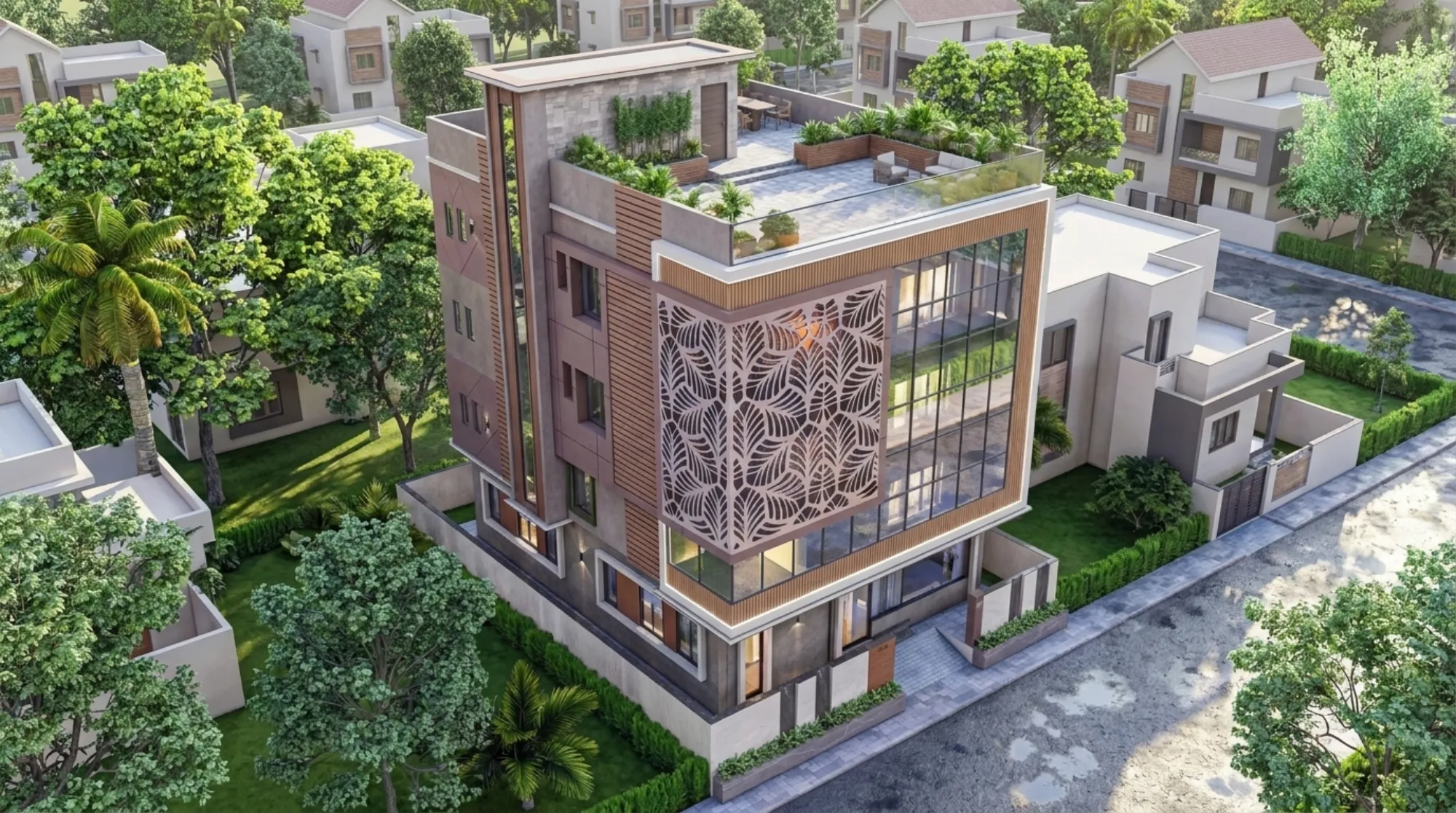
That is a building in FD Block, Salt Lake, one of ours, and the reason we can put a photo like this next to a maintenance conversation without flinching is that we designed it, built it, and we are still the first call if anything about it needs attention. That continuity is the whole argument, and it is worth being honest that it only works because we treat residential architecture and post-handover accountability as one job, not two separate transactions with two separate levels of care.
Why our local knowledge of Salt Lake actually matters here
Salt Lake is not generic Kolkata, and treating it that way is where a lot of maintenance problems start before the building is even finished. The sectors were developed on reclaimed wetland with specific soil behaviour, cooperative housing societies govern a large share of the residential stock with their own approval layers on top of Bidhannagar's municipal rules, and older blocks have plumbing and drainage infrastructure that was never designed for the load a modern renovated interior puts on it. We have been working in this specific geography since 2014, which means our familiarity with Salt Lake's building rules is not theoretical, it comes from having actually filed under them, and when we talk to a client about renovating a cooperative housing unit in Salt Lake we are talking from having done it, not from a checklist we read once.
That local depth is also why we can be useful after handover in a way an out-of-area firm cannot, because a maintenance issue in this part of the city is rarely just about the fitting that failed, it is usually about how that fitting interacts with the building's age, its society rules, and its position relative to the water table, and knowing all three at once is what separates a five-minute diagnosis from a two-week guessing game.
Freelancer, contractor, or firm: an honest breakdown for the post-project phase
We want to be fair here rather than just knock the alternatives, because each option genuinely has a place depending on budget and scope.
| Freelance Architect | Studio Contour (Firm) |
|---|---|
| Lower upfront fee, often 30-40% less | Slightly higher fee but includes structured handover process |
| No dedicated team once project ends, contact often goes cold | Named point of contact retained for defect-liability period |
| Good for very small single-room jobs | Better fit for full homes, renovations and anything with sanction-drawing complexity |
| Personal style, but limited backup if unavailable | Studio-level backup means someone always picks up the file |
| Post-handover fixes usually renegotiated from scratch | Post-handover issues handled as continuation of the same project file |
A general contractor working without an architect on record can be the cheapest route for a purely cosmetic job, repainting, a kitchen swap, nothing structural, and for that narrow case it is a reasonable choice. Where it falls apart is on anything touching structure, waterproofing, or sanctioned drawings, because a contractor has no obligation and usually no capability to certify that post-handover work still complies with what NKDA or Bidhannagar approved originally, and if you ever need documentation for a resale or a society NOC, that gap becomes expensive fast. A freelance architect sits in the middle, often excellent on design sensibility, often genuinely cheaper for a single project, but structurally unable to guarantee availability a year later because it is one person with one calendar and no bench behind them if they move cities, get busy, or simply move on to different work.
A studio like ours costs somewhat more than a freelancer on the initial quote, usually not dramatically more once you compare like for like, and the honest reason for that difference is that the fee is covering institutional continuity, not just design hours. If you want the fee side of that comparison spelled out plainly rather than taking our word for it, our own breakdown of architect fees in Salt Lake walks through what typically gets bundled in and what doesn't.
What we actually do once your project is handed over
- 01Defect-liability walkthrough at 3 months
- 02Monsoon-season check on waterproofing and drainage
- 03Follow-up call at the 12-month mark
- 04Ongoing access to original drawings and specs for any future renovation
The three-month walkthrough catches the things that only show up after the building has been lived in daily, sticking doors, settling grout lines, minor electrical adjustments, and we do it as a matter of course rather than waiting to be asked. The monsoon check matters more in this city than almost anywhere else in the country given how much Kolkata's rainy season stresses waterproofing, and for a building on reclaimed land in Salt Lake specifically we treat that first monsoon as close to non-negotiable to inspect. By the twelve-month mark, most of what needed shaking out has been shaken out, and from there our role shifts to being the studio you call if you ever want to extend, renovate, or reconfigure, because your file, drawings, and specifications stay with us rather than getting lost the way they do when a freelancer's laptop changes hands or a contractor's outfit dissolves.
A short checklist before you hire anyone in Salt Lake
- Ask whether post-handover support is written into the contract, not just promised verbally
- Confirm who specifically stays reachable after handover, a named person, not a generic office number
- Check whether the firm has done work under Bidhannagar/NKDA rules specifically, not just Kolkata broadly
- Ask to see a completed project you can actually visit or call the owner of
- Get a rough sense of response time commitments during the defect-liability period
This is worth doing due diligence on the way you would with any project management relationship that spans months rather than a single transaction, because the contract you sign at the start is the only leverage you have if things go sideways after the ribbon is cut, and most disputes we hear about from clients who came to us after a bad experience elsewhere trace back to a verbal promise of support that was never written down anywhere.
The track record behind the promise
We were founded in 2014, we have delivered more than 330 buildings across Kolkata, New Town, and Salt Lake since, and the reason that number matters in a maintenance conversation specifically is that a studio that has been doing this for over a decade has necessarily built the internal systems to handle post-handover issues at scale, because with a portfolio that size there is always something in the defect-liability window somewhere. If you want to see the range of what that portfolio looks like, our projects page has the fuller picture, and one property worth looking at directly for this exact neighbourhood is the FD Block residence in Salt Lake, which is the same building pictured above and a fair example of how we approach both the initial design and the years that follow it.
Our team's registration and practice sit within the framework the Council of Architecture sets for the profession nationally, and on the contractual side we structure our client agreements with the protections that came in under the RERA Act, 2016 in mind, which is part of why our post-handover commitments are written into the contract rather than left as a friendly verbal promise. If you are earlier in the process and still deciding who to bring on for the build itself, our guide on how to hire an architect in Salt Lake and Bidhannagar covers the vetting process in more depth, and our Salt Lake locality guide has the sector-by-sector detail we draw on for jobs across the area, while our broader Salt Lake hub rounds up everything we have delivered in the neighbourhood if you want to see the density of local work for yourself.
At the end of the day, the honest answer to "does your architect offer maintenance support after the project ends" for most of the market in this city is no, not really, not in writing, not with anyone specific on the other end of the phone, and that gap is exactly the reason this question gets typed into search bars at eleven at night by people standing under a leak they did not expect. We built our studio around not being that story for our clients, and if you are weighing who to bring on for a build or renovation in Salt Lake right now, the fastest way to see what a written, twelve-month, named-contact maintenance commitment actually looks like is to get in touch with us directly and ask us the same three questions we told you to ask everyone else.