






Wardrobe Cost Per Square Foot in New Town: Base, Mid and Premium Rates
Every second homeowner who calls our studio after their New Town flat gets handed over asks the same first question, and it's almost never about layout or finish, it's simply how much does a wardrobe cost per square foot here, right. Fair question, and also the wrong first question, because a per-square-foot number without context is basically a rumour that gets repeated at every housewarming until nobody can tell what it actually includes anymore.
We've built wardrobes across 330+ buildings since 2014, from rowhouses in Action Area I to high-rise flats in Action Area II and III and cooperative units in Salt Lake, and the honest answer is that wardrobe pricing in New Town swings wide enough that quoting a single number does you a disservice. So this piece breaks the real base, mid and premium bands down by what's actually inside them, the material, the hardware, the finish, and why two wardrobes that look identical in a WhatsApp photo can be 40% apart in price.
If you're planning interiors for a new possession flat or a renovation and wardrobes are the first big-ticket item on your list, this is the piece to read before you get three carpenter quotes that don't match on anything.
What actually moves the per-square-foot number
The rate you're quoted is a function of four things stacked together, and most quotes blur them into one line so you can't compare apples to apples. The carcass material is the base cost, whether it's commercial ply, BWP-grade plywood, or a pre-laminated particle board, and this alone can shift the number by 30-40%. The shutter finish sits on top of that, laminate being the cheapest, followed by PU or acrylic, followed by veneer or a lacquered glass shutter at the top end. Then there's hardware, which is where a lot of budget quotes quietly cut corners, soft-close hinges and telescopic channels from a known brand cost real money and cheap alternatives fail within 18-24 months in Kolkata's humidity. And finally there's internal configuration, because a wardrobe with a dedicated saree drawer, a pull-out trouser rack, a jewellery tray and a loft with proper shelving costs meaningfully more per square foot than a plain shelf-and-hanging-rod box, even at the same shutter finish.
| Band | Typical shutter finish | Carcass material | What you're really paying for | ||
|---|---|---|---|---|---|
| Base | Laminate | Pre-lam particle board / commercial ply | Straightforward storage | basic hinges | minimal customisation |
| Mid | PU or acrylic | BWP-grade plywood | Better hardware | some internal customisation | smoother finish |
| Premium | Veneer or lacquered glass | BWR/BWP marine ply | Full customisation | branded soft-close hardware | mirror or lighting integration |
Base-band wardrobes are what most builder-handover flats in New Town come pre-fitted with or what a local carpenter will quote first, and they're not a bad choice if the wardrobe is going into a guest room or a space you'll renovate again in five to seven years anyway. The catch here is that laminate on particle board doesn't handle Kolkata's monsoon humidity as gracefully as ply does, and edge-banding lifts faster if the carpenter hasn't sealed it properly, so what looks like a saving on day one sometimes isn't a saving over a five-year horizon.
Mid-band is where most of our New Town clients actually land once they've seen both ends, because PU or acrylic finishes hold colour better than laminate over time, plywood carcasses handle moisture and screw-grip far better than particle board, and the hardware upgrade alone changes how the wardrobe feels to use daily. If you're doing a full flat and want custom furniture built to the actual dimensions of your room rather than a stock size squeezed in, mid-band is usually the sensible floor, not the base.
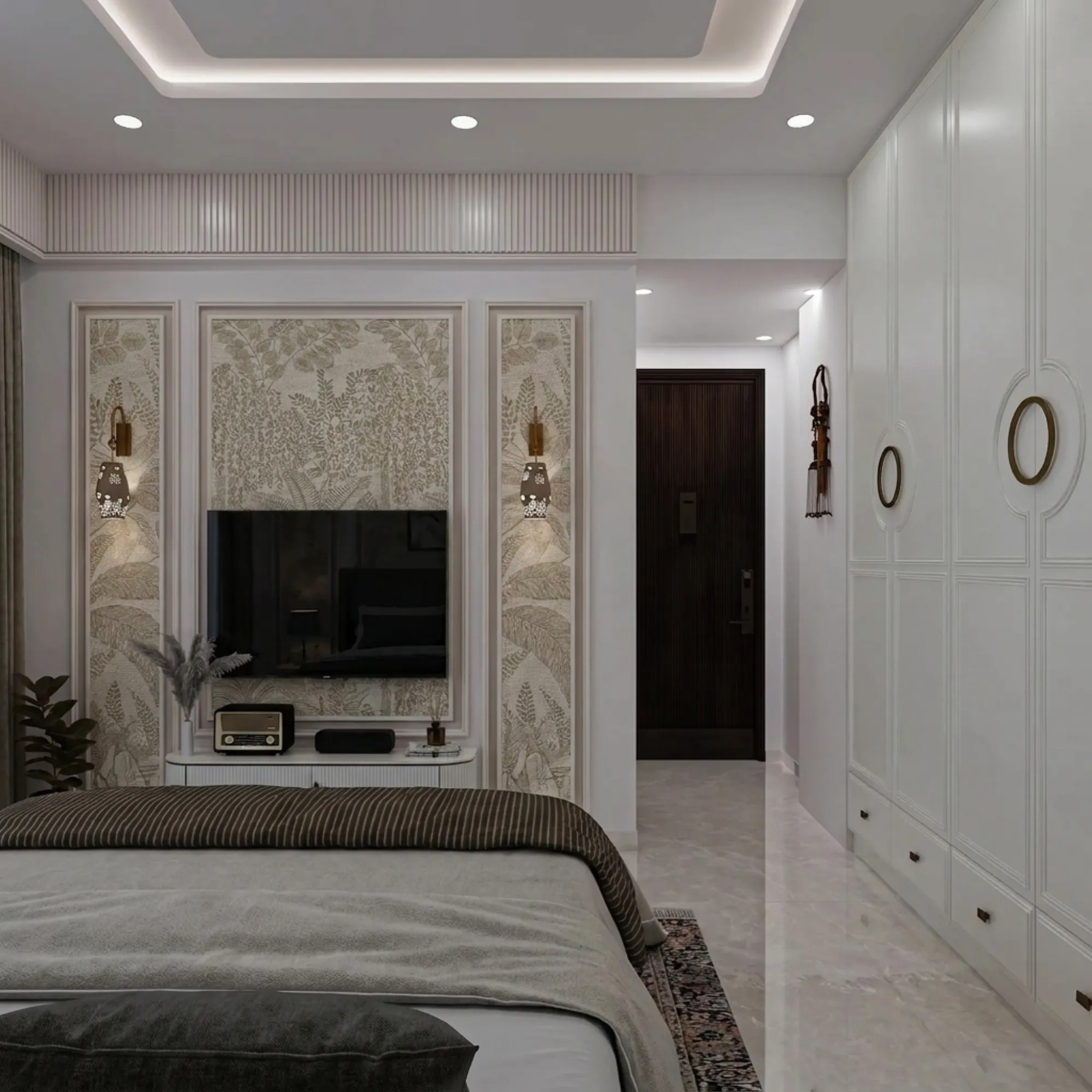
Premium-band wardrobes bring veneer finishes, lacquered or fluted glass shutters, integrated lighting, and full internal customisation down to trouser racks and pull-out accessory trays, and this is where engineered stone inserts or backlit panels sometimes show up as a design feature rather than just storage. We see this band most in Action Area I bungalows and larger duplex layouts where the wardrobe wall doubles as a design statement in the master bedroom, not just a functional box.
Why the same wardrobe gets three different quotes in New Town
This is the part nobody explains upfront, and it's the single biggest reason homeowners feel cheated after the fact even when nobody technically lied to them. A carpenter quoting per running foot without specifying shutter type, carcass grade, or hardware brand can legally hand you a bill that's 25-30% higher once you've agreed and the loft, the back panel thickness, and the hinge upgrade get added as extras mid-project. An interior design studio quoting per square foot with a detailed bill of materials, on the other hand, front-loads that conversation so the number you sign off on is closer to the number you actually pay.
| Local carpenter (verbal quote) | Design studio (itemised BOM) |
|---|---|
| Rate often quoted per running foot, ambiguous on carcass grade | Rate quoted per sq ft with material, hardware and finish specified |
| Loft, back panel, edge-banding frequently billed as extras later | Loft and back panel included or explicitly itemised upfront |
| Hardware brand rarely named | Hardware brand and warranty stated in the quote |
| No drawings, so on-site changes are common | 3D visualisation before fabrication starts, so changes happen on screen not on site |
We push every client toward seeing the wardrobe in 3D visualisation and rendering before a single sheet of ply is cut, because the difference between imagining a wardrobe wall and seeing it rendered at scale, with the actual shutter finish and handle style, catches sizing and proportion issues that a verbal description simply can't. It also means the quote you approve is the wardrobe you get, not a starting point for negotiation after installation.
What New Town's climate and flat sizes actually demand
New Town runs humid for a good stretch of the year, and that has real consequences for wardrobe material choice that a generic pricing guide from a different city won't tell you. BWR or BWP-grade ply resists moisture far better than standard commercial ply, and if your wardrobe backs onto an external wall or sits in a room that doesn't get much cross ventilation, spending the extra on marine-grade ply at the mid or premium band is one of the few upgrades that pays for itself by avoiding warping and delamination within the first monsoon cycle. This matters even more for ground-floor units and for flats close to Eco Park's greener, more humid pockets, where airflow inside built-in storage tends to be lower than in an open room.
Flat sizes in New Town's newer Action Area II and III towers also run tighter than older Salt Lake blocks, so wardrobe depth becomes a real constraint, standard 24-inch depth doesn't always fit comfortably in a bedroom under 100 square feet, and a lot of our mid and premium quotes actually go toward smart internal configuration, like sliding shutters instead of hinged ones to save floor clearance, rather than toward decorative finish. If you're weighing this against your overall budget, it helps to first understand what building a house costs in New Town at a macro level, since interior fit-out including wardrobes typically runs as a defined percentage of that total rather than an open-ended add-on.
- Confirm carcass grade (ply vs particle board) in writing
- Ask which hinge and channel brand is quoted, not just "soft-close"
- Get a 3D render before fabrication starts
- Clarify if loft, back panel and edge-banding are included
- Check moisture rating if the wardrobe sits on an external wall
Interior designer or straight carpenter, and when it matters
For a single wardrobe replacement in an existing flat, a good local carpenter with a clear, itemised quote can genuinely do the job well and at a fair price, and we'd never tell a homeowner to overpay for a designer's fee on a one-off piece. But once wardrobes are part of a larger fit-out, bedroom, dressing area, maybe a walk-in closet off the master, the value of working with a studio that plans the whole residential interior design scope together shows up in how the storage integrates with lighting, mirror placement, and the room's overall flow rather than sitting as an isolated box against a wall. We've written more on who to hire first, architect or interior designer, in New Town if you're still at the planning stage and unsure which conversation to start with. It also helps to understand what architects typically charge in Kolkata before those conversations begin, so the wardrobe number sits inside a budget you actually trust.
One of our recent Action Area II projects, a full residence fit-out where storage had to work around an irregular room shape, is a decent reference point for what mid-to-premium wardrobe work looks like when it's planned alongside the rest of the interior rather than bolted on afterward, you can see it in our Action Area II residence project. If you're renovating an older Salt Lake cooperative flat rather than fitting out a new possession, the calculus shifts again, since existing wall alignment and electrical points often dictate wardrobe placement more than the design brief does, and that's a conversation worth having with someone who does renovation and remodeling regularly in this specific building stock.
Getting a quote you can actually trust
At the end of the day, the per-square-foot number is only useful once you know what's sitting behind it, carcass grade, shutter finish, hardware brand, and what's included versus billed as an extra. Ask for all four in writing before you compare quotes side by side, and be suspicious of any number that seems unusually low without a material specification attached to it, because that gap almost always gets filled in later. If you'd rather skip the guesswork entirely and get an itemised quote based on your actual room dimensions, talk to our team and we'll walk you through base, mid and premium options with real numbers attached, not rough estimates. We've done this across New Town long enough to know exactly where the humidity, the flat sizes, and the finish choices intersect, and that's usually worth more than chasing the lowest per-square-foot rate you can find.