






Work-From-Home Setups for Sector V Professionals in New Town Flats
If you work for one of the IT parks in Sector V but live in a New Town flat, chances are your "home office" right now is a dining chair pulled up to a laptop balanced on a stack of books, and by 4 pm your back has opinions about that arrangement. We hear this constantly from clients across Action Area I, II and III, and honestly it makes sense, because most New Town flats were designed before hybrid work was a category anyone planned for, so the layouts assume you sleep, eat and relax there, not that you spend nine hours a day on video calls from the same 900 square feet.
This piece is about what actually fixes that, not generic advice about buying a nicer chair. We are Studio Contour, an architecture and interior design studio based in New Town since 2014, and we have delivered 330+ buildings across New Town and Salt Lake, a good chunk of them flats belonging to people who work in Sector V, Rajarhat's IT corridor, or run their own consulting practice out of a spare room. So we know exactly which corners of a New Town flat quietly sabotage a workday, and which fixes are worth the money.
We will walk through room selection and acoustics, lighting and the desk setup itself, the electrical and connectivity retrofits that matter more than people expect, and roughly what this costs and takes in New Town's specific building stock. If you are three months into working from a flat that was never meant for it, this should save you a fair bit of trial and error.
Why Most New Town Flats Fight You on WFH
New Town's residential stock skews toward 2BHK and 3BHK apartments in G+3 to G+4 blocks, built with open-plan living-dining zones and bedrooms sized for sleeping rather than sitting at a desk for eight hours straight. That open-plan living room, the one with the big window facing the internal courtyard or the road, is usually the loudest room in the flat during the day, which is precisely the room most people end up working from because it has the best light. The bedroom, meanwhile, has decent acoustic separation but terrible daylighting and almost no ventilation once you shut the door for a call, so people either overheat the room with the AC running non-stop or work in a box with the door cracked open and every household sound bleeding in.
The other recurring issue is electrical load. Flats sanctioned a decade ago typically ran one or two power points per room, sized for a table lamp and a phone charger, not a monitor, a laptop charger, a desk lamp, a router and a UPS all drawing off the same board. We see burnt-out extension cords and daisy-chained multi-plugs in almost every WFH retrofit we walk into, and it is one of the first things worth fixing properly rather than patching around.
Building the Room That Actually Works
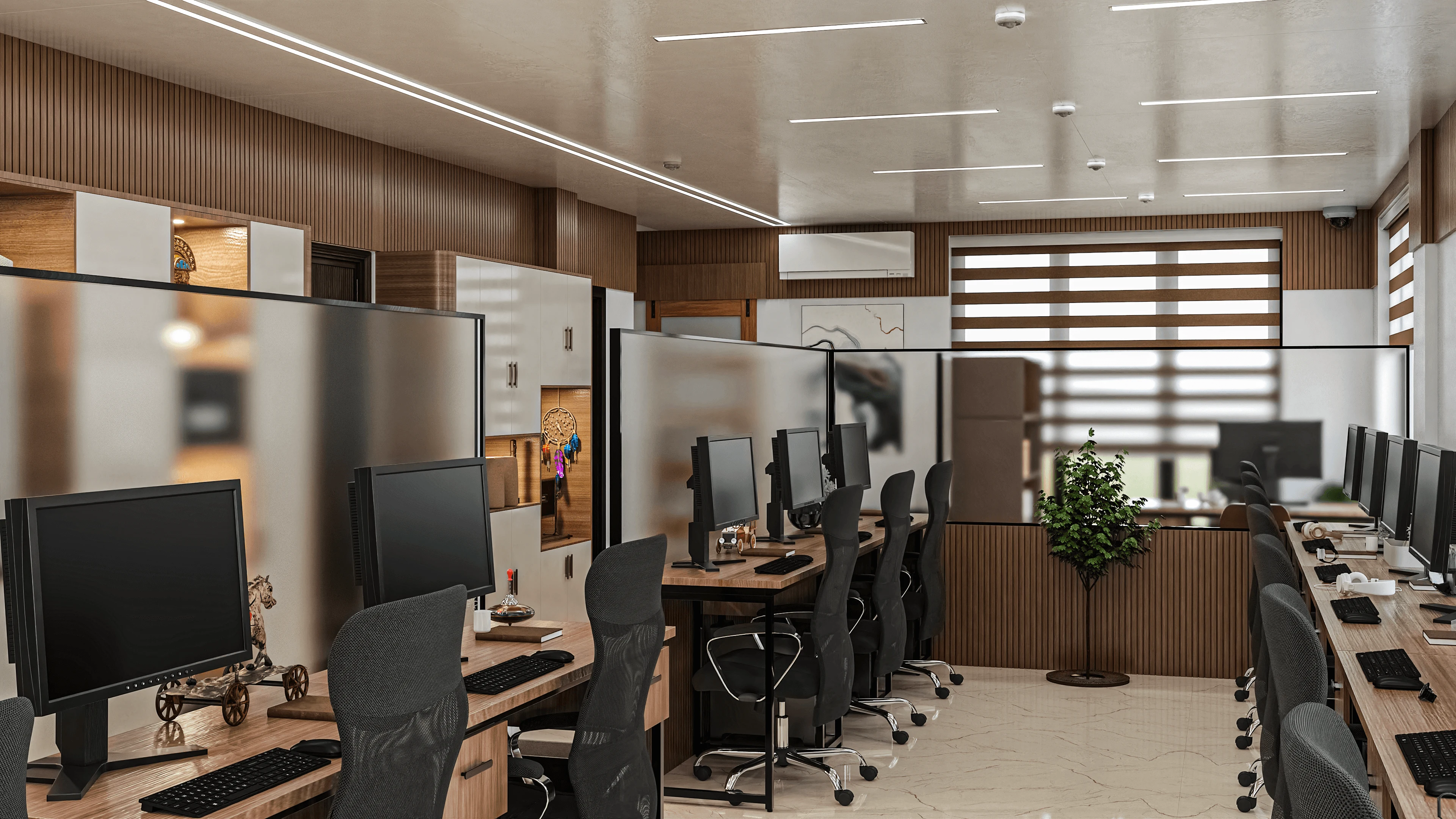
The single highest-leverage move we make in these projects is carving out a genuinely separate workspace, even a small one, rather than trying to make an open living room double as an office. In a 2BHK this is often a study nook built into an underused corner, screened off with a partition, a bookshelf unit, or in some cases a sliding door retrofit that lets the space close off completely during calls. In a 3BHK it is usually the smaller bedroom converted outright, which is a conversation we have a lot under our residential interior design scope, because the fix is rarely just furniture, it is layout.
Acoustics matter more here than most people expect going in. New Town's concrete-and-glass construction actually helps with sound transfer between units, but it does nothing for the noise bouncing around inside your own flat, kitchen clatter, a television in the next room, a child's classes on Zoom at the same time as yours. A properly detailed false ceiling with acoustic backing, paired with a soft-surfaced wall panel behind the desk, cuts reverberation noticeably, which is the difference between a call where you sound like you are in a stairwell and one where you sound like you are in an actual office. We cover this kind of detailing through false ceiling and lighting design, and if the room in question is genuinely open-plan we would point you to our piece on acoustic design for open-plan offices in Kolkata, because the same principles apply almost one-to-one to an open-plan flat.
Lighting is the other piece that gets underrated until someone's camera makes them look like they are calling from a cave. Daylighting from New Town's typically generous window openings is a genuine asset, so the goal is layering that with adjustable artificial light rather than fighting it, using a desk lamp with a warmer or cooler colour temperature depending on time of day, so your video presence and your eyes both hold up past 6 pm.
| Common Setup | Fixed Setup |
|---|---|
| Desk in the living room corner | Dedicated room or partitioned nook with a door |
| One shared power strip | Two to three dedicated circuits, surge-protected |
| Overhead tube light only | Layered daylight + adjustable desk lamp |
| Bare wall behind the desk | Acoustic panel or soft furnishing behind the desk |
Furniture, Ergonomics and the Long Haul
Nine hours a day at a desk is a different physical demand than the occasional evening of admin work, and generic flat-pack furniture usually was not built for it. The desk height, chair support and monitor eye-line all need to work together, which is basic ergonomics but it is the part almost everyone skips because it feels like the least urgent line item until their shoulders start locking up around month four. We build a fair number of these setups through custom furniture design, sized to the actual room rather than whatever standard desk width happened to fit through the door, and increasingly we are using AI-assisted layout tools to test furniture arrangements against a room's real dimensions before anything gets built, something we have written about in AI furniture layout optimisation for 2026, which is genuinely useful for squeezing a proper desk-and-storage setup into a smaller New Town bedroom without it feeling cramped.
Storage is the quiet failure point too. A desk with nowhere to put files, chargers, a second monitor stand or the odd bit of client paperwork just becomes clutter within a month, so we usually build in closed storage below or beside the desk as part of the same brief, not as an afterthought.
- Dedicated room or clearly partitioned zone, not a dining table corner
- At least two independent power circuits with surge protection
- Acoustic treatment behind and above the desk
- Adjustable task lighting layered with daylight
- Custom-sized desk and storage, not off-the-shelf dimensions
- Router placed for a clean line of sight to the desk, not buried in a cabinet
Power, Connectivity and the NKDA Reality of Retrofitting
If your WFH setup involves any structural change, moving a partition wall, converting a balcony into usable floor area, or altering an opening, that is not purely an interior decision anymore, it touches sanctioned plan compliance under New Town Kolkata Development Authority norms. Most people do not realise a wall shift needs to sit within the flat's approved layout, and NKDA's process for what counts as a minor internal change versus something requiring fresh sanction is worth understanding before work starts, not after. We would point you to our guide on the interior designer in New Town process for how that typically plays out, and if you are converting a whole flat rather than one room, our guide on apartment and flat interiors in New Town covers the layout logic in more depth. As always with anything NKDA-adjacent, current figures and thresholds should be confirmed directly with the authority since these do get revised.
Electrical retrofits are more straightforward but still worth planning properly rather than doing piecemeal. A dedicated circuit for the workspace, ideally on its own MCB, protects your equipment from the voltage fluctuations that are still fairly common in parts of New Town during peak load hours, and a UPS sized to your actual draw, not a generic one bought off a shelf, is the difference between a graceful shutdown and losing an hour of unsaved work mid-call.
Deciding Whether You Need an Architect or Just an Interior Team
This is the question we get asked most on WFH projects, and honestly it depends on whether you are moving walls or just reworking what is already there. If the fix is furniture, lighting, acoustics and storage within the existing footprint, an interior-focused brief is enough. If you are converting a balcony, shifting a partition, or reworking the flat's internal layout in a way that touches load-bearing elements or the sanctioned plan, you need architectural input first. We have laid out the decision logic in architect or interior designer, who to hire first in New Town, and at the end of the day this is exactly the kind of call worth having a short conversation about before committing to a scope, because getting the sequence wrong usually costs more in rework than it would have cost to just ask first.
For a sense of what a full New Town flat conversion looks like in practice, including how a spare room gets repurposed alongside the rest of the interior, our residence project in New Town is a reasonable reference point, though every flat's constraints are different enough that we would still walk your specific layout before quoting anything.
Getting This Right the First Time
The pattern we see over and over is people spending on a nice chair and a ring light while the room itself is still working against them, bad acoustics, one overloaded socket, light that flatters nobody on camera, and a desk height picked because it was in stock rather than because it fits the person using it. Fixing the room properly, even a modest one in a New Town flat, usually costs less than most people assume once it is scoped as one coordinated brief rather than a pile of separate purchases, and it holds up for years rather than needing patching every few months. If you are in New Town or Salt Lake and want an honest read on what your specific flat needs, get in touch with us and we will walk the space with you before recommending anything.