






An NRI's Checklist for Hiring an Architect Remotely in Salt Lake
You are sitting in Fremont or Frisco or wherever the current posting has landed you, it is past midnight your time because Kolkata just woke up, and you are trying to figure out how to build or renovate a home in Salt Lake, Sector 3 or Sector 1 or BD Block, from six thousand miles away, using nothing but WhatsApp, a rough sketch your father drew on the back of an electricity bill, and a level of trust you would never extend to a vendor you have not met. This is not a hypothetical. It is basically every second inquiry we get at Studio Contour, and it is exactly the situation this checklist is built for, because hiring an architect remotely is a different exercise than hiring one down the street, and pretending otherwise is how NRIs end up with half-built houses, missing contractors, and a relative in Kolkata who has stopped picking up the phone.
The trust gap is the actual problem, not the design
When you hire an architect locally, you can drive to the site, you can walk into the office, you can see the last three projects with your own eyes before you sign anything, and none of that is available to you when you are managing this from abroad, so the entire relationship has to be rebuilt around evidence instead of proximity. That means photographs are not enough, a slick Instagram grid is not enough, and a WhatsApp number that responds fast is not enough either. What you actually need is a studio with a long, checkable, physically-verifiable track record in the specific neighbourhood you are building in, because that is the only thing that substitutes for the site visit you cannot make. We have been doing this since 2014, we have delivered 330+ buildings across Kolkata, New Town and Salt Lake, and that number matters here specifically because it means there is a paper trail, sanctioned plans, and actual structures a cousin or a broker can go stand in front of if you ask them to.
Freelancer, contractor-led package, or a proper firm, here is the honest breakdown
Most NRIs we talk to have already tried one of two routes before they come to us, and both routes fail for reasons that are worth naming plainly rather than glossing over. The freelance route, usually a single architect working out of a home office, is cheap and fast to start, but there is no institutional memory if that person gets busy or unwell or simply stops responding, and you have no recourse beyond a phone number that may or may not still work in eight months. The builder-package route, where a local contractor bundles design "for free" into the construction cost, solves the responsiveness problem but creates a conflict of interest baked into the structure itself, because the same party drawing your plan is the same party billing you for materials, so there is no independent check on quantities or quality. A proper design firm sits between these, with a studio, a team, drawings that survive personnel changes, and a business that has to answer to its own portfolio, which is the entire reason we built Studio Contour around residential architecture and residential interior design as one continuous service rather than handing you off between disconnected vendors at each stage.
| Freelance Architect | Design Firm (like us) |
|---|---|
| Single point of failure, no backup | Team continuity, project survives staff changes |
| Verbal estimates, few precedents | 330+ documented builds, real addresses |
| No formal NKDA/Bidhannagar process knowledge | Deep, repeated sanction experience in Salt Lake and New Town |
| Cash-and-carry billing | Structured milestone payments tied to deliverables |
What "local knowledge" actually means for Salt Lake specifically
Salt Lake, formally part of Bidhannagar, runs on its own municipal machinery, its own plot coverage norms, and its own set of sanction quirks that differ meaningfully from what applies a few kilometres away in New Town, Kolkata or under the Kolkata Municipal Corporation further south, and this is precisely where an out-of-town or foreign-based design consultant tends to get it wrong. We have run sanction files through Bidhannagar's process enough times that we know the standard clarification queries before they come, and if you want the mechanics laid out plainly before you commit to anyone, our own guide to Bidhannagar building rules for Salt Lake and our breakdown of how to hire an architect in Salt Lake under Bidhannagar's process are both worth reading before your first call with anyone, us included. Cooperative housing blocks in Salt Lake in particular carry their own layer of society approvals on top of the municipal one, which is a wrinkle we cover more specifically for renovation work, and it is the kind of detail that separates a firm that has actually done ten Salt Lake projects from one that is learning on your file.
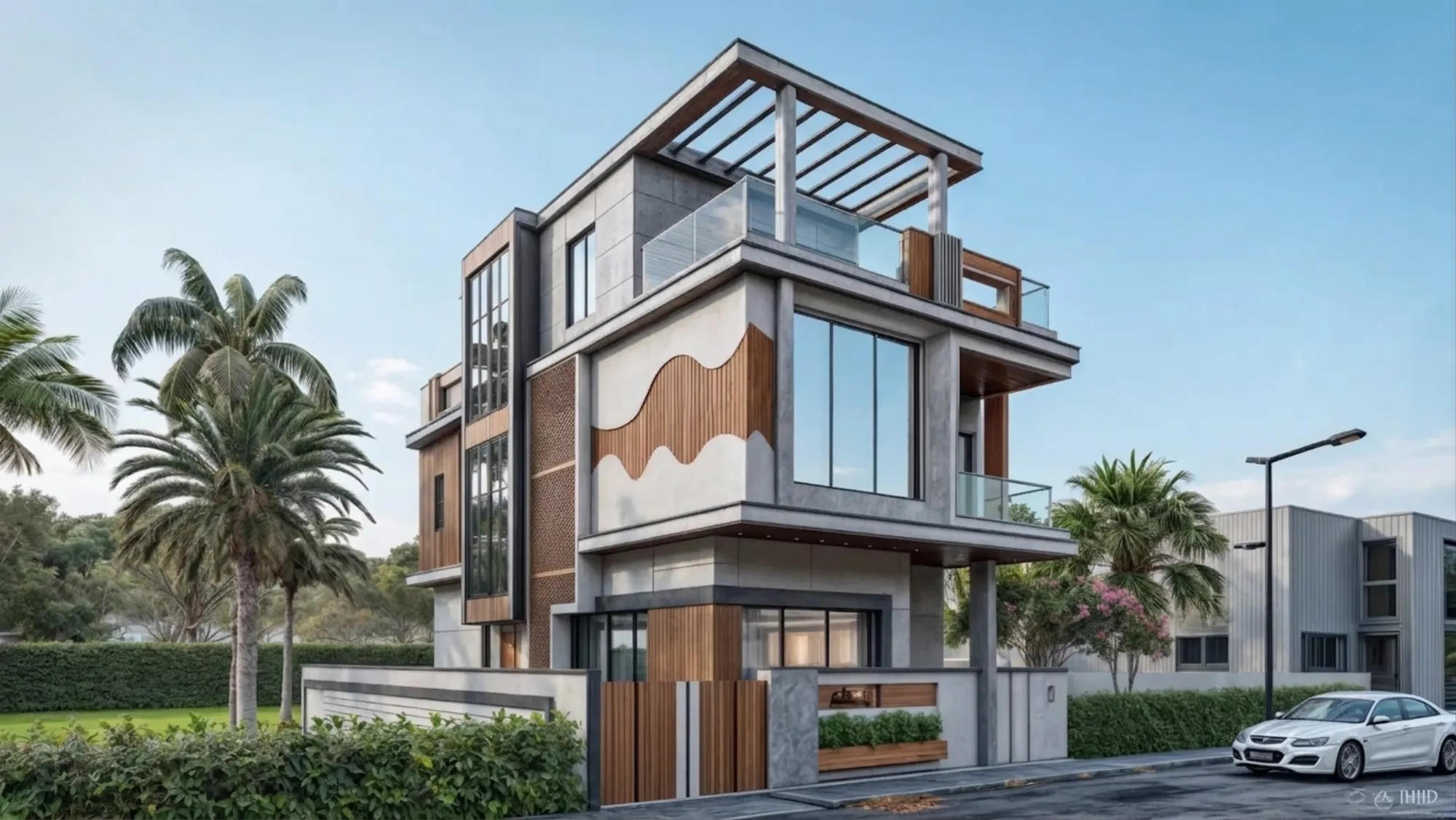
This is AB-271, one of our completed residences in Salt Lake, and we point to it not because it is unusually dramatic but because it is representative, an ordinary plot with ordinary setback and coverage constraints handled the way we handle most of our Salt Lake work, which is the point. You can see the fuller project record at AB-271, and if you want to browse the wider set before deciding anything, our full project archive has enough Salt Lake and New Town work in it that you should be able to find something close to your own plot size and budget.
The checklist itself, the part you actually came here for
Before you sign a retainer with anyone, remote or local, run them through this list, and do not accept "trust me" as an answer to any single item on it.
- Verify the architect is registered with the [Council of Architecture](https://en.wikipedia.org/wiki/Council_of_Architecture) and ask for the registration number directly
- Ask for at least three completed, addressable projects in the specific locality you are building in, not just renders
- Confirm who handles the NKDA or Bidhannagar sanction filing and whether that is included in the fee or billed separately
- Get milestone-based payment terms in writing, tied to deliverables like drawing sets and site stages, not calendar dates
- Ask how site supervision works when you cannot be physically present, and who signs off on quality at each stage
- Confirm turnaround time in writing, and compare it against the 8-12 week range that is typical for a full residential design package here
The payment structure item deserves a bit more weight than a single checklist line, because it is where most remote hiring mistakes actually happen.
How a remote engagement actually runs, week by week
The mechanics matter more than the sales pitch, so here is roughly how we sequence a project when the client is not physically in Kolkata for most of it, which by now is close to a third of our active files at any given time.
- 01Week 1-2: brief, site measurement by our team, and a video walkthrough sent to you
- 02Week 3-6: concept layout and 3D visuals reviewed over calls at a time that works for your time zone
- 03Week 6-9: sanction-ready drawings filed with NKDA or Bidhannagar as applicable, working drawings finalised in parallel
- 04Week 9-12: execution begins with weekly photo and video updates, site visits logged and shared
We lean hard on 3D visualization and rendering at the concept stage specifically because it removes the biggest source of remote-hiring anxiety, which is not being able to picture what you are approving from a flat plan. A render you can walk through on a video call does more to build confidence across a time zone gap than any amount of reassurance over text, and it also catches layout problems, a kitchen that does not clear the door swing, a bedroom that loses window light, before they are poured in concrete rather than after. It is a small operational choice, but it is the difference between a client who feels informed and one who is just hoping for the best.
The paperwork nobody mentions until a document gets rejected at the counter
Most NRIs walk into this assuming the hard part is design quality and the second hard part is money, and both of those matter, but there is a third layer that catches people off guard almost every time, which is that certain steps in the sanction and construction process in Salt Lake still require a physical signature on a physical form at a physical counter, and you are not going to be standing at that counter from Fremont or Frisco. Sanction applications, mutation-linked paperwork, and certain site formalities under Bidhannagar's process are built around the assumption that someone local is available to sign, so the actual fix is not hoping this resolves itself but getting a Power of Attorney executed and notarized at the Indian consulate nearest you before the project starts, naming a specific person, sometimes a parent, sometimes us directly for the scope that touches our own filings, to sign on your behalf. A studio that has run this for enough NRI clients knows the exact wording that particular office expects and knows it because a badly worded or wrongly stamped POA is one of the single most common reasons a sanction file sits in a queue for weeks longer than it needs to, and we would rather flag that on the first call than let you discover it after a clerk hands the document back unstamped.
The second piece of paperwork that gets underestimated is the money trail itself, and it is a different problem from the payment-structure question already covered here, because this one is about documentation your bank needs rather than about protecting you from a studio that overbills. Payments moving out of an NRE or NRO account for design or construction work usually need to be backed by proper invoices for the remittance to clear without friction, and for your own tax filing to hold up later if it is ever questioned, so a registered design firm issuing GST-compliant invoices tied to each milestone gives you that trail automatically, whereas a freelancer working off cash or informal transfers leaves you improvising a paper trail after the fact, right when you need it to be clean. This is a small operational detail until the one time your bank's remittance desk asks for supporting documentation you do not have, and then it stops being small very quickly.
There is also a relationship layer to this that most NRIs default into without thinking it through, which is routing everything through a parent or sibling in Kolkata as the eyes on the ground, and while that named local contact is genuinely useful for physical tasks, receiving a delivery, letting a surveyor onto the plot, we make a point of keeping the actual design decisions and approvals running directly between us and you over video, so the relationship does not degrade into a game of translated instructions passed through a third party who did not sit in on the original conversation. Your relative becomes the hands on the ground, not the decision-maker by default, and that distinction alone prevents a surprising number of the misunderstandings that show up later as change orders.
We handle this bundle of paperwork, the POA wording, the GST invoicing, the structuring of who does what locally, often enough with our NRI clients that it has stopped being a special case for us and started being just how a Salt Lake file gets opened, and that is worth as much as the design credentials themselves when you are the one signing from six thousand miles away.
Why the track record has to be the deciding factor, not the pitch
At the end of the day, anyone can build a polished website and speak confidently on a video call, and the catch here is that a confident pitch and a real, physically-standing portfolio in your own neighbourhood are not the same thing, and only one of them actually protects you when you are eight time zones away and cannot walk the site yourself. Our answer to that gap is not a better sales deck, it is 330+ buildings that exist, that were sanctioned through the same NKDA and Bidhannagar processes your project will go through, and that were delivered on a timeline we can show you rather than just promise you. If you want a sense of how that portfolio breaks down by area and typology before you talk to us, our piece on the 330-building portfolio across New Town and Salt Lake and our honest look at trust signals worth checking before hiring anyone in Kolkata are both good next reads, and if Salt Lake specifically is where your project sits, our Salt Lake locality guide has the fuller picture of the work we have done in that pocket of the city.
None of this replaces the due diligence you should be doing on your own regardless of who you hire, checking registration, checking addresses, calling references directly rather than trusting a forwarded testimonial, but if you run us through that same checklist, the registration is verifiable, the Salt Lake addresses are drivable, and the process is one we have repeated enough times that your project will not be the one we are figuring out as we go. Send us your plot details, your rough budget, and the block or sector you are building in, and we will walk you through exactly how a remote engagement would run for your specific site on our contact page.