






Wallpaper Versus Texture Paint in a Salt Lake Flat
Wallpaper Versus Texture Paint in a Salt Lake Flat
If you are standing in your flat with a paint shade card in one hand and a wallpaper sample book in the other, the question you are actually asking is not which of the two looks better, because both can look very good when they are done properly, and it is which of the two will still look good on this particular wall in this particular building after three monsoons have come and gone. That is a question about the wall rather than about the finish, and most of the wallpaper failures we have been called in to look at across the Salt Lake belt trace back to a wall that was never going to hold a sealed surface in the first place.
Salt Lake is a planned grid of blocks and sectors, and a large share of its building stock dates from the sixties through the nineties, which means plaster that has already lived through decades of a long humid stretch followed every year by a serious monsoon, often on a wall that touches a neighbour who built right up to the boundary. In those flats light and air come from your own plot alone, one or two faces sit in permanent shade, and the walls on those faces behave nothing like the walls that get morning sun. The newer G+3 and G+4 rebuilds standing beside the older houses have the opposite problem, because fresh reinforced concrete and fresh masonry carry construction moisture for months after handover, and paper that goes up inside that drying window will lift at the seams however good the roll was.
We are Studio Contour, an architecture and interiors studio working out of New Town across the Salt Lake, New Town and Rajarhat belt, founded in 2014, with 330+ buildings delivered, and the principal architect, Sumana Kumar, stays on a project through sanction and site instead of handing it to a junior once the agreement is signed. What follows is how we actually decide between wallpaper and texture paint on a given wall, what each one costs you in reversibility rather than only at the quotation stage, and the order the work has to happen in so that the finish ends up being the last decision rather than the first. The wider picture of how we work here sits on our Salt Lake area page, and the room by room specifics of interior design across Salt Lake sit alongside it.
What the wall is doing before you finish anything
Before either option is genuinely on the table the wall has to be read. We tap the plaster across its full height to find hollow patches where it has parted from the masonry, we look along the skirting line and up at the ceiling junction for the pale powdery bloom that tells you salts are migrating, and we check the faces that share a boundary with the next building most carefully, because that is where water sits longest and dries slowest. Rising damp in an older wall is basically water moving through masonry and carrying dissolved salts with it, and when that water reaches a sealed surface such as a vinyl paper it cannot evaporate, so pressure builds behind the sheet and the seams open from the bottom up. A breathable coating lets the same wall dry outward instead, which is the whole reason texture paint survives where paper will not, and the broader logic of building for this climate is in Monsoon-Resilient House Design in Salt Lake.
Where wallpaper genuinely earns its place
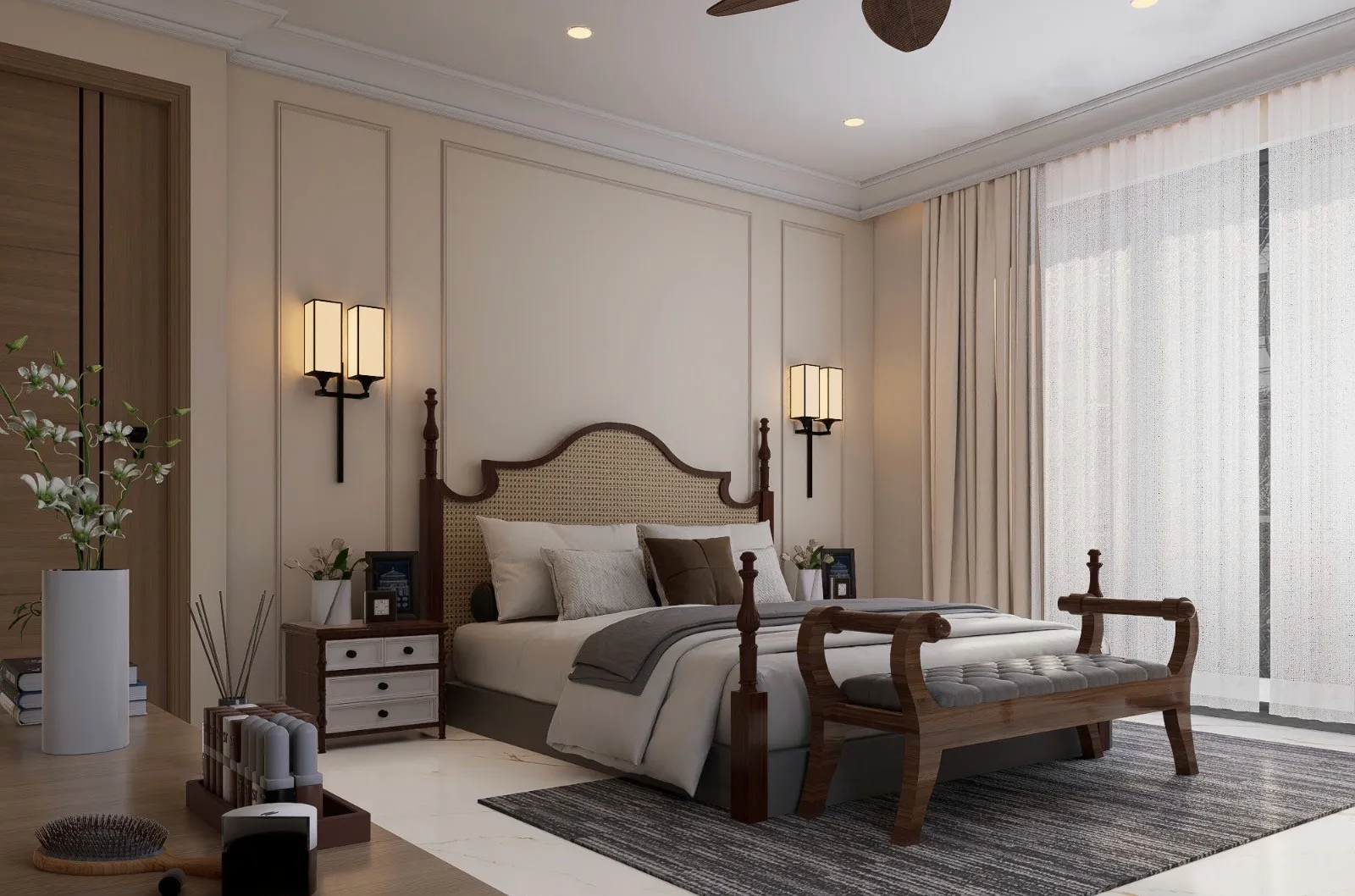
Wallpaper buys you pattern and depth at a scale no roller achieves, and on the right wall it is the best value in the room. That wall, in a Salt Lake flat, is almost always an internal partition: the headboard wall of a bedroom, the end wall of a dining alcove, the back of a study niche, or a passage wall that terminates a view. These walls are dry on both faces, they are not fighting the weather, and a sealed surface does them no harm at all. The catch here is that paper demands a near perfect substrate, because any undulation left in the plaster is read instantly once light grazes along the surface, and a seam sitting slightly out of plumb stays visible for the life of the installation, so the honest cost of a papered wall includes skimming and sanding that wall to a tolerance nobody bothers with under paint.
Where texture paint earns its place
Texture paint earns its place on everything the paper should not touch. It stays breathable, so an external face or a wall shared with the building next door can still dry outward through the humid stretch, and it forgives the minor variation decades leave in old plaster, because a trowelled or rolled surface absorbs small undulations instead of advertising them. It can also be patched, which matters more than people expect, since a chased wall after an electrical fault or a weeping pipe can be made good in a day on texture, while the same repair on paper means the whole wall comes off and the batch may no longer exist. The trade-off runs the other way too, because deep textures hold dust in the top coat, so we keep the deeper finishes to walls people look at and the flatter ones to walls people brush past.
| Wall condition | Wallpaper | Texture paint |
|---|---|---|
| Dry internal partition with sound plaster | Best use of the budget here | Works but adds less than paper does |
| Wall shared with the building next door | We advise against it | Preferred because the wall still dries outward |
| Recently built and recently plastered | Wait out the drying window | Can proceed once the primer reads dry |
| Old plaster hollow in patches | Only after the plaster is redone | Redo the patches first and texture forgives the rest |
Going room by room rather than flat by flat
A flat does not get one answer, it gets one answer per wall, and walls differ a great deal within twenty feet. In the living room the sofa or television wall is usually the candidate for paper and the window wall almost never is, because the glazing reveal and the sill bring moisture and movement to that face. Bedrooms are where paper does its best work, on the headboard wall, with the other three kept in a quiet washable paint so the room is not exhausting to sleep in. Children's rooms argue for paint, simply because the wall will be drawn on and the repair has to be cheap. Wet zones in kitchens and bathrooms are out of scope for both of these finishes, since tile or a washable system belongs there, and the dry wall opposite the counter can take a light texture. Where the finish meets joinery the decision changes again, which is why we fix the furniture layout first, and on a full-home job the custom furniture design drawings are issued before anybody orders a roll.
Light, and why one sample behaves differently on two walls
The same roll and the same tin look like two different products on two walls of one room, and this is what most people discover too late. A north facing wall in a shaded flat receives flat diffuse light all day, which kills relief, so a heavy trowelled finish there simply reads as a dull wall. A wall catching low morning or evening sun gets raking light along its surface, which is wonderful for texture and merciless on paper seams, and artificial lighting does the same thing harder, since a cove or a wall washer aimed down a papered wall will find every lap joint. So we test on the actual wall at the actual hours with the actual fitting, and that one step changes the decision more often than any conversation about brands.
What each option costs you later, and not only now
Every option we put in front of a client carries its cost consequence on the same page, because a budget that cannot move with the decisions is not really a budget. For these two finishes the numbers that matter are not the opening per wall rates but three others: what it costs to prepare the wall to the tolerance the finish needs, what it costs to patch a small area in year three, and what it costs to strip the finish entirely when the room changes. Paper is cheapest to install on a wall that was already perfect and most expensive to reverse, since removal commonly takes the top skin of plaster with it, while texture is more forgiving at both ends. Rates and fee structures vary by scope and by flat and have to be quoted against your actual drawings, and the way we scope and price work is set out in Architect Fees and Scope for a Salt Lake House, Explained Plainly. Marble & Walnut Drawing Room project in Kolkata is an example of that category of residential work in this belt, and Ivory Ledge project in New Town is another.
The order the work has to happen in
- 01Read the walls and trace the damp
- 02Repair plaster and close the services
- 03Lock the furniture and lighting layout
- 04Apply the chosen finish last
Finish selection goes last, and when it goes first the money is usually wasted. Damp has to be traced and treated, hollow plaster has to be replaced, electrical chases and air conditioning drain lines have to be cut and closed, and the false ceiling has to be in place, because every one of those operations damages a finished wall. Only once the wall is in its final condition can anybody sensibly choose between a sealed surface and a breathable one. Where the job is a rebuild rather than a refit this sits at the far end of a longer process that begins with residential architecture and the sanction route through Bidhannagar Municipal Corporation, and because architecture, interiors and sanction drawings sit with one team here you are not carrying information between a drafting service, a contractor and a furnishing vendor. That route is laid out in Bidhannagar Municipal Corporation Building Plan Sanction for a G+2 Residential Building in Salt Lake and the paperwork that follows is covered in Mutation and Property Assessment Under Bidhannagar Municipal Corporation in Salt Lake: A Plot Owner's Guide, while what is permissible on your plot varies plot by plot and has to be confirmed for your specific address. Commercial interiors in Sector V follow a different logic again, which Commercial Building Architecture in Salt Lake and Sector V goes into.
- Ask whether the wall shares a boundary with the building next door
- Confirm the plaster has been checked for hollow patches and salts
- Check how a patch repair in year three will be made good
- Get the preparation and removal cost in writing before you choose
When another kind of provider suits you better
There are readers for whom hiring a studio is the wrong move, and it is worth saying so plainly. If you are a tenant doing one feature wall in a flat you will leave in two years, a competent wallpaper installer working on his own is the right answer and a design engagement is overhead you will not recover. If one bedroom needs freshening before a wedding and the plaster is sound, a painting contractor with a good texture hand will be faster and cheaper than we will be. A turnkey fit-out contractor suits somebody who wants a single price and a single signature and is content to take the specification that price was assembled around. The structural trade-off in that model is that the margin sits inside the material choice, so the incentive runs toward whatever is quickest to apply across every wall, and the drawing set that would have told you why one particular wall needs to stay breathable never gets produced. That is a consequence of how the business is built, not a comment on anybody's competence.
| Studio Contour | A turnkey fit-out contractor |
|---|---|
| each wall gets a finish chosen from its own condition | one specification applied across the whole flat |
| every option presented with its cost consequence attached | a single quoted price with the specification inside it |
| principal architect stays on through sanction and site | supervision by the crew running the job |
| architecture interiors and sanction drawings in one team | finish work in house with other scopes subcontracted |
Deciding it for your flat
If you are weighing these two finishes for a specific flat, the useful next step is not another sample book, it is somebody reading your actual walls, because the answer genuinely changes between a shaded party wall and a bedroom partition eight feet away from it. Get in touch with the address and a few photographs taken along the skirting line and up at the ceiling junction, and we will tell you which walls can carry paper, which ones should stay breathable, and what each route costs you to undo later. At the end of the day the finish you can repair in year five without redoing an entire wall is worth more than the one that photographed best in the showroom.