






How Much Does It Cost to Hire an Interior Designer in New Town in 2026?
How Much Does It Cost to Hire an Interior Designer in New Town in 2026?
If you have already spent a weekend calling three "interior designers" in New Town and gotten three answers that are nowhere near each other, you are not doing anything wrong, the market itself is just that fragmented right now. One quote comes in as a flat per-square-foot rate, another comes in as a percentage of your total build cost, and a third is basically a WhatsApp number attached to a carpenter who also does "design." So before we get to what we charge, it is worth laying out what actually moves the number, because the honest answer to "how much does it cost" is that it depends far more on scope and who is actually accountable for the outcome than most people assume when they start Googling.
We are Studio Contour, an architect-led and interior design studio that has been working out of New Town, Kolkata since 2014, and at this point we have delivered 330-plus buildings across New Town and Salt Lake, which is enough volume that we can talk about pricing patterns with actual data behind us rather than a rate card we invented last quarter.
What Actually Determines the Cost of Hiring an Interior Designer in New Town
The single biggest swing factor is scope, and specifically whether you are hiring someone to design a space or to actually deliver it. Pure design consultation, where a designer hands you drawings, mood boards, and a shopping list and you find your own contractor, sits at the low end of the market because the designer is carrying almost none of the execution risk. Full turnkey interior work, where one studio handles design, procurement, civil work, electrical, false ceiling, modular units, and site supervision through to handover, costs more per square foot, and it should, because that studio is now the single point of accountability for everything that can go wrong on a construction site.
The second factor is finish grade, which is really a proxy for the brands and materials you are specifying, so a kitchen with laminate shutters and standard hardware and a kitchen with acrylic or PU finishes and German hinges can differ by 40 to 60 percent on the same footprint even with identical layouts. The third factor, one people in New Town underestimate constantly, is compliance overhead. A flat inside a HIDCO-approved group housing society in Action Area II has different structural and fire-safety constraints than an independent bungalow plot in Action Area I, and a designer who does not already know the difference will spend your money and your timeline figuring it out live, on your project.
What New Town Homeowners Are Actually Budgeting in 2026
Across the projects we handle, apartment interiors in New Town societies generally land in a broader band than most rate cards admit, because a semi-furnished 2BHK renovation and a full turnkey 3BHK with custom furniture and false ceiling work are not the same purchase even though both get called "interior design" in casual conversation. What we can say with confidence, having run over a hundred projects specifically in the Kolkata metro, is that the studios quoting a single flat number for every home in the city are usually simplifying something you will discover later, either in the form of change orders or in the form of a finish downgrade nobody flagged upfront.
| Project Type | Typical Scope | What Drives the Range | ||
|---|---|---|---|---|
| Consultation Only | Drawings + mood boards + BOQ | Designer fee alone | no execution risk | |
| Design + Execution | Full design to handover | Finish grade | plot type | society vs independent |
| Renovation of Existing Flat | Partial civil + interiors | Extent of demolition | existing MEP condition | |
| New Bungalow/Duplex Interiors | Architecture + interiors | Plot size | sanctioned FAR | custom furniture volume |
If you are trying to sanity-check a quote you have already received, our cost to build a house in New Town guide breaks down the construction-side numbers, and if you want the fee structure specifically, our piece on architect fees in Kolkata walks through how percentage-based and fixed-fee models actually compare over a project's life.
Freelancer vs Small Studio vs an Established Firm
This is the comparison most homeowners actually need to make, and it is worth being honest about the trade-offs on each side rather than pretending there is one obviously correct answer, because there isn't, it depends on how much risk you are willing to carry yourself.
| What You Get | What You Give Up |
|---|---|
| A solo [freelancer](https://en.wikipedia.org/wiki/Freelancer) is usually the cheapest quote and the most flexible on scheduling | A freelancer has no team to fall back on if they get sick, overbooked, or simply move on to a bigger client mid-project |
| A small local studio brings a real design sensibility and personal attention from the principal designer | A small studio often lacks in-house structural or MEP capability, so compliance issues get outsourced and timelines stretch |
| An established firm like ours carries site supervision, vendor accountability, and a documented process from sanction to occupancy | An established firm's base fee sits higher than a freelancer's, because you are paying for redundancy and accountability, not just design hours |
The catch here is that the cheapest option on day one is rarely the cheapest option by the time you account for rework, delayed possession, or a general contractor walking off a site mid-project because the freelancer who hired them never had the standing to enforce the contract. We have been called in more than once to finish a New Town flat that a freelancer started, and the second phase almost always costs more than if the client had hired for execution capability from the start.
Why 330+ Buildings Across New Town and Salt Lake Changes the Math
At the end of the day, the reason our fee looks the way it does comes down to what that fee is actually buying you, and having delivered 330-plus buildings since 2014, we have effectively already made and fixed the mistakes that a first-time studio would make on your project, on someone else's dime, years ago. We know which HIDCO plots in Action Area II have soil conditions that need extra foundation work, we know the NKDA turnaround times for a completion certificate down to the week, and we know which societies in New Town and Salt Lake have strict move-in-hour restrictions that will blow your handover date if your contractor doesn't plan around them from day one.
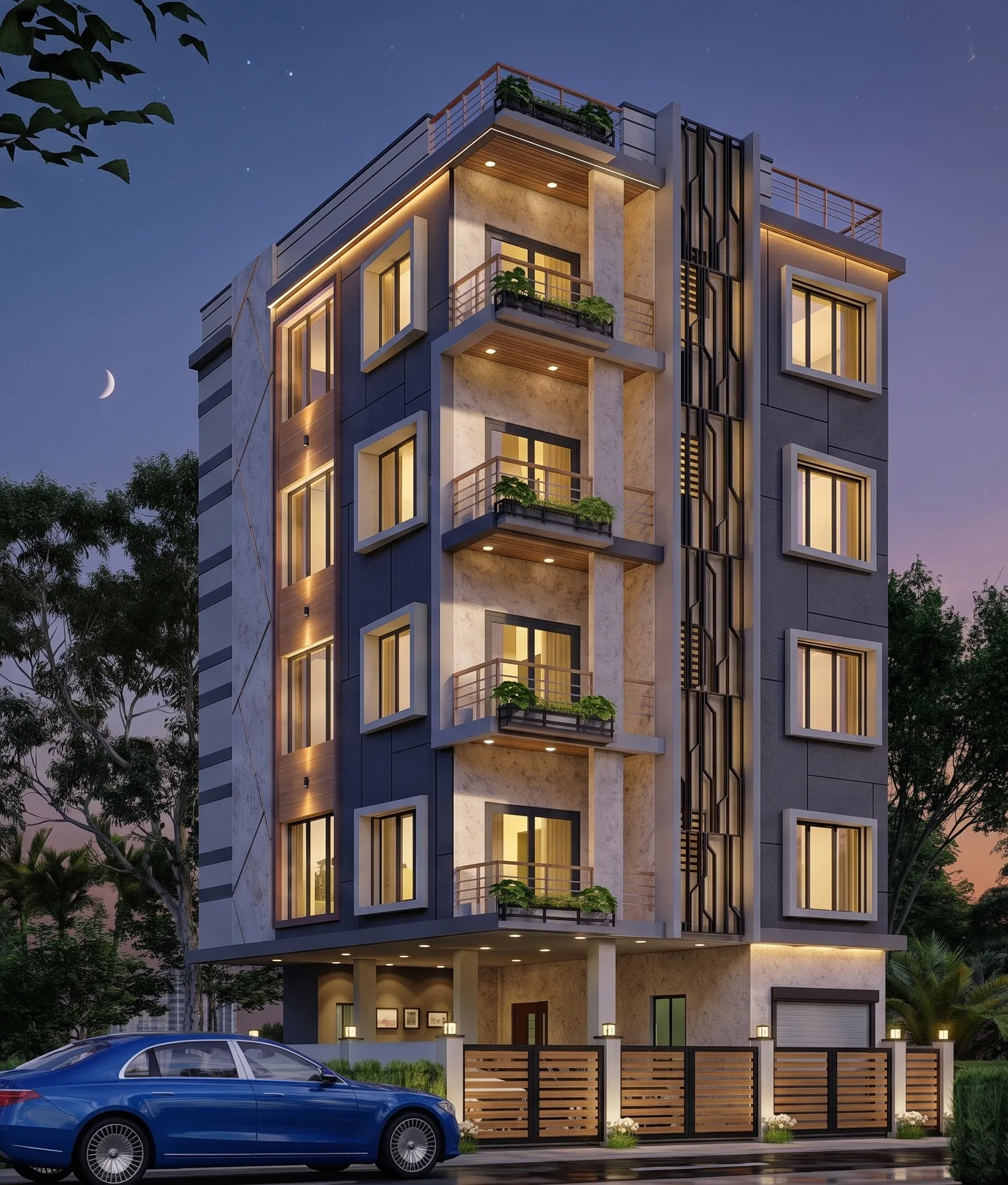
That project experience shows up directly in projects like our DE Block residence in New Town, where the interior layout, the vastu-conscious room placement, and the structural work all had to be coordinated as one process rather than three separate vendors handing off responsibility to each other. If you want to see the range of work this looks like across the neighborhood, our full project portfolio covers residences, renovations, and commercial fit-outs across New Town, Salt Lake, and Rajarhat, and our dedicated guide on hiring an interior designer in New Town goes deeper into how we scope a project before a single rupee gets committed.
What Our Fee Actually Covers, From First Sketch to Occupancy Certificate
A lot of the confusion around cost comes from not knowing what stages a fee is even supposed to span, so here is how a typical residential interior design engagement moves through our studio, start to finish.
- 01Site survey and brief, usually within the first week
- 02Concept design and 3D visuals for sign-off
- 03Detailed working drawings, BOQ, and vendor finalization
- 04Execution and site supervision through to handover
That whole cycle typically runs 8 to 12 weeks for a standard apartment interior, longer for full residential architecture projects that involve new construction or NKDA sanction from scratch. Every stage is priced into the fee upfront, so there is no separate "supervision charge" that shows up in month three, and if your project needs 3D visualization to get a housing society or a spouse on board before construction starts, that is part of the same process rather than a bolt-on extra.
What the Sticker Price Doesn't Tell You About the Years After Handover
Most cost conversations in New Town stop the moment the flat is handed over, the snag list is signed off, and everyone shakes hands and moves on, but a real chunk of what you are actually paying for only shows up eighteen months or three years later, when a modular hinge starts sagging under its own soft-close mechanism, or a false ceiling joint opens a hairline crack after its first proper monsoon, or the veneer on a wardrobe shutter starts lifting at the edge because the adhesive underneath it was never rated for Kolkata's humidity in the first place, and at that point the only number that matters is not what you paid up front, it is whether the studio that built it is still reachable and still willing to send someone out.
This is where a defect liability period earns its keep, and it is worth asking any studio you are quoting to spell it out in writing rather than waving at it verbally, because a twelve-month DLP that actually gets honored is worth more than a longer one that exists only on paper. On our projects, civil and finishing work carries a standard defect liability period, modular hardware and shutters carry manufacturer warranties that typically run three to five years depending on the brand specified, and where we have specified branded electrical or plumbing fixtures, those warranties get registered in the client's name at handover so the paperwork is never sitting in a drawer somewhere unclaimed. None of that changes what the fee looks like on day one, but it changes what the fee is actually buying, which is the difference between a price and a cost.
The reason this section matters more in New Town specifically than in an older, more settled part of Kolkata is that a large share of the stock here is still under ten years old, so a lot of homeowners are hitting their first real post-handover issue right about now, in 2026, and discovering that the freelancer or small outfit that did their interiors in 2019 or 2020 has since folded, rebranded, or simply stopped picking up calls once the final payment cleared. We have taken calls from exactly these homeowners, people who are not our clients, asking whether we can look at a ceiling that a studio that no longer exists installed five years ago, and the honest answer is that we can fix it, but fixing someone else's unaccountable work always costs more than building it right the first time with someone who plans to still be in New Town a decade from now.
Having delivered 330-plus buildings since 2014, we are now old enough as a studio that we are servicing warranty and maintenance calls on our own early projects, which is a genuinely uncomfortable test to put yourself through voluntarily because it means someone from our first years of operation can call us today and hold us to what we promised them then, and it is also the clearest proof we can offer that our pricing was never built around disappearing after handover. So when you are comparing a lower quote against ours, it is worth asking that studio directly what happens to your warranty if they are not around in three years, because that answer, more than any per-square-foot rate, is what actually determines whether the cheaper number today stays cheaper over the life of the home.
Five Questions to Ask Before You Sign Anything
Whoever you end up hiring, and we obviously think it should be us, run them through these questions first, because the answers tell you more than any quote will.
- Who is legally accountable if the contractor damages a neighboring flat during work
- Does the fee include NKDA or Bidhannagar compliance documentation, or is that separate
- What happens to your payment if the project runs past the agreed timeline
- Is there a single point of contact for the whole project, or do design and execution sit with different vendors
- Can they show you a completed project in a New Town or Salt Lake society, not just renders
A studio registered with a body recognized by the Council of Architecture and familiar with the local sanction process, including everything covered in our guide to the NKDA building plan sanction process, should be able to answer all five without hesitating. If they can't, that gap is going to become your problem sometime around month four.
We have run this same conversation with enough homeowners across New Town and Salt Lake, from a young family renovating a resale flat near Action Area I to a joint family building a new bungalow from an empty plot, that we can usually tell within one site visit whether a project needs a light-touch design consultation or full turnkey delivery, and we will tell you honestly which one you actually need rather than upselling the bigger package by default. If you want that same straight assessment on your own project, talk to us and we will walk you through what it would actually cost to do it right.