





Multi-City Design Chain or a Local Kolkata Studio: What You Actually Lose With Scale
Type "multi city firm vs local studio Kolkata" into Google at eleven at night while you're staring at a half-approved floor plan and a WhatsApp message from a design firm's Mumbai office asking you to hop on a call next Tuesday, and you already know something is off about the whole arrangement, because the team that is actually going to build inside your plot in Action Area IIB or your flat in AC Block, Salt Lake, sits over a thousand kilometers away, and the drawings they hand off still have to clear the same New Town, Kolkata sanctioning desk regardless of how polished their national portfolio looks on a pitch deck.
We've been doing this from inside New Town since 2014, so we're not writing this to scare you off big names for the sake of it, we're writing it because we've picked up the pieces on more than one project where a multi-city studio's Kolkata "branch" turned out to be a single coordinator answering emails between two other cities, and by the time the client realized it, the plan revisions were stacking up and the site visits had thinned out to whenever someone could squeeze in a flight.
What "Multi-City" Actually Means Once You Sign the Contract
The pitch is always the same, a national design language, a bench of senior architects who've worked across five metros, a process that's been "refined over hundreds of projects," and honestly none of that is a lie, it's just not the part of the story that affects your build. The catch here is that the person who runs the sales meeting in a serviced office off EM Bypass is almost never the person who ends up on your site checking whether the false ceiling framing cleared the beam by the right margin, that job typically falls to a local execution partner the firm has subcontracted for the Kolkata leg, someone whose incentives and whose familiarity with your specific project are both several steps removed from the studio whose name is on your contract. We're not saying that structure can't work, plenty of large commercial rollouts genuinely need it, we're saying that for a residential build or a mid-size interior fit-out, you end up paying a national overhead for what functions, on the ground, as a local subcontractor anyway, minus the direct accountability you'd get from hiring that local studio outright. If you're weighing this decision, it's worth reading through the red flags worth checking before hiring an interior designer in New Town before you sign anything, because most of them trace back to exactly this gap between who pitches you and who shows up.
The Sanction Process Doesn't Care About Your Studio's National Ranking
Here's the part that actually costs people money and months, the New Town Kolkata Development Authority, Bidhannagar, and the Kolkata Municipal Corporation each run their own building sanction machinery, with their own quirks around setback, ground coverage, and how a corner plot or a co-operative housing plot gets treated differently from a standalone bungalow plot. Action Area I, II, and III inside New Town don't even follow identical rules from each other, and a firm that's mostly done its sanction work in Pune or Bangalore is, quite reasonably, going to spend part of your project's timeline relearning a jurisdiction it doesn't live inside. We've filed plans through the NKDA sanction process and the Bidhannagar building rules for Salt Lake often enough that we know which desk officer wants the drainage layout on a separate sheet and which revision cycle actually needs a fresh structural certificate versus a simple addendum, and that kind of knowledge only comes from doing it locally, repeatedly, not from a national SOP document.
| Local Kolkata Studio | Multi-City Firm |
|---|---|
| Sanction desk relationships built over years in NKDA/Bidhannagar/KMC | Local partner re-learns jurisdiction rules per project |
| Senior architect or founder visits your site directly | Site visits routed through a subcontracted local supervisor |
| Design and execution team sit under one roof, one accountability chain | Design team and execution team are often different companies |
| Pricing reflects one Kolkata-scale overhead | Pricing carries national-office overhead passed down to a regional job |
Where the Multi-City Model Genuinely Wins, and We'd Rather Say So Than Pretend Otherwise
At the end of the day, a fair comparison has to admit where the bigger model earns its size. If you're building a large-format retail chain that needs the exact same retail design language replicated across six cities in a fixed rollout window, or a hospitality group standardizing interiors across a dozen properties, a multi-city firm's bench strength and its documented SOPs genuinely reduce risk, because consistency across locations is the actual deliverable, not just a nice-to-have. Their scale also helps when a project needs specialized engineering consultants that a boutique local studio would otherwise have to bring in from outside anyway. What that model is weaker at is the opposite situation, a single home, a single flat, a single commercial unit, where the value isn't standardization across five cities, it's someone who actually understands your specific plot, your specific building committee, and your specific neighbours' complaint history with the local ward office. Before you commit to either model, it's worth running through a short checklist.
- Ask who will physically visit your site and how often, by name, not by department
- Ask whether the design team and the execution team are the same company or two separate contracts
- Ask for local sanction timelines they've actually closed in New Town, Salt Lake, or your specific KMC ward
- Ask what happens to project continuity if the assigned coordinator gets rotated to another city
- Ask for a fixed, itemized quote rather than a range that "depends on scope discovery"
What 330+ Buildings in New Town and Salt Lake Actually Teaches a Studio
We were founded in 2014 and since then we've delivered upwards of 330 buildings concentrated almost entirely in New Town, Salt Lake, and the immediate Kolkata belt, and that concentration is the whole point, we're not spread thin trying to hold a design language together across five states, we're deep in one geography, which means we've seen the same drainage issue on three different AA IIB plots and know exactly how to design around it before the site engineer even flags it.
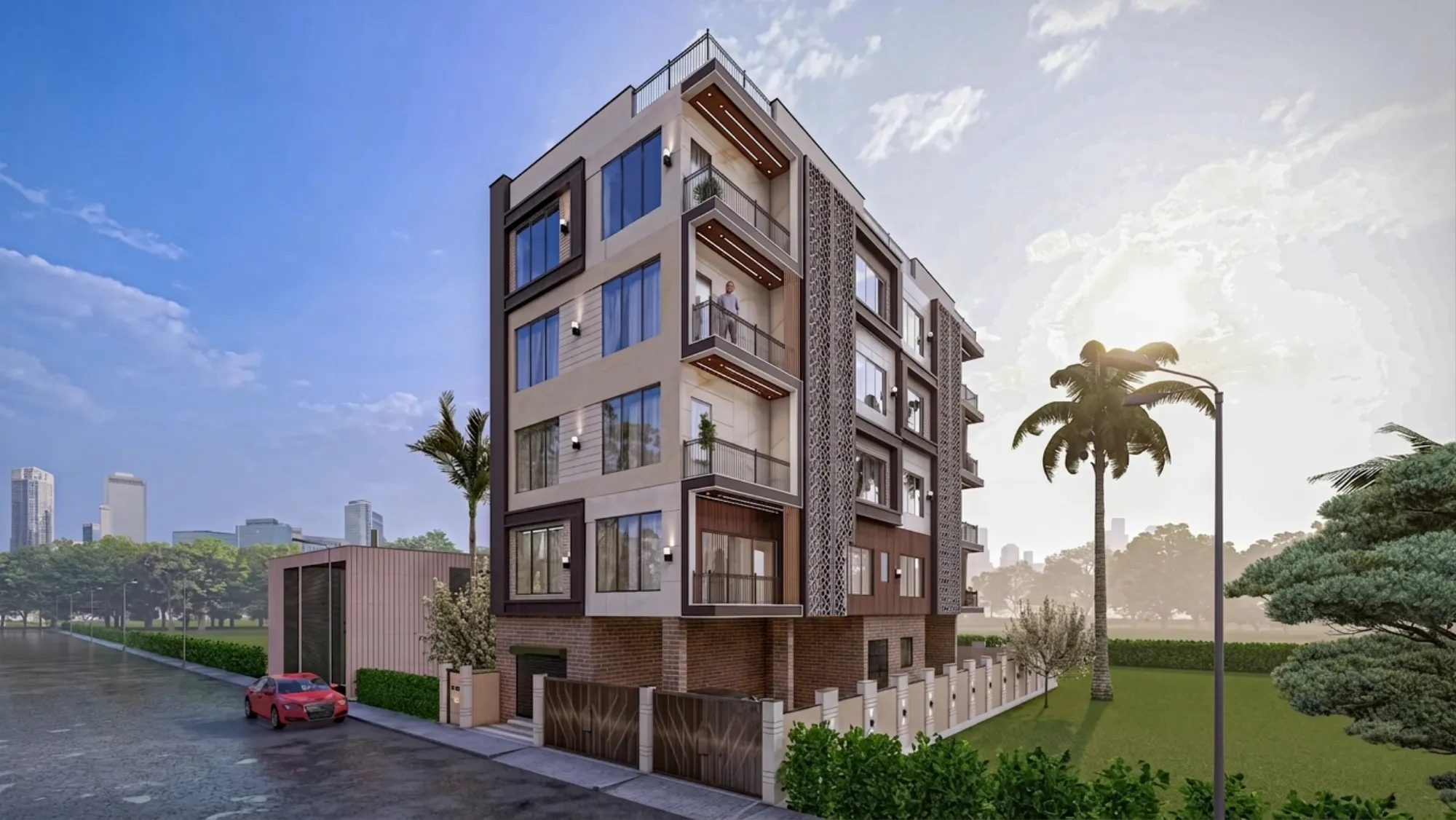
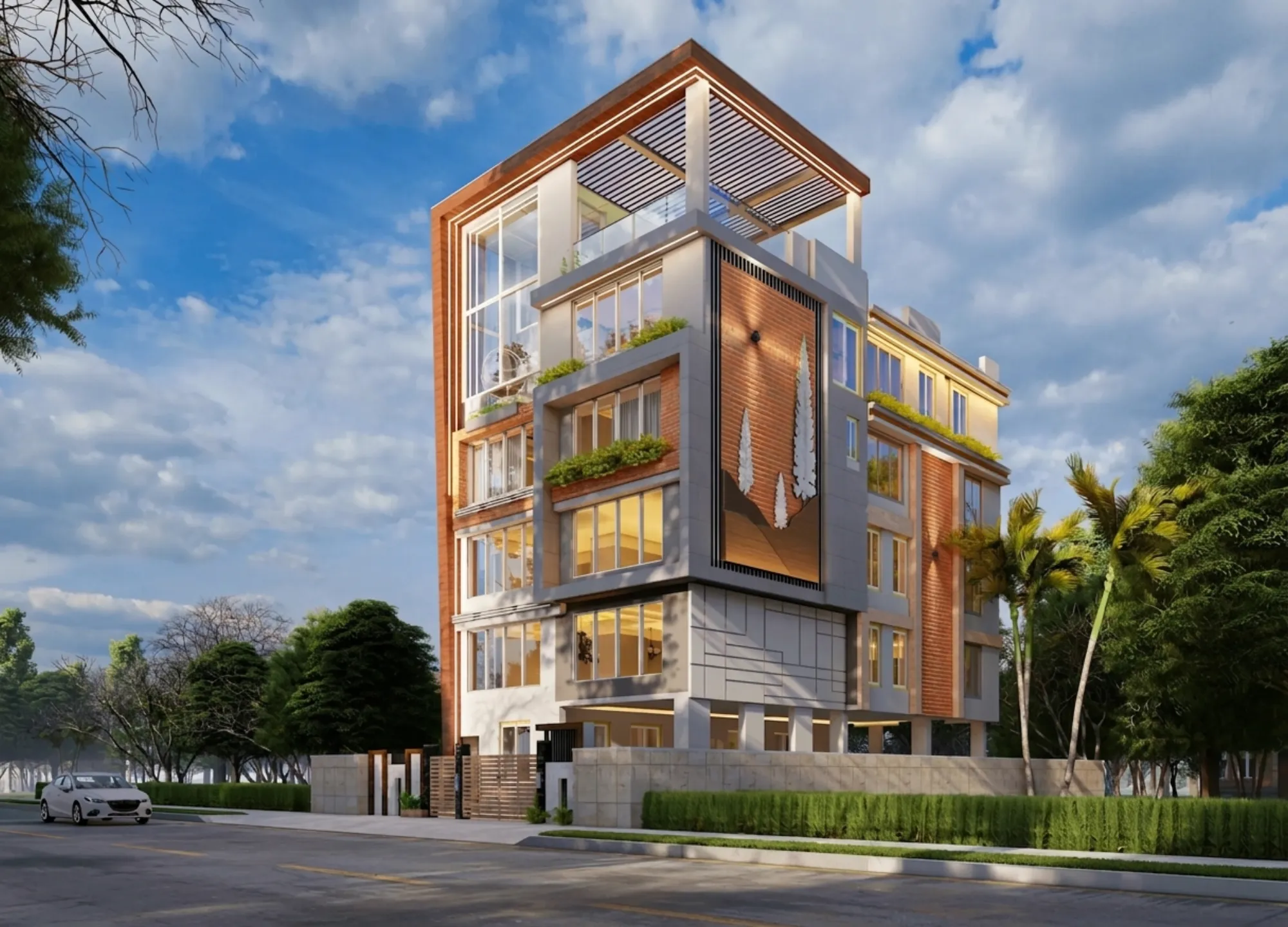
The AA IIB residence in Action Area 2, pictured above, is a fair example of how that local depth shows up in the finished building, from the facade proportions to the entry landscaping, all of it drawn and supervised by people who were on site every week rather than flown in for milestone reviews. Our work isn't confined to New Town and Salt Lake either, client references and site visits have pulled our team as far as Jadavpur on the south Kolkata side, so the "local" in local studio isn't a narrow claim, it just means every project sits within an hour's drive of our own office rather than a flight.
You can read more about how that portfolio came together in our note on the 330-building New Town and Salt Lake track record, and the pattern that runs through nearly all of it is the same, repetition inside one geography builds a kind of judgment that a firm covering six cities structurally cannot match on any single one of them.
The Site-Visit Math Nobody Puts in the Pitch Deck
Do the arithmetic honestly and the gap becomes obvious. A studio headquartered inside New Town or within a short drive of Salt Lake can put a senior designer on your site two or three times a week without that visit being treated as a special trip, it's just Tuesday. A multi-city firm running your project out of a regional hub, even a good one, is usually working on a fortnightly or monthly site-visit cadence for the senior people, with the in-between weeks covered by whoever the local execution partner assigns that day, and that gap is exactly where the small deviations creep in, a wrong tile alignment, a plumbing line routed through the wrong wall cavity, a false ceiling height that doesn't match the drawing because nobody caught it in week two. None of this shows up in a glossy proposal, it only shows up eight months into your build when you're the one paying for the rework. It's the same reason we push hard on Vastu-compliant design decisions being made at the design stage rather than retrofitted later, because catching a misalignment while it's still a line on paper costs nothing, catching it after the wall is up costs a demolition.
What Hiring Us Actually Looks Like, Week to Week
We don't run a five-city playbook, we run one process, refined over eleven years and 330-plus buildings inside a single metro, and it stays consistent because the same people who scope your project are the ones who show up to execute it.
- 01Site visit and brief within days, not weeks
- 02Design and sanction-ready drawings, coordinated directly with NKDA, Bidhannagar, or KMC as your plot requires
- 03Execution with our own supervisors on site, typically 8-12 weeks for a full interior fit-out
- 04Handover with documentation you can actually hand to a future buyer or your own [general contractor](https://en.wikipedia.org/wiki/General_contractor) if you ever need one
Whether the brief is a full residential architecture build from foundation up or a residential interior turnkey job on an existing flat, the team that measures your site is the team that finishes it, and that continuity is the thing a multi-city structure has to work hardest to fake. Every one of our architects and designers works under the same Council of Architecture framework any licensed professional in the country does, so the credentials aren't different, what's different is proximity and repetition, the two things that actually determine whether your project runs on schedule.
If you'd rather see the range of what that looks like before deciding anything, our full project portfolio is open to browse, and if you're ready to talk through your plot, your building type, or which action area or ward your project falls under, get in touch with us and we'll walk you through it directly, no regional coordinator in between, no five-city SOP standing in for local judgment, just the same studio that's already built 330 times over in the neighbourhoods you're building in now.