






New Town Homeowners: Online D2C Furniture Brand or a Full Interior Design Firm

New Town Homeowners: Online D2C Furniture Brand or a Full Interior Design Firm
A 3BHK in Action Area IIB gets its sofa delivered on a Tuesday afternoon from one of the big D2C furniture sites, and by Thursday the homeowner is standing in the middle of the living room realizing the sofa faces a false column the site never asked about, the TV unit is twelve inches too wide for the wall it was measured against on a phone screen, and the delivery crew has already left with the packaging, and that is the moment the D2C-versus-firm question actually gets asked, not before the cart was full and the checkout button felt so satisfying to click. We get calls like this every few months, sometimes as a full project and sometimes just as a "can you fix this" visit, and honestly we understand why the D2C route feels like the smart, fast, cheaper option when you are staring at an empty flat and a moving date, so this post is us laying out, as plainly as we can, what you actually get from each path and where the real difference shows up once the boxes are open.
What a D2C furniture brand actually sells you
A D2C brand sells individual pieces, and it sells them well, with decent photography, EMI options, a return window, and delivery windows that mostly hold. What it does not sell you is a plan for the room, because the sofa listing has no idea your living room in New Town's Action Area I has a beam drop of nine inches running across the ceiling, or that your flat's carpet area versus its built-up area leaves you eleven percent less usable floor than the brochure suggested, a gap we've written about in detail in our piece on carpet area versus built-up area under NKDA sanction rules. The furniture arrives standardized, sized for a generic apartment that does not exist, and the burden of making it fit, of sequencing the electrician before the modular units go up, of deciding whether the false ceiling clears the AC duct, sits entirely on the homeowner, usually discovered mid-install rather than on a drawing beforehand.
| D2C Furniture Brand | Full Interior Design Firm |
|---|---|
| Sells individual pieces off a catalogue | Designs the whole space around how you actually live in it |
| No site visit before you buy | Measures your actual New Town flat, walls, columns and all |
| You coordinate electrician, carpenter, painter yourself | One team sequences every trade so nothing waits on nothing |
| Standard sizes, standard finishes | Custom-built to your exact dimensions and Vastu needs |
| Fast checkout, slow real-world fit | Slower start, but it fits the first time |
| No accountability once delivered | One point of contact for the full 8-12 week build |
What "full interior design firm" actually means, and where it costs more
We are not going to pretend a full firm is the cheap option, because it usually is not for the raw furniture line item, and if all you need is a bookshelf for a spare room, buying it online is genuinely the right call and we would tell you that in a consultation too. What a firm like ours does differently is treat the flat as one connected system rather than a shopping list, which means the residential interior design work starts with a measured layout, moves through Vastu and structural checks, and only then gets to finishes and furniture, so by the time anything is fabricated it is already known to fit the specific unit, the specific block, the specific light coming in from whichever direction the balcony faces. A general contractor coordinating trades without a design brief runs into the same sequencing problems a DIY homeowner does, just with more people on site making the same mistakes faster, and that gap between "someone is doing the work" and "someone designed the work" is the whole argument for hiring a firm in the first place.
New Town specifics a furniture site has no way of knowing
New Town, Kolkata is not one uniform grid, it is Action Area I, IIB, III and the newer sectors, each governed by NKDA rules that affect floor area ratio, setback, and what you're even allowed to build on a balcony, and a furniture retailer's measuring tape app has zero awareness of any of it. We've spent since 2014 working inside these exact constraints, which is a big part of why we wrote separate guides on FAR and ground coverage rules in New Town and on Vastu-compliant, NKDA-compliant home design, because homeowners keep running into the same three or four surprises, a kitchen platform that can't be moved because of a load-bearing wall, a puja corner that has to shift because of the actual compass direction of the flat rather than the builder's floor plan orientation, a balcony enclosure that technically needs sanction paperwork nobody mentioned at possession.
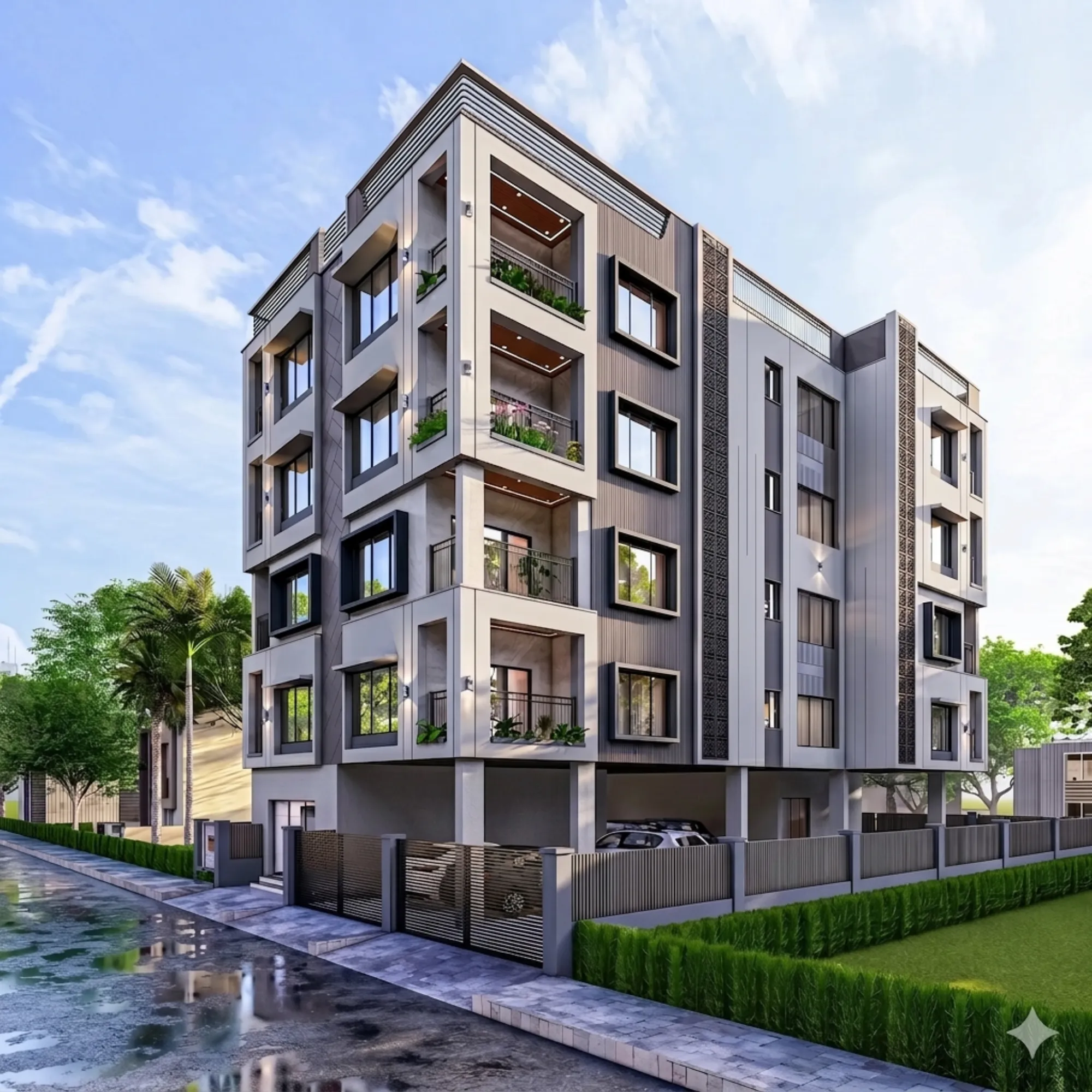
That building above is our Plot 214 residence in New Town, and we're using it here because it's a decent visual example of the difference between a house that was furnished and a house that was designed, the facade, the window placement, the material choices all working together rather than being decided room by room after the fact. If you want to see more of what a full build looks like end to end rather than piece by piece, our portfolio has close to two decades of it, all delivered inside Kolkata, New Town, and Salt Lake.
Where D2C actually wins, and we'll say it plainly
For a single room refresh, a rental flat you're not going to renovate structurally, or a homeowner who genuinely enjoys picking finishes themselves and just needs the big furniture pieces, a D2C brand is often the right call and we're not going to talk anyone out of it. The catch here is scope, because the moment the project involves more than one room, involves any structural or electrical rework, or involves a flat that needs NKDA building plan sanction at all, the D2C model stops being a complete answer and starts being one line item inside a much bigger job that still needs someone managing it. At that point the question is not furniture brand versus firm anymore, it's whether you want to be the general contractor yourself, coordinating five vendors who've never spoken to each other, or whether you want one team accountable for the whole thing.
- Does the plan account for your flat's actual Vastu orientation, not a generic template
- Has someone physically measured beams, columns and duct drops before ordering
- Is there one point of contact if the electrician's timeline slips
- Are finishes and furniture chosen to work together, not bought separately over months
- Does the firm know NKDA and Bidhannagar sanction rules for your specific Action Area
The real cost of getting the sequencing wrong
We see the same pattern often enough that it's worth naming honestly, homeowners who buy furniture first and hire design help later end up paying for rework, a wardrobe that has to be shortened on site, a dining table returned because it blocks the kitchen door swing, and that rework cost, added up, frequently erases whatever they saved buying direct. Our guide on full home interior costs for 2, 3 and 4BHK flats in New Town breaks down realistic ranges so there's no illusion here, a full firm-led interior does cost more upfront than a stack of D2C invoices, but it's priced for the whole job including 3D visualization before anything is built, so the homeowner sees the room before it exists rather than after, and that alone eliminates most of the expensive surprises we get called in to fix. If you're weighing this decision and want the honest red flags to check for either way, we laid out a longer list in red flags when hiring an interior designer in New Town, and it applies just as much to evaluating a firm as it does to skipping one entirely.
What happens three years after move-in, and why that's the real test
Most of the D2C-versus-firm conversation happens in the first few weeks, cart versus consultation, delivery date versus site visit, and almost nobody asks the question that actually separates the two paths, which is what happens when something needs fixing or extending three or four years down the line, because that's usually the moment a homeowner finds out what they actually bought. A D2C brand sells you a wardrobe as a SKU, and SKUs get discontinued, colourways get replaced, and entire product lines get quietly pulled the day the brand refreshes its catalogue, so when a hinge fails or a shutter cracks and you go back to reorder just that one panel, you're told the finish doesn't exist anymore and your options are to live with a mismatch or replace the whole unit, and we've had homeowners call us for exactly this, not for a renovation, just for one door that no longer has a match anywhere.
A firm-built interior doesn't have that problem in the same way, and it's worth being specific about why, because it's not just goodwill, it's a records question. When we design a wardrobe or a kitchen for a New Town flat, we hold the drawing, the exact laminate code, the hardware spec, and the vendor who supplied it, so if a homeowner calls us in year three asking for a repair or a small addition, we're not guessing, we're pulling the same file and matching it exactly, down to the grain direction, which is a kind of continuity a marketplace checkout was never built to offer because nobody at a D2C brand is holding a folder with your specific flat's specs in it three years after the delivery truck left.
This matters even more when the ask isn't a repair but an extension, a second child arriving and a study needing to become a bedroom, a work-from-home setup needing a proper desk wall that wasn't in the original brief, because a space that was designed as one connected system from the start tends to have room to grow into, a wardrobe run that was planned with a logical stopping point for a future extra module, an electrical layout that already accounted for a possible partition wall, while a room furnished piece by piece off different D2C listings usually has no such logic to extend, so the homeowner ends up doing a second round of standalone shopping that has to awkwardly coexist with whatever was bought the first time round, rarely matching in proportion or finish.
We've been doing this specific kind of long-term work since 2014, and across 330+ buildings in Kolkata, New Town and Salt Lake we still get calls from homeowners we worked with years back, someone wanting a matching cabinet for a room we didn't originally touch, someone wanting the same countertop material for a kitchen extension, and we can answer those calls properly because our own project records go back that far and our vendor relationships have held for that long too, which is the kind of thing you only value once you actually need it, and it's a fair reason on its own to hire a firm that plans to still be answering the phone in year five, not just the one that ships the fastest box this week.
Why homeowners in New Town end up calling us specifically
At the end of the day we've delivered 330+ buildings across Kolkata, New Town and Salt Lake since we started in 2014, and that number matters less as a marketing line and more as the reason we already know which blocks in Action Area 2 and 3 have tighter setback rules, which cooperative housing complexes near Salt Lake have their own internal renovation approval process, and which combinations of modular kitchen layouts actually work inside the smaller carpet areas that newer New Town towers ship with. We built our name doing full projects, architecture through custom furniture design, not selling catalogue pieces, and we go deeper into why that full-stack approach holds up over a piece-by-piece one in why Studio Contour is the studio homeowners end up hiring. Our typical turnkey build runs 8 to 12 weeks from sanctioned drawing to move-in, and every project in our New Town portfolio went through the same measured, sanctioned, sequenced process rather than a homeowner assembling it room by room over a stressful year.
- 01Site visit and measurement
- 02Design and Vastu-checked layout
- 03NKDA-aware execution planning
- 048-12 week build to move-in
None of this is a knock on furniture retailers doing their own job well, it's just that their job stops at the doorstep and ours starts there, and if you're standing in an empty New Town flat right now trying to decide between a cart full of D2C listings and a team that will actually measure the room, sanction the drawing, and hand you back a finished home in three months, talk to us and we'll walk the flat with you before you spend a rupee on either.